
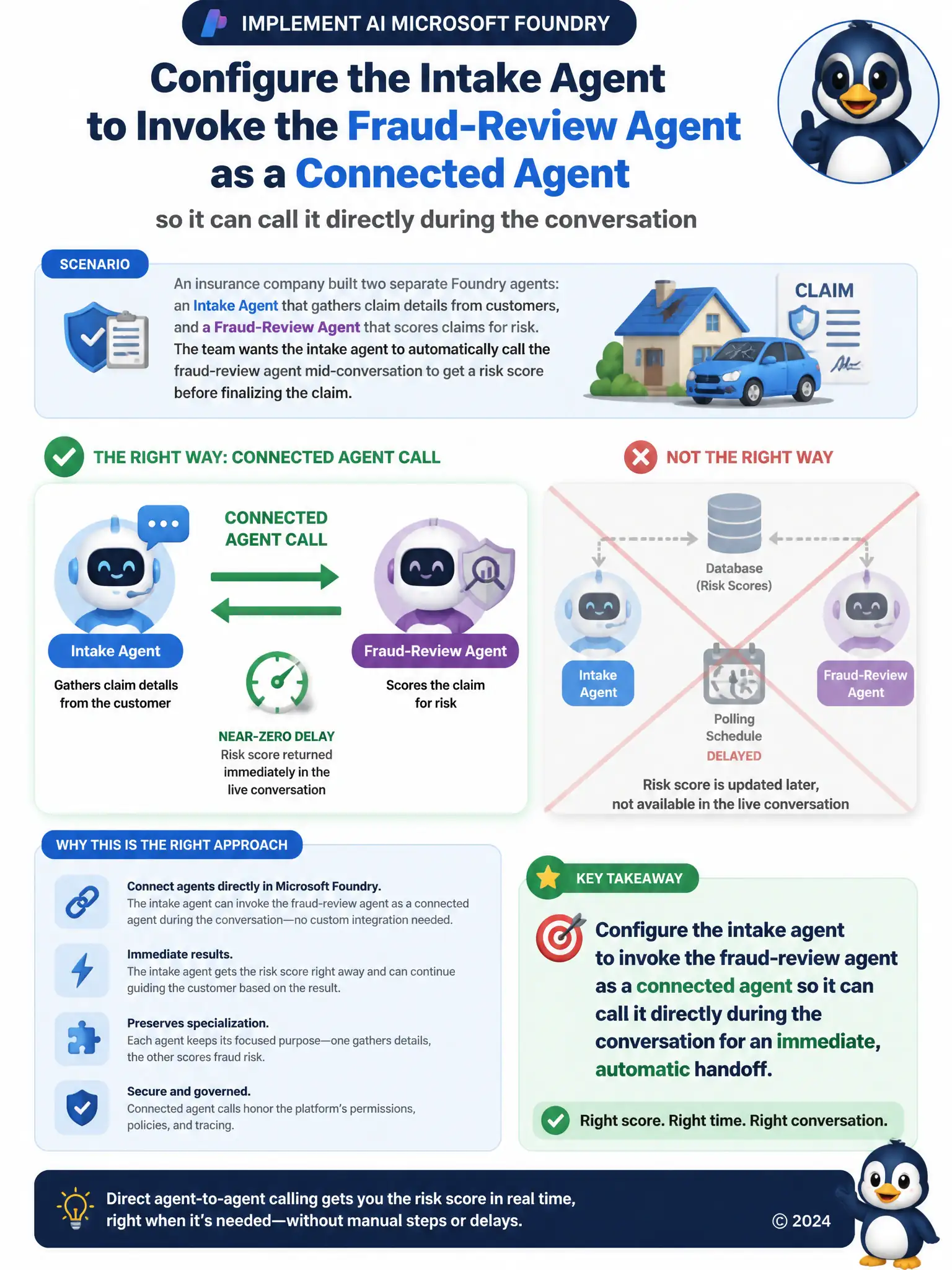
An insurance company built two separate Foundry agents: an intake agent that gathers claim details from customers, and a fraud-review agent that scores claims for risk. The team wants the intake agent to automatically call the fraud-review agent mid-conversation to get a risk score before finalizing the claim, without a developer manually wiring a custom integration between the two chat sessions.
Select an answer to reveal the explanation.
Short Explanation
When you need one agent to reach out to another mid-conversation, you connect the fraud-review agent to the intake agent so it can call it directly. That gives you an automatic, real-time risk score without custom glue code. Manual transcript copying, one giant prompt, or database polling all miss the live handoff you need.
Full Explanation
The right approach is to configure the intake agent to invoke the fraud-review agent as a connected agent so it can call it directly during the conversation. Foundry Agent Service supports connecting one agent to another as a connected agent, letting the intake agent call the fraud-review agent directly within the same conversation to get a risk score in real time, exactly the automatic, mid-conversation call the team wants without custom integration work. The option describing manually copying conversation transcripts between the two agents' separate chat sessions each time a claim is processed is incorrect because it is a manual, error-prone process that defeats the goal of automation and does not scale to production claims volume. The option describing merging both agents into a single system prompt with no separate tools or agents involved is incorrect because it discards the specialized behavior and separation of concerns each agent was built for, and it is not how the team wants to preserve two distinct, purpose-built agents. The option describing having the fraud-review agent poll the intake agent's database on a fixed schedule to check for new claims is incorrect because it introduces delay between when a claim is submitted and when it gets scored, rather than getting an immediate risk score during the live conversation as the scenario requires. Connecting the fraud-review agent as a callable agent from the intake agent directly satisfies the real-time, low-integration-effort requirement.