
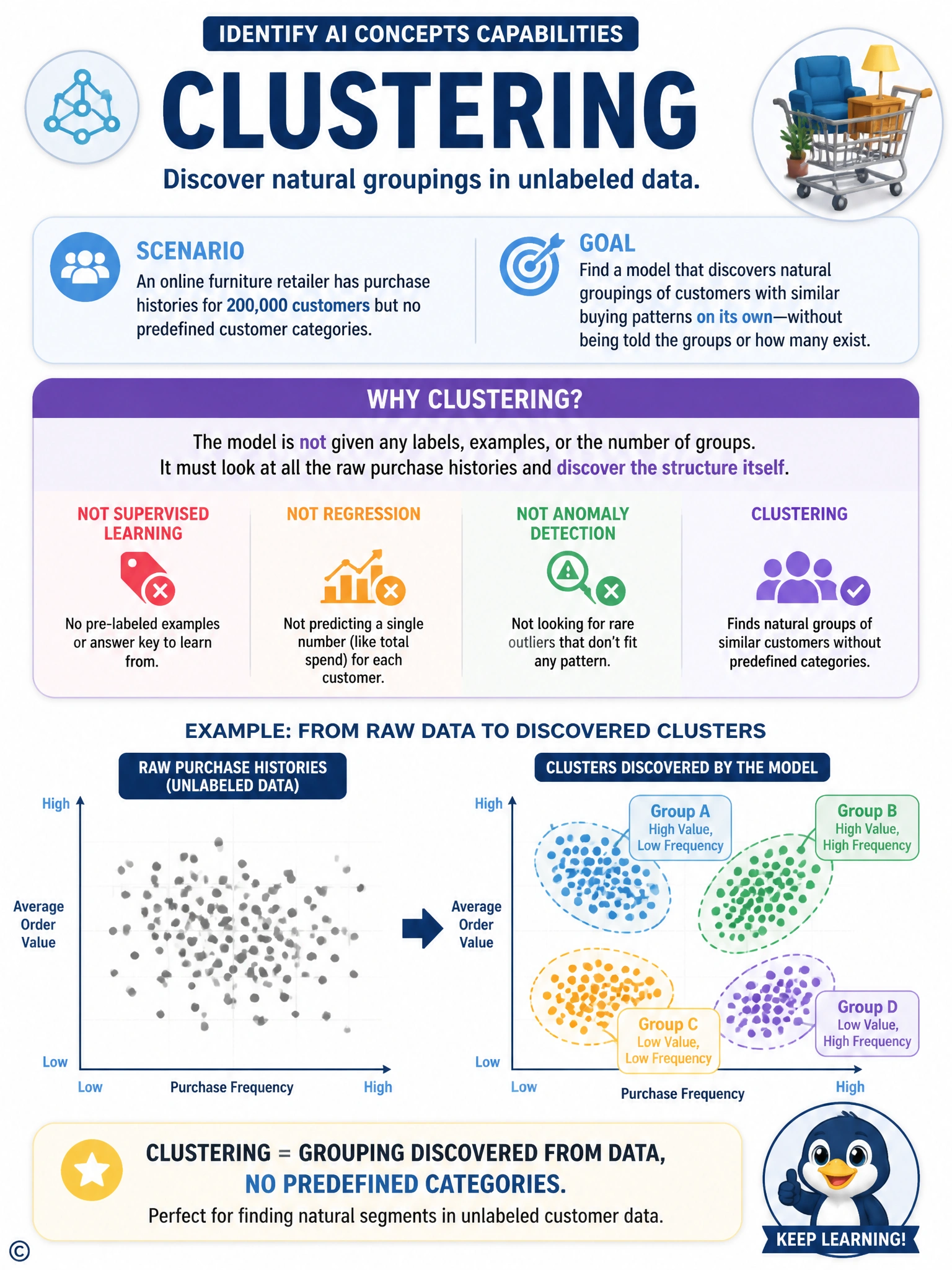
An online furniture retailer has purchase histories for 200,000 customers but no predefined customer categories. A data science team wants a model to discover natural groupings of customers with similar buying patterns on its own, without being told in advance what the groups should be or how many exist. Which type of machine learning task fits this goal?
Select an answer to reveal the explanation.
Short Explanation
The key detail is that nobody has told the model what the groups should look like or how many there should be, it just has raw purchase histories and has to find the structure itself. That rules out anything that needs pre-labeled examples to learn from, since there's no answer key here for the model to study. It also isn't about predicting one specific number for each customer, like a spend total, and it isn't about hunting for the rare oddball customer who doesn't fit any pattern. What the team wants is for the model to look at all 200,000 histories and sort similar buying patterns together into natural clusters on its own, which is precisely the kind of unlabeled, pattern-discovery task built for finding groups nobody defined ahead of time.
Full Explanation
The correct answer is A. Clustering is an unsupervised technique that groups data points by similarity without relying on predefined labels or a fixed number of categories, which matches the team's goal of letting the model discover customer segments on its own. Option B is incorrect because classification is a supervised technique that requires training data already labeled with the correct category for each example, but the scenario explicitly states there are no predefined categories to learn from. Option C is incorrect because regression predicts a single continuous numeric value, such as expected spend, rather than organizing the entire customer base into groups of similar behavior. Option D is incorrect because anomaly detection is built to flag rare or unusual data points that deviate from normal patterns, not to organize the full population of customers into cohesive segments. Because the retailer wants the model to find structure in unlabeled purchase data and produce groupings that were not specified beforehand, clustering is the task that matches both the unsupervised nature of the problem and the goal of discovering segments rather than predicting a number or spotting outliers.