
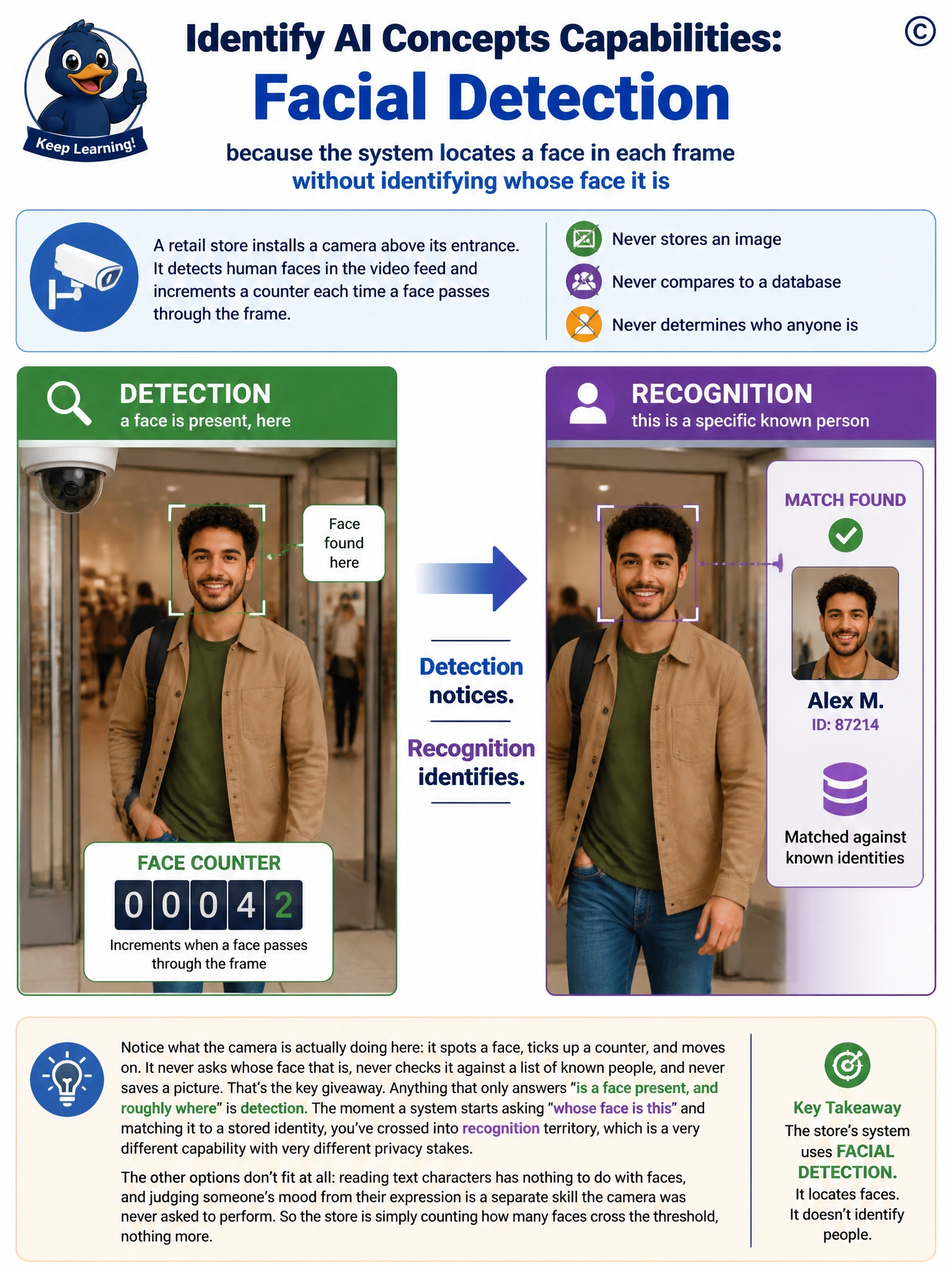
A retail store installs a camera above its entrance that detects human faces in the video feed and increments a counter each time a face passes through the frame. The system never stores an image, compares a face to a database, or determines who anyone is; it only notices that a face is present and where. Which AI capability does the store's system use?
Select an answer to reveal the explanation.
Short Explanation
Notice what the camera is actually doing here: it spots a face, ticks up a counter, and moves on. It never asks whose face that is, never checks it against a list of known people, and never saves a picture. That's the key giveaway. Anything that only answers 'is a face present, and roughly where' is detection. The moment a system starts asking 'whose face is this' and matching it to a stored identity, you've crossed into recognition territory, which is a very different capability with very different privacy stakes. The other options don't fit at all: reading text characters has nothing to do with faces, and judging someone's mood from their expression is a separate skill the camera was never asked to perform. So the store is simply counting how many faces cross the threshold, nothing more.
Full Explanation
The correct answer is A. The store's camera only locates the presence and position of a face within each frame to increment a counter; it never compares that face against a stored identity, so this is facial detection, not identification. Option B is incorrect because facial recognition specifically means matching a detected face to a known identity in a database, which this system never attempts. Option C is incorrect because optical character recognition extracts printed or handwritten text characters from an image, not human faces, and nothing in this scenario involves text. Option D is incorrect because sentiment analysis evaluates emotional tone, typically from text or speech, or in vision contexts from facial expression classification, but the store's system is not scoring expressions or moods; it is only counting the presence of faces. Understanding this distinction matters for AI-901 because detection and recognition are frequently confused: detection answers whether and where something appears, while recognition answers who or what it specifically is, and the privacy implications of the two differ substantially.