
A retail company wants to add a product-recognition feature to an in-store kiosk that has limited processing power and a requirement that results appear within a fraction of a second, even when the kiosk's internet connection is unreliable. A larger, more accurate cloud-hosted vision model is available in Azure AI Foundry's model catalog but requires a network round trip and noticeably more processing time. Which factor should most influence the team's choice of model?
Select an answer to reveal the explanation.
Short Explanation
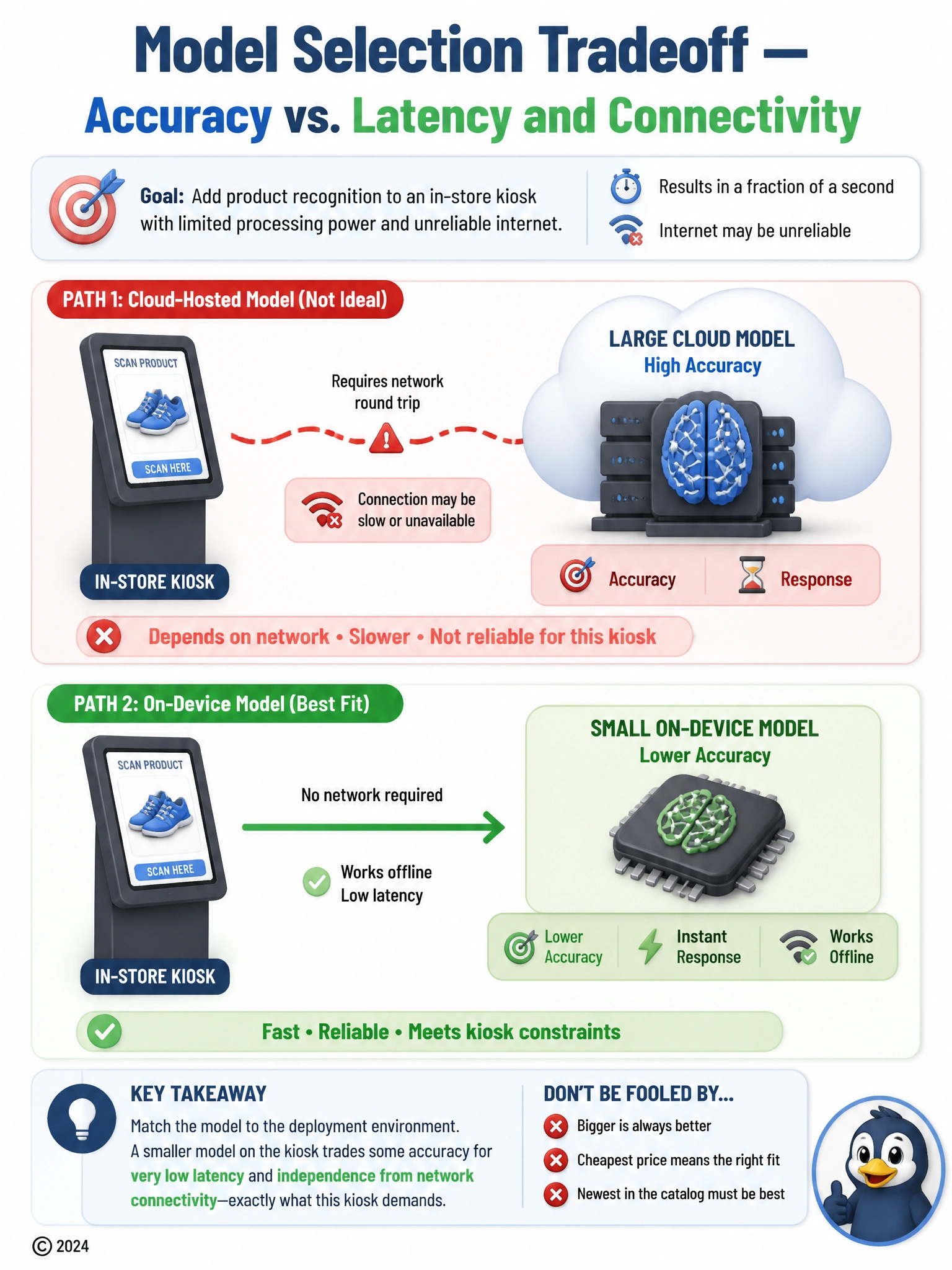
Notice what the kiosk actually demands: barely any processing muscle, an answer in a fraction of a second, and a network connection you can't count on. Against those constraints, a bigger, more accurate model sitting in the cloud is tempting on paper but wrong in practice, because every query has to travel out over a connection that might not be there and come back slower than the kiosk can tolerate. A smaller model that lives right on the device sacrifices a bit of accuracy, but it keeps working when the network hiccups and it answers fast enough to feel instant, which is what actually matters here. The trap is assuming that bigger always wins, or that the cheapest price tag automatically means the right fit, or that whatever was added to the catalog most recently must be the best pick. None of those account for the very real hardware and connectivity limits sitting in front of this specific kiosk. Matching the model to the deployment environment, not chasing size, price, or novelty, is the deciding factor.
Full Explanation
The correct answer is D. Given the kiosk's constraints, a limited processing budget, a sub-second latency requirement, and an unreliable internet connection, a smaller model that runs locally on the device is the right choice even though it sacrifices some accuracy compared to the larger cloud-hosted option, because it can meet the response-time requirement and keep working when the network drops. Option A is incorrect because treating model size as the only relevant factor ignores the deployment constraints described in the scenario; the larger cloud model's extra accuracy is not useful if it cannot deliver results within the required time or when the connection fails. Option B is incorrect because focusing solely on the lowest price per call ignores whether the model can even be deployed within the kiosk's hardware and connectivity limits; a cheap model that cannot run locally or respond fast enough does not solve the stated problem. Option C is incorrect because newer models are not automatically better for every scenario; a recently added model could still be large, cloud-dependent, or otherwise poorly suited to a low-power, latency-sensitive, intermittently connected device. Selecting a model appropriate to this workload requires weighing accuracy against latency, footprint, and connectivity, not defaulting to size, price, or recency alone.