
A regional bank's finance operations team automates two processes. The first automatically approves and reimburses any expense report under $50 whenever the total matches a fixed threshold coded directly into the workflow. The second reviews years of past transaction records, learns the spending patterns that preceded confirmed fraud cases, and flags new transactions that resemble those patterns even though no explicit threshold was written for them. Which process is best classified as an artificial intelligence workload?
Select an answer to reveal the explanation.
Short Explanation
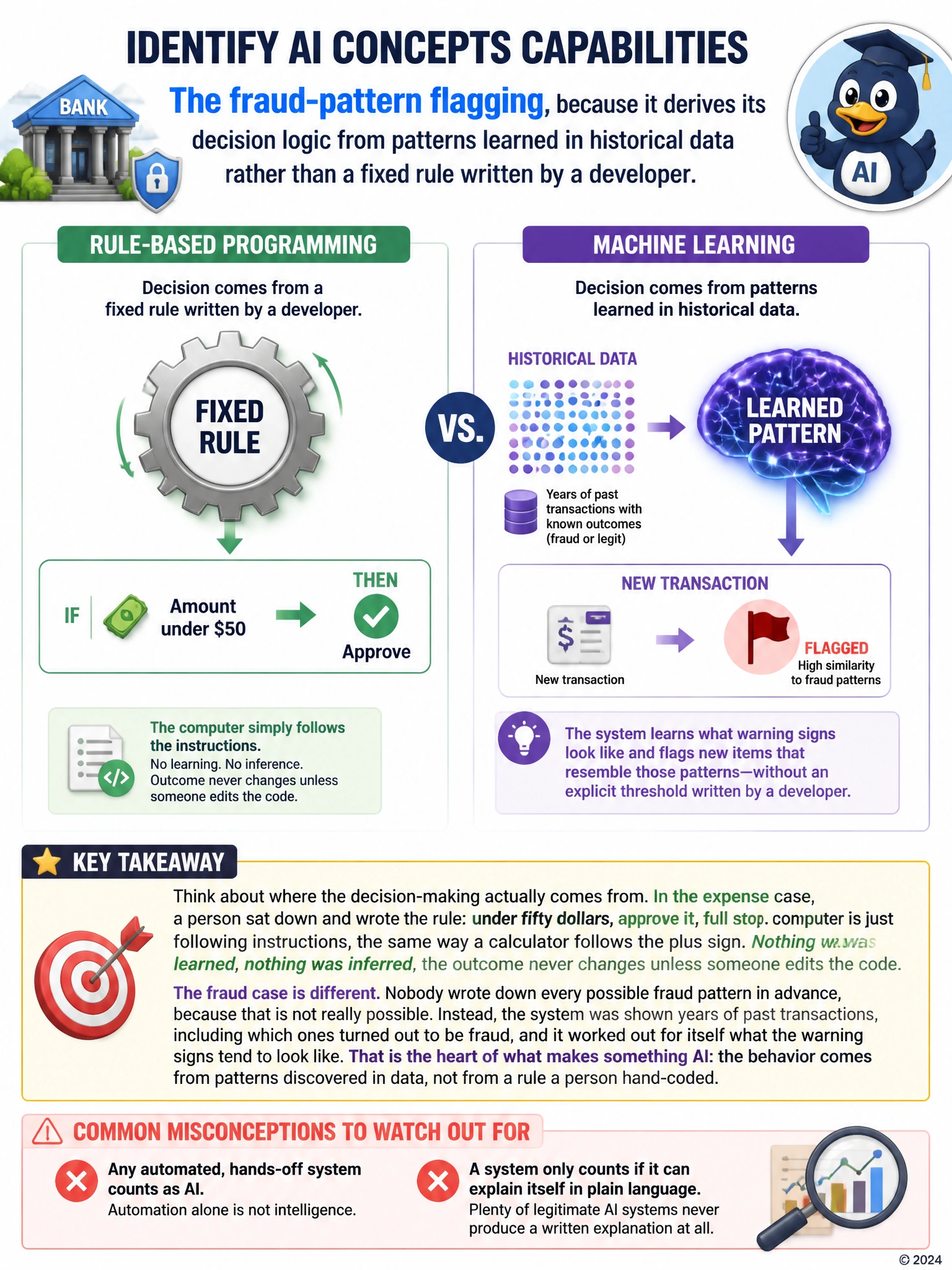
Think about where the decision-making actually comes from. In the expense case, a person sat down and wrote the rule: under fifty dollars, approve it, full stop. The computer is just following instructions, the same way a calculator follows the plus sign. Nothing was learned, nothing was inferred, and the outcome never changes unless someone edits the code. The fraud case is different. Nobody wrote down every possible fraud pattern in advance, because that is not really possible. Instead, the system was shown years of past transactions, including which ones turned out to be fraud, and it worked out for itself what the warning signs tend to look like. That is the heart of what makes something AI: the behavior comes from patterns discovered in data, not from a rule a person hand-coded. Watch out for the idea that any automated, hands-off system counts as AI, or that a system only counts if it can explain itself in plain language. Automation alone is not intelligence, and plenty of legitimate AI systems never produce a written explanation at all.
Full Explanation
The correct answer is A. The fraud-pattern flagging system is an AI workload because its decision logic comes from a model that learned patterns in historical transaction data, rather than from a rule a developer typed in advance; it can recognize new transactions that resemble past fraud even though no one specified the exact conditions to check. Option B is incorrect because the expense approval process follows a fixed, explicitly coded threshold with no learning involved, which is traditional deterministic programming, not AI, even though it runs unattended. Option C is incorrect because automation and artificial intelligence are not the same thing; a system can run without human intervention and still just be executing rules a person wrote, which describes the expense approval process. Option D is incorrect because the ability to explain reasoning in natural language describes a specific responsible AI property called transparency or interpretability, not a requirement for something to count as AI in the first place; many valid AI systems, including this fraud model, qualify as AI without producing natural-language explanations.