
An enterprise expects a steady, predictable volume of several million chat requests per day for a customer-facing deployment and wants guaranteed, consistent throughput regardless of how busy other Foundry customers are at the same time. Which deployment approach best fits this need?
Select an answer to reveal the explanation.
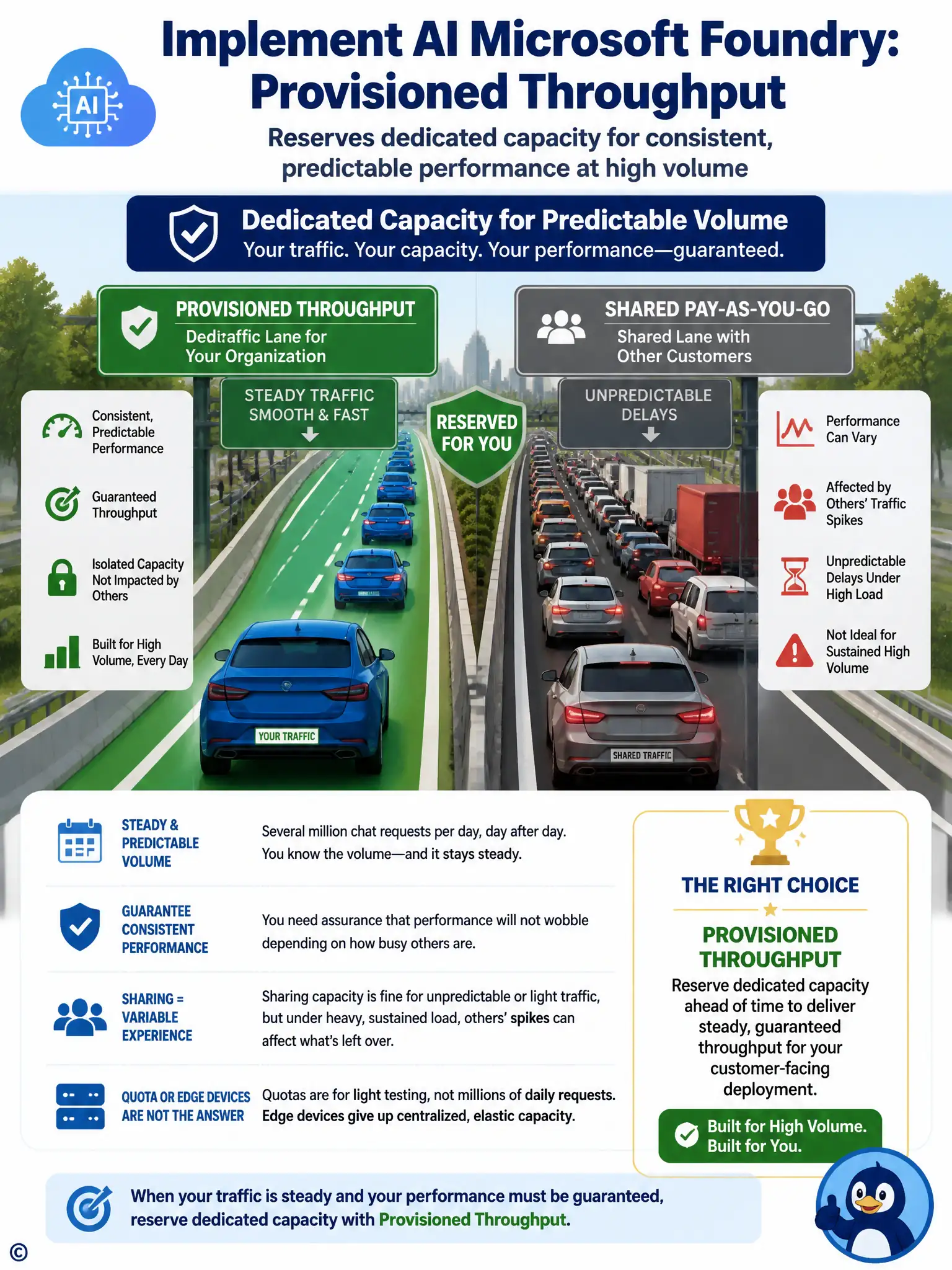
Short Explanation
When you need several million chat requests a day with steady, predictable volume, you want dedicated capacity reserved for your deployment. That's what provisioned throughput gives you: consistent, guaranteed performance even when other Foundry customers are busy. Shared pay-as-you-go, free-tier quotas, and on-device deployments don't give you that guaranteed cloud throughput.
Full Explanation
Provisioned throughput reserves dedicated capacity for a deployment, which gives an enterprise consistent, predictable performance at high volume regardless of how busy other customers on the shared platform happen to be at the same time, matching the requirement for guaranteed throughput on several million requests a day. Standard pay-as-you-go is incorrect because it shares capacity across customers, which is exactly the source of the variable latency this enterprise is trying to avoid under heavy, steady load. The free-tier evaluation quota is incorrect because it is scoped for light testing and experimentation, not for sustained production traffic at millions of requests per day. A local on-device deployment is incorrect because it removes the elastic, centrally managed cloud capacity this deployment depends on, and it is not how Foundry deployments of this kind are provisioned for a customer-facing, cloud-hosted application. When a workload's volume is steady and predictable and the requirement is guaranteed, consistent throughput rather than the lowest possible cost per request, reserving dedicated provisioned capacity is the deployment approach designed specifically to deliver that consistency.