
A finance team is forecasting next month's Foundry spend for a new chat deployment. They estimate cost by multiplying the number of expected conversations by the price of a single input token, then multiplying by average conversation length. After the first week, actual charges are far higher than predicted. What did their estimate most likely leave out?
Select an answer to reveal the explanation.
Short Explanation
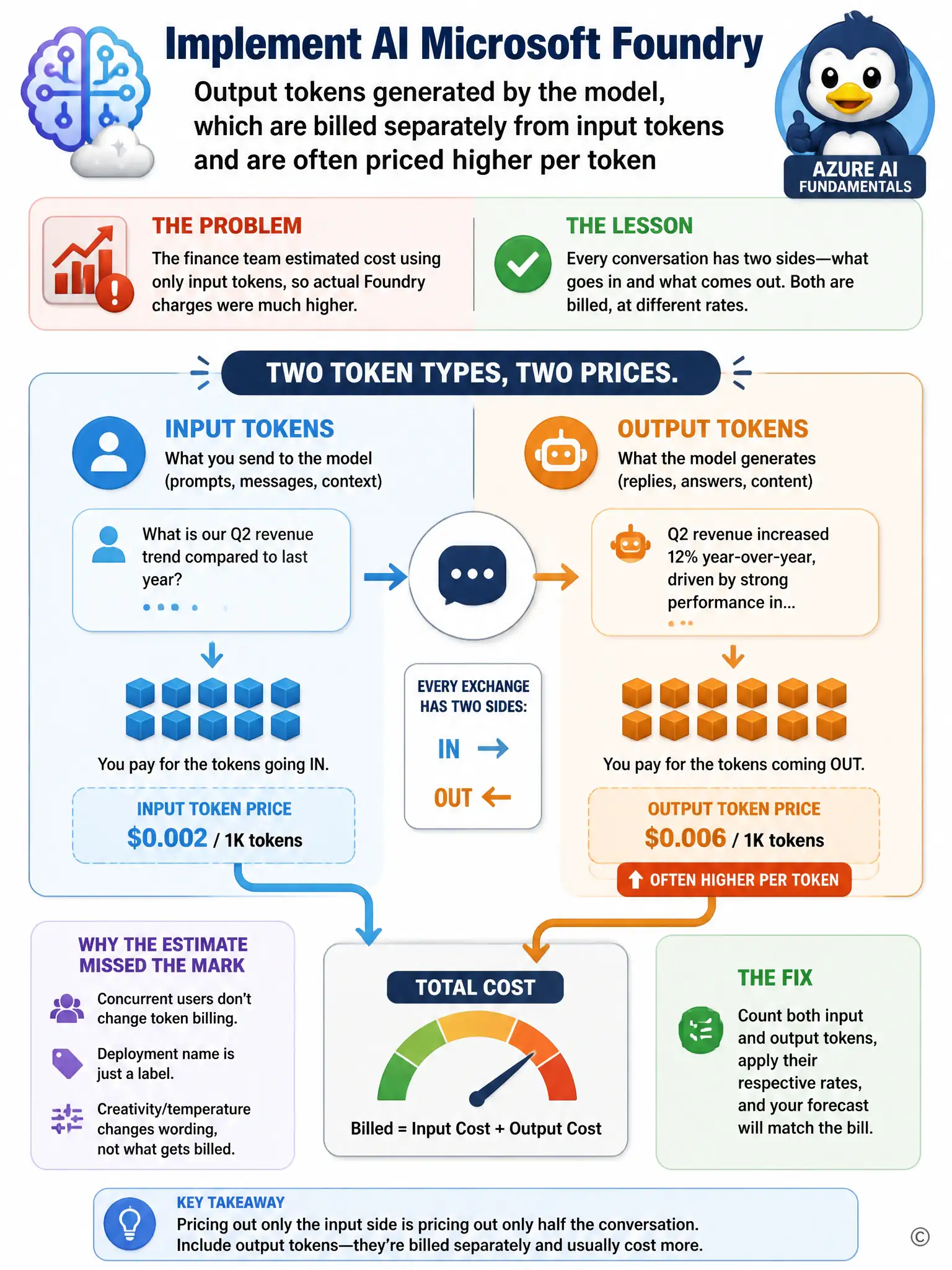
You priced only the input side of each chat. Every reply the model generates also costs tokens, often at a higher rate, so the bill jumped once real conversations started. Count both input and output tokens to match the charges.
Full Explanation
The estimate most likely left out output tokens generated by the model, which are billed separately from input tokens and are often priced higher per token. Foundry deployments typically bill input tokens and output tokens separately, so an estimate built only on the input token price will systematically undercount the true cost of every conversation, especially for a chatbot that generates lengthy replies. The number of users accessing the chatbot simultaneously is not the missing cost driver here because token-based billing charges for the tokens processed and generated, not for how many users happen to be connected at the same moment. The name of the deployment is also not the missing cost driver because it is just a label with no bearing on what is billed. The temperature setting is not the missing cost driver either because it controls how varied or creative the model's wording is; it does not change how tokens are counted or priced, so it has no effect on the bill. Once the finance team accounts for both the input tokens sent to the model and the output tokens the model generates in reply, priced according to each rate, their forecast should line up much more closely with the actual charges they are seeing after the first week of live traffic.