
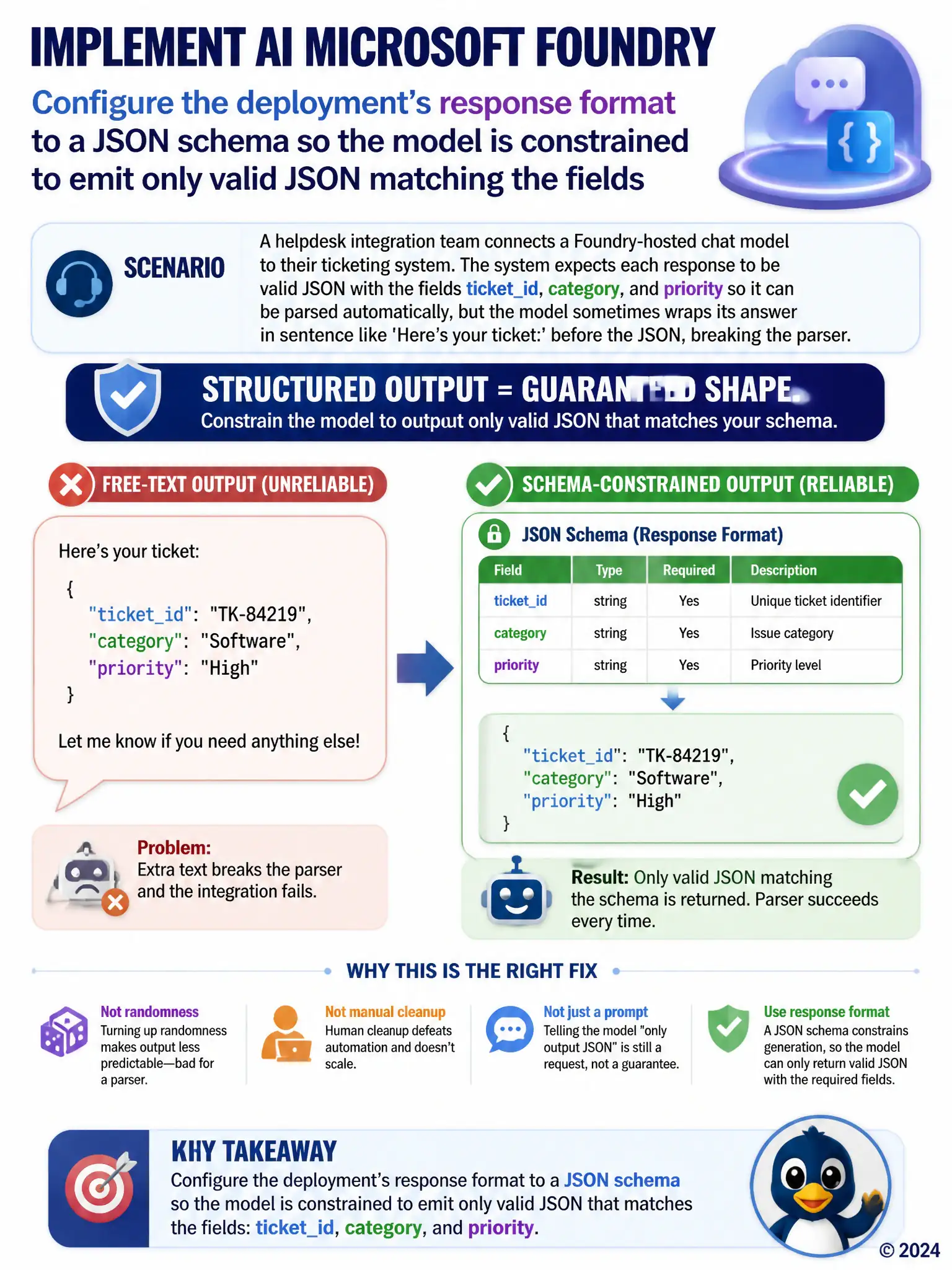
A helpdesk integration team connects a Foundry-hosted chat model to their ticketing system. The system expects each response to be valid JSON with the fields ticket_id, category, and priority so it can be parsed automatically, but the model sometimes wraps its answer in a sentence like 'Here's your ticket:' before the JSON, breaking the parser. What should the team do to guarantee the response is parseable JSON matching their schema?
Select an answer to reveal the explanation.
Short Explanation
You need to force the shape of the answer, not beg the model to behave. Configure the deployment's response format to a JSON schema so it can only emit valid JSON with ticket_id, category, and priority. That's what keeps your parser from choking on extra sentences.
Full Explanation
The reliable fix is to configure the deployment's response format to a JSON schema so the model is constrained to emit only valid JSON matching the required fields: ticket_id, category, and priority. This forces the output to conform to the structure every time, which is exactly what an automated parser needs. The approach of raising the temperature setting is wrong because it increases randomness in the model's wording, making inconsistent formatting more likely, not less. The approach of asking users to manually reformat the assistant's replies before submission is wrong because it removes automation entirely and requires a person to fix every response, defeating the purpose of an integration meant to run without manual intervention. The approach of adding a note in the system prompt asking the model to 'please only output JSON' is wrong because a natural-language instruction is only a request the model may or may not follow consistently; it lacks the enforcement that a structured output configuration provides, so stray sentences like 'Here's your ticket:' can still slip through. Structured output support in Foundry lets a team specify the exact schema a response must satisfy, and the platform enforces that shape at generation time rather than hoping the model complies, which is the reliable fix for a downstream system that expects clean, parseable JSON on every single call.