
A telecom call center wants to let customers speak naturally over the phone to a Foundry-hosted assistant instead of typing, and have the assistant's replies read back to the caller in a natural voice. Which combination of Azure AI capabilities should the team add to the existing text-based Foundry deployment to support this phone workflow?
Select an answer to reveal the explanation.
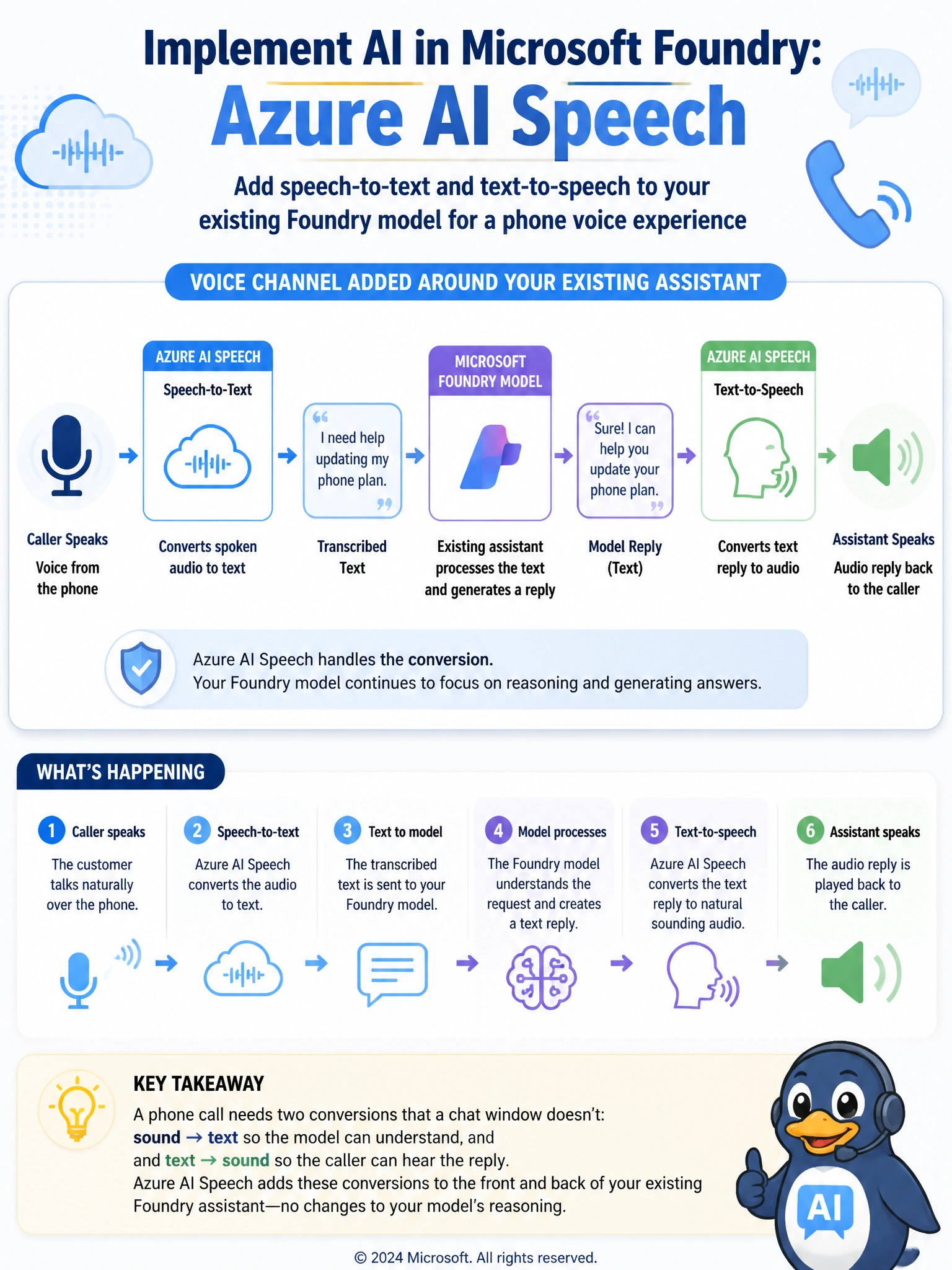
Short Explanation
Think about what actually has to happen on a phone call versus a chat window: someone talks, and words have to become text before any language model can do anything with them, and then the model's reply has to become sound again before the caller hears it. That conversion, sound to text and text back to sound, is a distinct job from the reasoning the assistant already does, and it needs a dedicated speech service bolted onto the front and back of the existing setup, not a change to the assistant itself. The distractors all reach for the wrong lever: making the model able to read more text at once doesn't teach it to understand audio, tuning a safety filter deals with harmful words and images rather than the hiss and static of a phone line, and storing recordings in a search index is about finding old documents later, not converting a live voice in real time. The actual fix bolts speech-to-text and text-to-speech onto the front and back end of the assistant that's already working.
Full Explanation
The correct answer is C. Azure AI Speech provides speech-to-text to convert the caller's spoken words into text the Foundry model can process, and text-to-speech to convert the model's text reply into natural-sounding audio played back to the caller; pairing these with the existing Foundry deployment is the standard way to add a voice channel without rebuilding the underlying assistant. Option A is incorrect because a larger context window only affects how much text a model can consider in a single request; the language models used in Foundry deployments do not natively ingest raw audio, so window size does not solve the audio-to-text problem. Option B is incorrect because content safety filters screen generated or submitted text and images for harmful content categories; they are not designed to detect or remove background noise from an audio signal, which is an audio-processing problem, not a safety problem. Option D is incorrect because a vector index in Azure AI Search supports semantic retrieval over stored documents for grounding answers, not real-time conversion of speech to text or storage of call audio for playback. The phone workflow needs dedicated speech services layered around the existing model, not a change to the model's storage or safety configuration.