
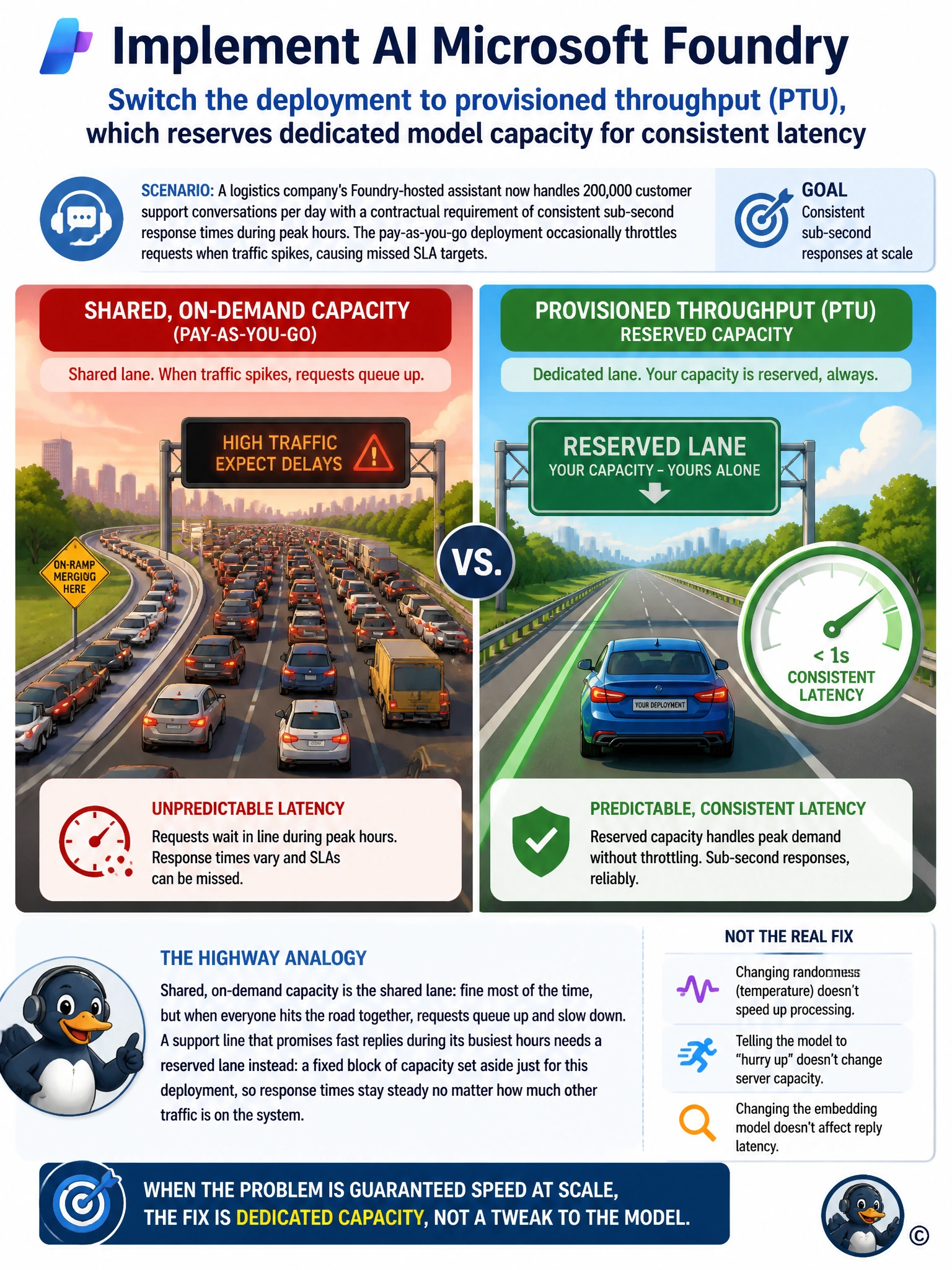
A logistics company's Foundry-hosted assistant now handles 200,000 customer support conversations per day with a contractual requirement of consistent sub-second response times during peak hours. The pay-as-you-go deployment occasionally throttles requests when traffic spikes, causing missed SLA targets. What should the team do to meet the latency guarantee?
Select an answer to reveal the explanation.
Short Explanation
Picture the difference between renting a lane on a highway that's yours alone versus merging into shared traffic that gets jammed at rush hour. Shared, on-demand capacity is the shared lane: fine most of the time, but when everyone hits the road together, requests queue up and slow down. A support line that promises fast replies during its busiest hours needs a reserved lane instead: a fixed block of capacity set aside just for this deployment, so response times stay steady no matter how much other traffic is on the system. The tempting shortcuts don't touch the real bottleneck. Tweaking how random the wording sounds doesn't speed up processing. Telling the model to 'hurry up' in its instructions doesn't change how the underlying servers are provisioned. And swapping out the component used for search similarity has nothing to do with how fast a conversational reply gets generated. When the problem is guaranteed speed at scale, the fix is dedicated capacity, not a tweak to the model's behavior.
Full Explanation
The correct answer is B. Provisioned throughput (PTU) reserves dedicated compute capacity for a Foundry deployment, so the logistics company's assistant gets predictable, guaranteed latency and throughput even during the busiest hours, which is exactly what an SLA for sub-second response times demands. Pay-as-you-go capacity is shared and best-effort, which explains the throttling the team is already seeing under peak load. Option A is incorrect because temperature controls how random or varied the model's word choices are, not how much compute a request consumes; lowering it does not reduce processing time or prevent throttling. Option C is incorrect because a system message shapes the content and tone of a response, but it cannot change the underlying infrastructure capacity allocated to the deployment, so it has no effect on throughput limits. Option D is incorrect because embedding models are used for search and similarity tasks, not for generating the chat responses described here, and swapping the embedding model would do nothing to address latency in the conversational assistant itself. PTU is the mechanism built specifically to guarantee capacity.