
A telecom call center wants to let customers speak naturally over the phone to a Foundry-hosted assistant instead of typing, and have the assistant's replies read back to the caller in a natural voice. Which combination of Azure AI capabilities should the team add to the existing text-based Foundry deployment to support this phone workflow?
Select an answer to reveal the explanation.
Short Explanation
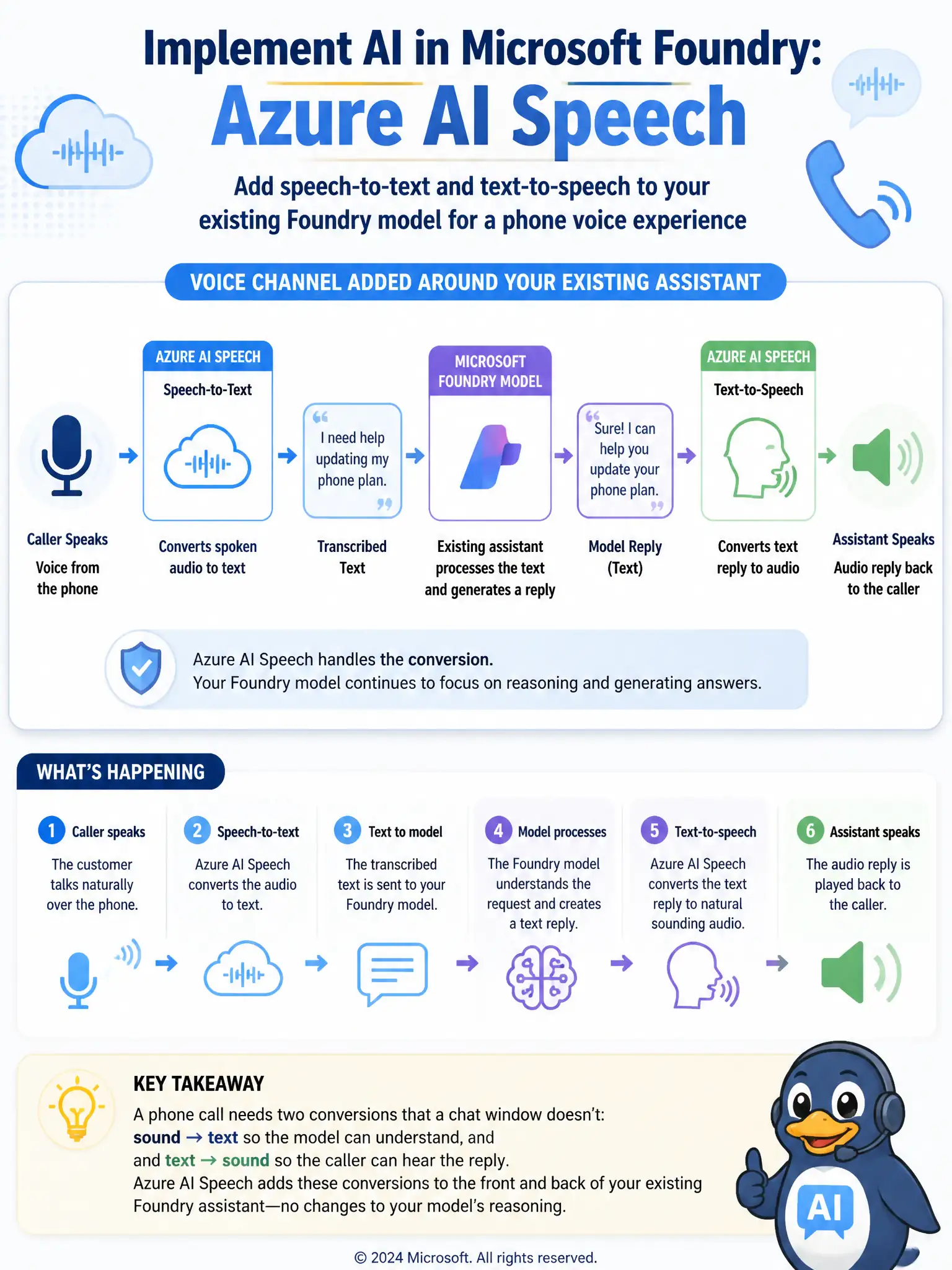
You need Azure AI Speech to turn the caller's voice into text for the existing Foundry model, then turn the model's text reply back into natural audio. That's the clean way to add a phone channel without rebuilding the assistant. The other ideas don't solve live speech conversion.
Full Explanation
The correct choice is Azure AI Speech for speech-to-text and text-to-speech, feeding the transcribed text into the existing Foundry model and converting its text reply back to audio. Azure AI Speech provides speech-to-text to convert the caller's spoken words into text the Foundry model can process, and text-to-speech to convert the model's text reply into natural-sounding audio played back to the caller; pairing these with the existing Foundry deployment is the standard way to add a voice channel without rebuilding the underlying assistant. The larger-context-window choice is incorrect because a larger context window only affects how much text a model can consider in a single request; the language models used in Foundry deployments do not natively ingest raw audio, so window size does not solve the audio-to-text problem. The custom-content-safety-filter choice is incorrect because content safety filters screen generated or submitted text and images for harmful content categories; they are not designed to detect or remove background noise from an audio signal, which is an audio-processing problem, not a safety problem. The vector-index choice is incorrect because a vector index in Azure AI Search supports semantic retrieval over stored documents for grounding answers, not real-time conversion of speech to text or storage of call audio for playback. The phone workflow needs dedicated speech services layered around the existing model, not a change to the model's storage or safety configuration.