
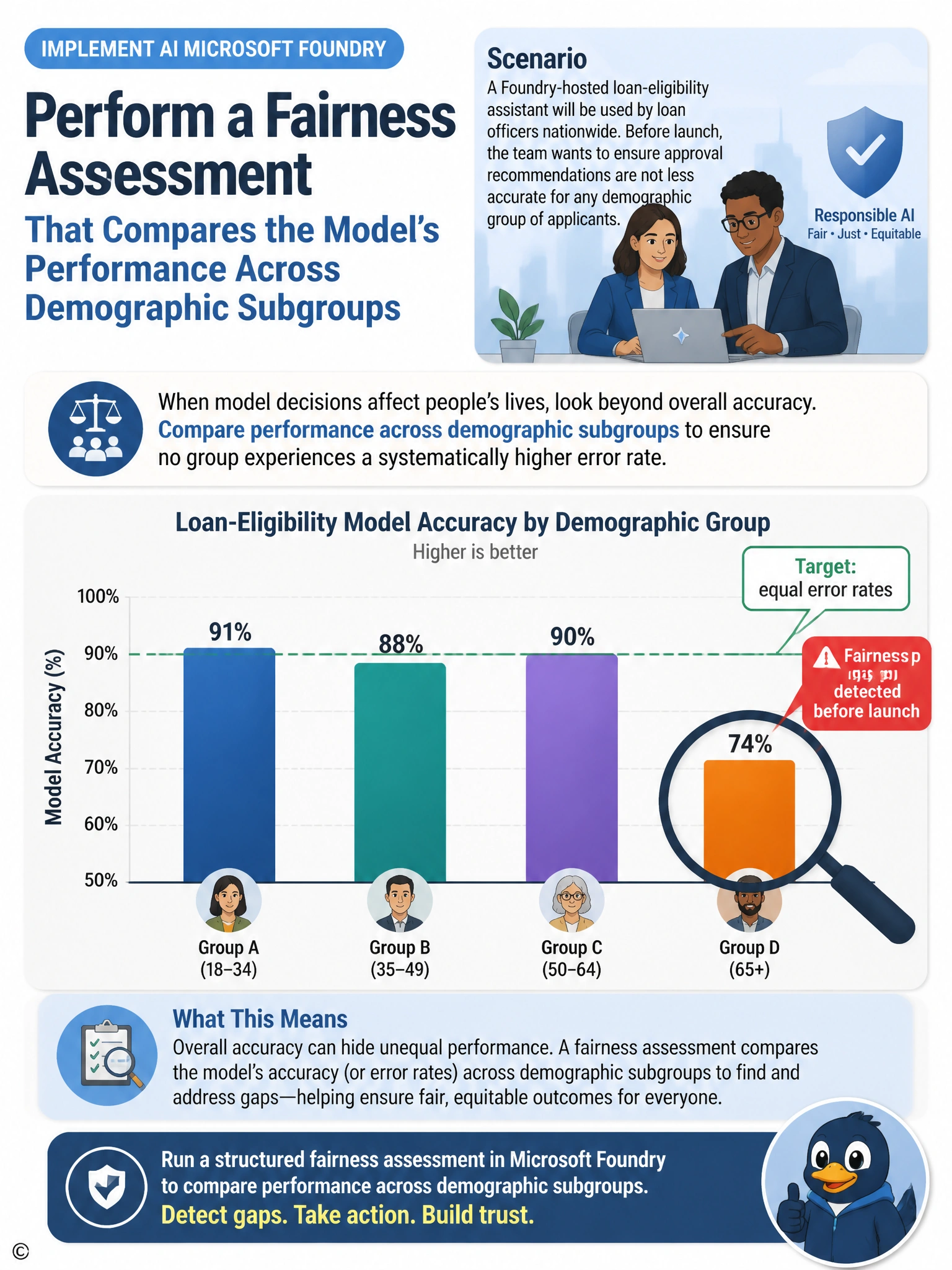
A team building a Foundry-hosted loan-eligibility assistant plans to roll it out to loan officers across the country. Before launch, they want to check whether the assistant's approval recommendations are less accurate for some demographic groups of applicants than others, so that no group experiences a systematically higher error rate. Which practice directly addresses this concern?
Select an answer to reveal the explanation.
Short Explanation
When a model makes decisions that affect people's lives, like whether someone qualifies for a loan, the real risk isn't just whether it's occasionally rude or wordy, it's whether it quietly performs worse for certain groups of people than others. Catching that requires deliberately checking the model's accuracy separately for different demographic slices of applicants, not just looking at overall accuracy, since overall numbers can look fine while one subgroup is being shortchanged. Adjusting how random the wording is won't surface that kind of bias, and giving the model more background text to read doesn't reveal a pattern of unequal treatment either. Filtering offensive language is a different safeguard entirely, aimed at tone rather than decision equity. What actually answers the team's question is running the model's outputs through a structured comparison across groups and looking for gaps in error rates, which is the responsible AI check built specifically for this kind of concern.
Full Explanation
The correct answer is C. A fairness assessment specifically measures whether a model's accuracy, error rates, or outcomes differ across demographic groups such as age, gender, or ethnicity, which is exactly the risk this loan-eligibility team is worried about before a nationwide launch. Option A is incorrect because temperature only affects how varied the wording of a response is, it does nothing to reveal or correct differences in decision accuracy between groups. Option B is incorrect because a larger context window lets the model consider more input text per request, but it does not measure or fix uneven error rates across populations of applicants. Option D is incorrect because content safety filtering targets harmful or offensive language in generated text, which is a separate concern from whether the underlying loan decisions are equitable across groups. Since the team's stated goal is confirming that no demographic group is disproportionately disadvantaged by the model's recommendations, the responsible AI practice built for exactly that purpose, a fairness assessment across subgroups, is the appropriate step before production release.