
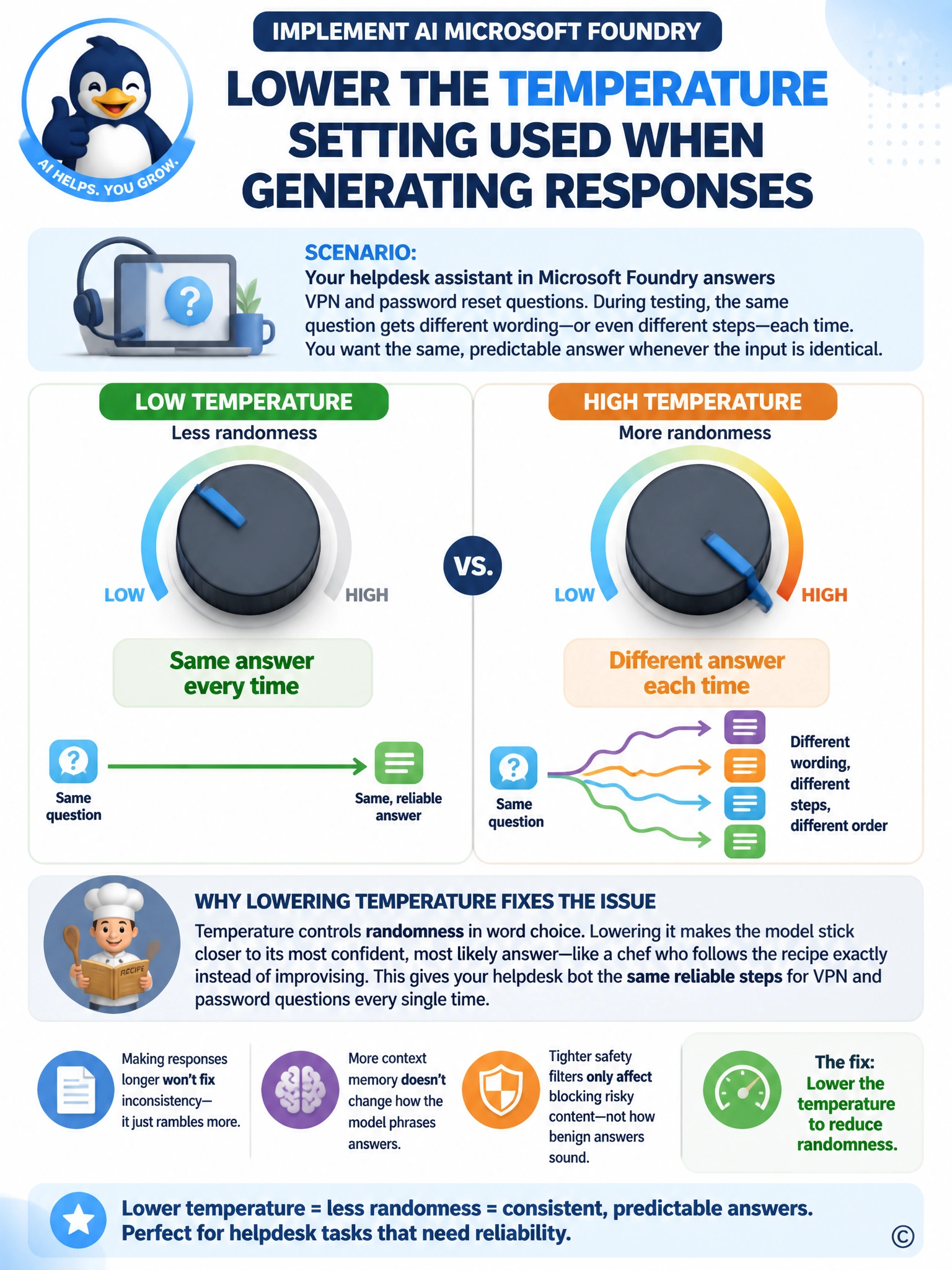
A software company's internal helpdesk assistant, built in Microsoft Foundry, answers routine questions about VPN setup and password resets. During testing, the team asks the exact same question multiple times and notices the wording, and sometimes even the recommended steps, change each time. For this use case they want the assistant to give the same, predictable answer whenever the input is identical. Which setting should they adjust to achieve this?
Select an answer to reveal the explanation.
Short Explanation
When the same question keeps getting different-sounding answers, the culprit is usually how much randomness the model is allowed when picking its words. Think of it like a chef who sometimes follows the recipe exactly and other times improvises a little each time they cook the same dish. For a helpdesk bot answering VPN and password questions, you don't want improvisation, you want the same reliable steps every time. Turning down that randomness dial makes the model stick closer to its most confident, most likely answer instead of wandering into slightly different phrasing or a different order of steps. Making responses longer won't fix inconsistency, it just lets them ramble more. Giving the model a bigger memory for context doesn't touch how it phrases things either. And tightening safety filters only affects whether risky content gets blocked, it has nothing to do with a benign IT question sounding different each time. The fix is squarely about reducing randomness in word choice.
Full Explanation
The correct answer is B. Temperature controls how much randomness the model injects when choosing its next words; lowering it makes the model favor its highest-probability response each time, which produces the consistent, repeatable wording and steps this helpdesk assistant needs for identical questions. Option A is incorrect because the max token limit only caps how long a response can be, it does not make repeated answers more similar to one another. Option C is incorrect because context window size determines how much conversation or document text the model can consider at once, not how deterministic its wording is from one run to the next. Option D is incorrect because content safety severity thresholds govern whether potentially harmful content is blocked or allowed through, which has nothing to do with variability in phrasing or steps for a benign VPN or password question. Since the reported problem is inconsistent phrasing and inconsistent steps for the same factual query, the fix belongs to the parameter that governs randomness in generation, not to length limits, context capacity, or safety filtering.