
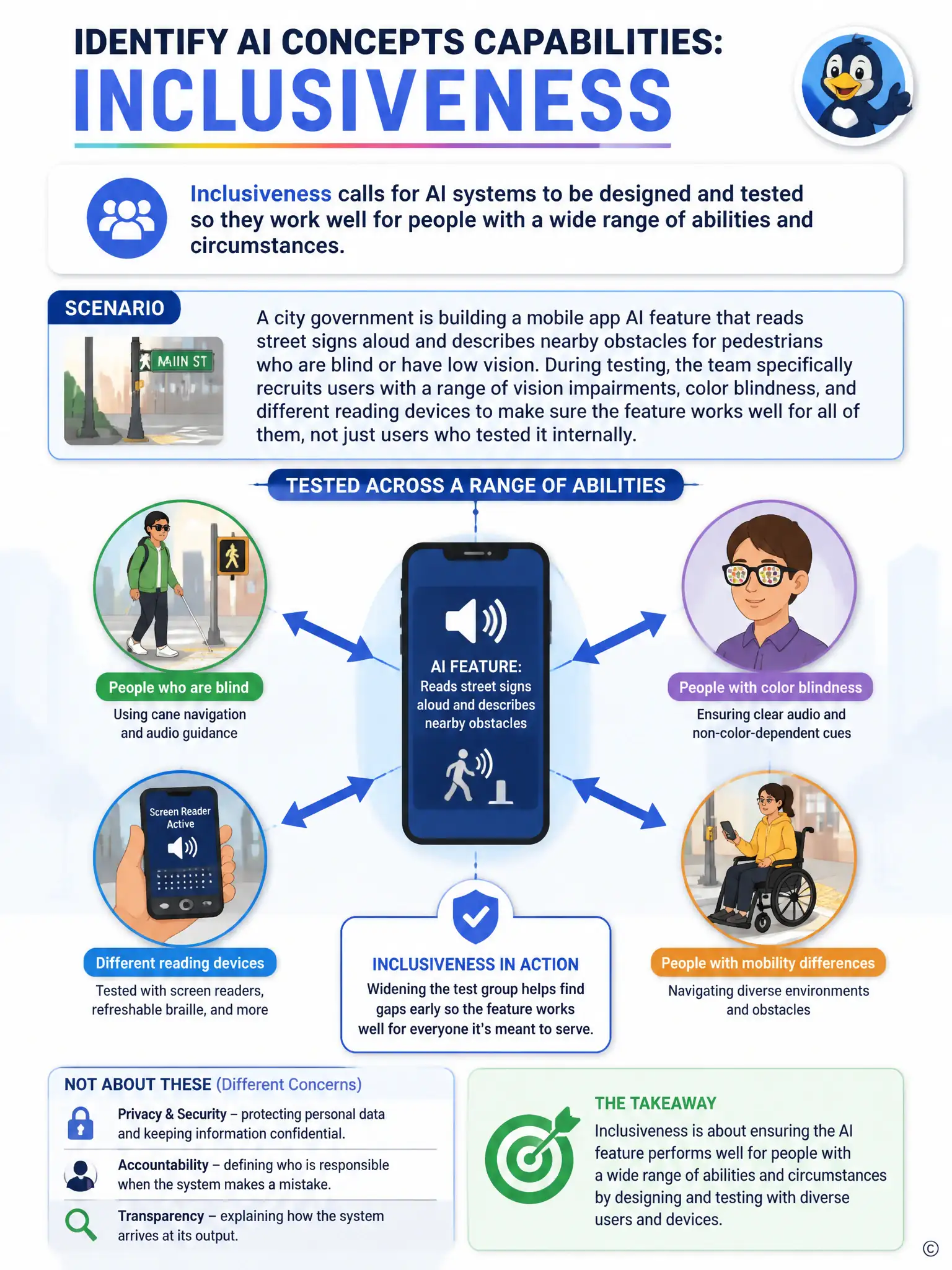
A city government is building a mobile app AI feature that reads street signs aloud and describes nearby obstacles for pedestrians who are blind or have low vision. During testing, the team specifically recruits users with a range of vision impairments, color blindness, and different reading devices to make sure the feature works well for all of them, not just users who tested it internally. Which responsible AI principle is the team primarily addressing by broadening its test group this way?
Select an answer to reveal the explanation.
Short Explanation
You're not just testing what your team can see. You're making sure the feature works for people with different vision abilities, color blindness, and devices. That's inclusiveness.
Full Explanation
The correct choice is the inclusiveness principle. By deliberately recruiting testers with a range of vision impairments, color blindness, and different assistive devices, the team is checking that the feature genuinely works for the full diversity of people who will rely on it, rather than only the narrower group who happened to build or informally test it. That deliberate effort to design and validate the system for people with varied abilities and circumstances is the responsible artificial intelligence principle of inclusiveness. The privacy and security principle is incorrect because it concerns how personal data collected by the app is protected from unauthorized access, which is a separate issue from whether the feature performs well across different users' abilities. The accountability principle is incorrect because it concerns who remains responsible for the system's outcomes and how oversight is structured, not how broadly the system was tested against user diversity. The transparency principle is incorrect because it concerns clearly communicating how the system produces its results so users can understand its behavior, which is different from ensuring the underlying feature itself performs equally well for a wide range of users.