
A software company's internal help-center has thousands of articles. Employees often type questions in their own words, such as how do I get my money back, and expect the system to return the refund-policy article even though that article never contains the word money or back. Which capability should the search feature rely on?
Select an answer to reveal the explanation.
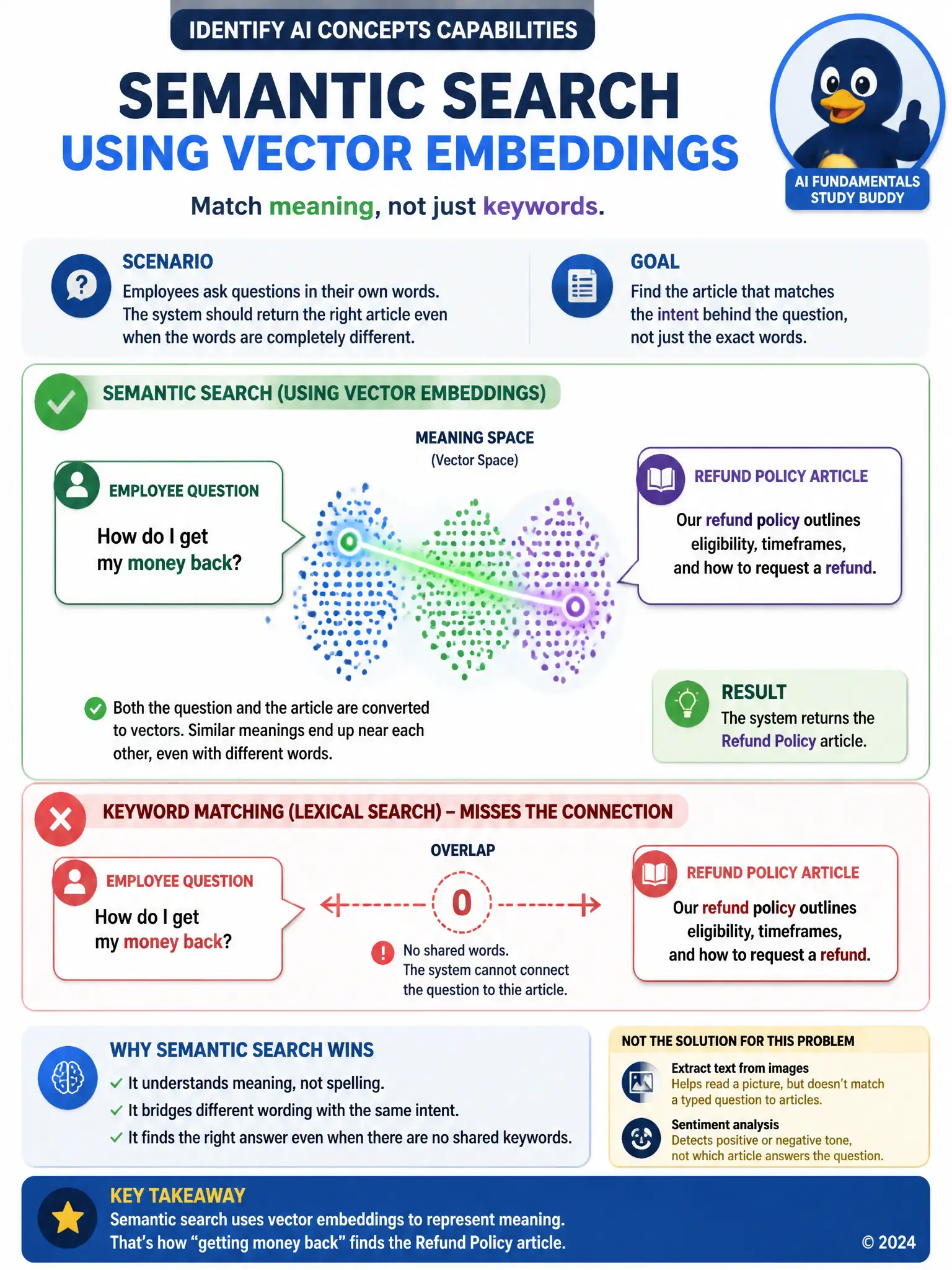
Short Explanation
You need matching by meaning, not exact words. Vector embeddings turn the question and articles into meaning-space points, so 'get my money back' lands near the refund-policy article even when the wording doesn't overlap.
Full Explanation
Semantic search using vector embeddings converts both the employee's question and each article into numeric representations that capture meaning rather than exact wording, so a query like how to get money back can be matched to a refund-policy article based on conceptual similarity even without shared keywords. Keyword-based full-text search is incorrect because it matches literal words and phrases between the query and the documents, so it would fail here precisely because the query and the article do not share the words money or back. Optical character recognition is incorrect because it extracts text from images or scanned pages, which is unrelated to matching a typed question to the right article by meaning. Sentiment analysis is incorrect because it measures the emotional tone of a passage, such as whether it sounds positive or negative, and has no mechanism for retrieving a relevant document based on what a query is asking about. Because the scenario hinges on returning results connected by meaning rather than shared vocabulary, the embedding-based semantic approach is the capability that solves the mismatch between how employees phrase questions and how articles are worded.