
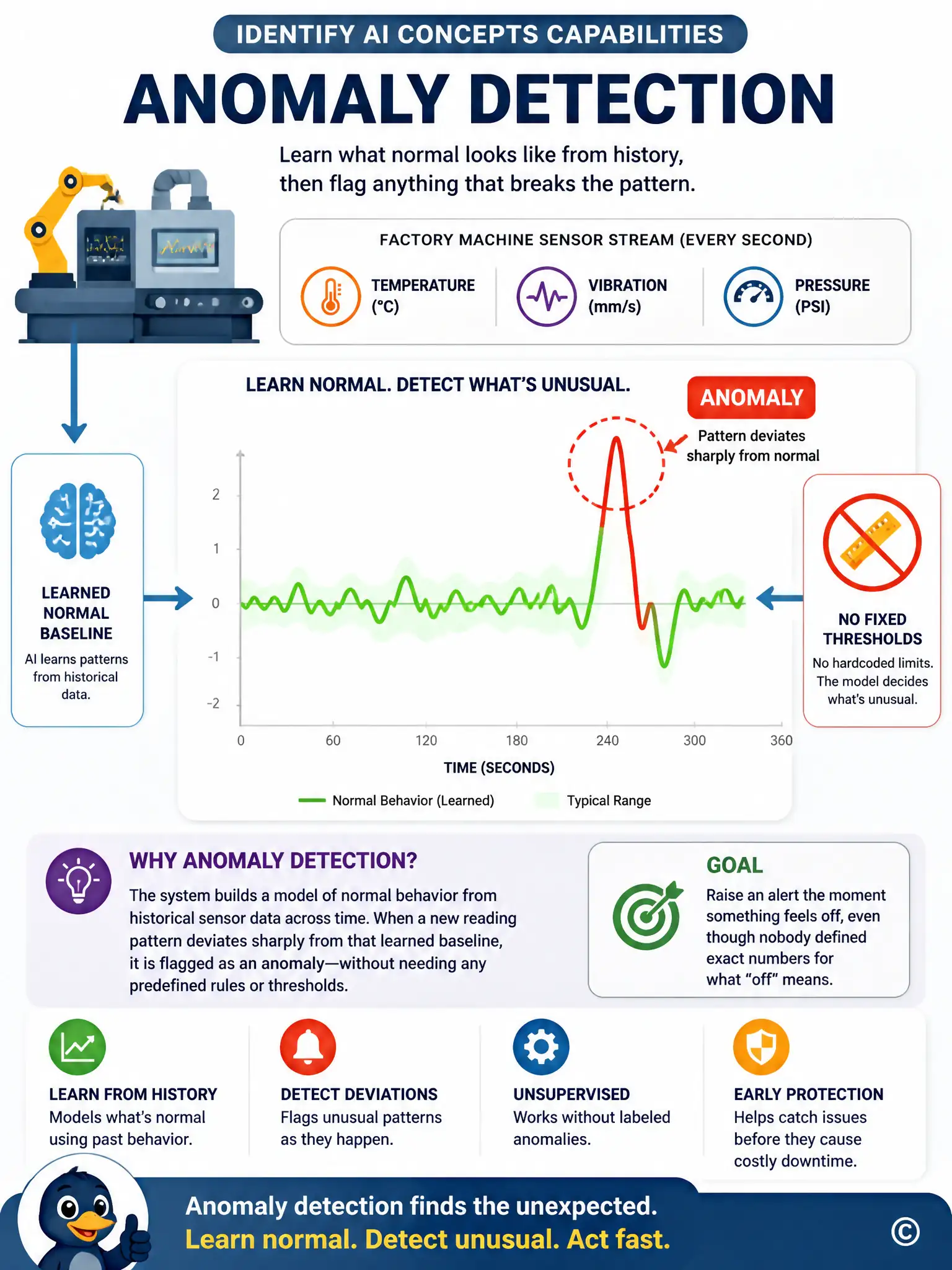
A manufacturer streams temperature, vibration, and pressure readings from a factory machine every second. Engineers have not defined fixed threshold values for what counts as a problem, but they want the system to automatically flag any reading pattern that deviates sharply from the machine's normal historical behavior. Which AI workload fits this need?
Select an answer to reveal the explanation.
Short Explanation
You want the system to learn the machine's normal hum from history and raise a flag when a reading breaks that pattern, without hardcoded limits. That's anomaly detection. Predicting the next temperature, classifying images, or grouping similar states doesn't raise the alert you need.
Full Explanation
Anomaly detection is built to learn what normal behavior looks like from historical time-series data and then flag new readings that fall outside that learned pattern, which matches the engineers' need to catch unusual sensor behavior without hand-coding threshold rules. The regression option is incorrect because regression predicts a specific continuous numeric value, such as tomorrow's expected temperature, rather than judging whether an observed value is unusual compared to a learned baseline. The image classification option is incorrect because image classification assigns a label to a picture, such as identifying a defect in a photograph, and has no role in evaluating a stream of numeric sensor readings over time. The clustering option is incorrect because clustering groups similar data points together to reveal natural categories, which could help segment normal operating states but is not itself the task of flagging individual readings that break from those patterns in real time. The engineers explicitly say they lack predefined thresholds and want deviations from normal behavior surfaced automatically, which is the defining trait of an anomaly detection workload rather than a prediction, image, or grouping task.