
A retail company collects thousands of customer product reviews as free text and wants a single score for each review classifying the customer's overall tone as positive, negative, or neutral, without needing a list of specific topics or products mentioned. Which Azure AI Language capability should the team use?
Select an answer to reveal the explanation.
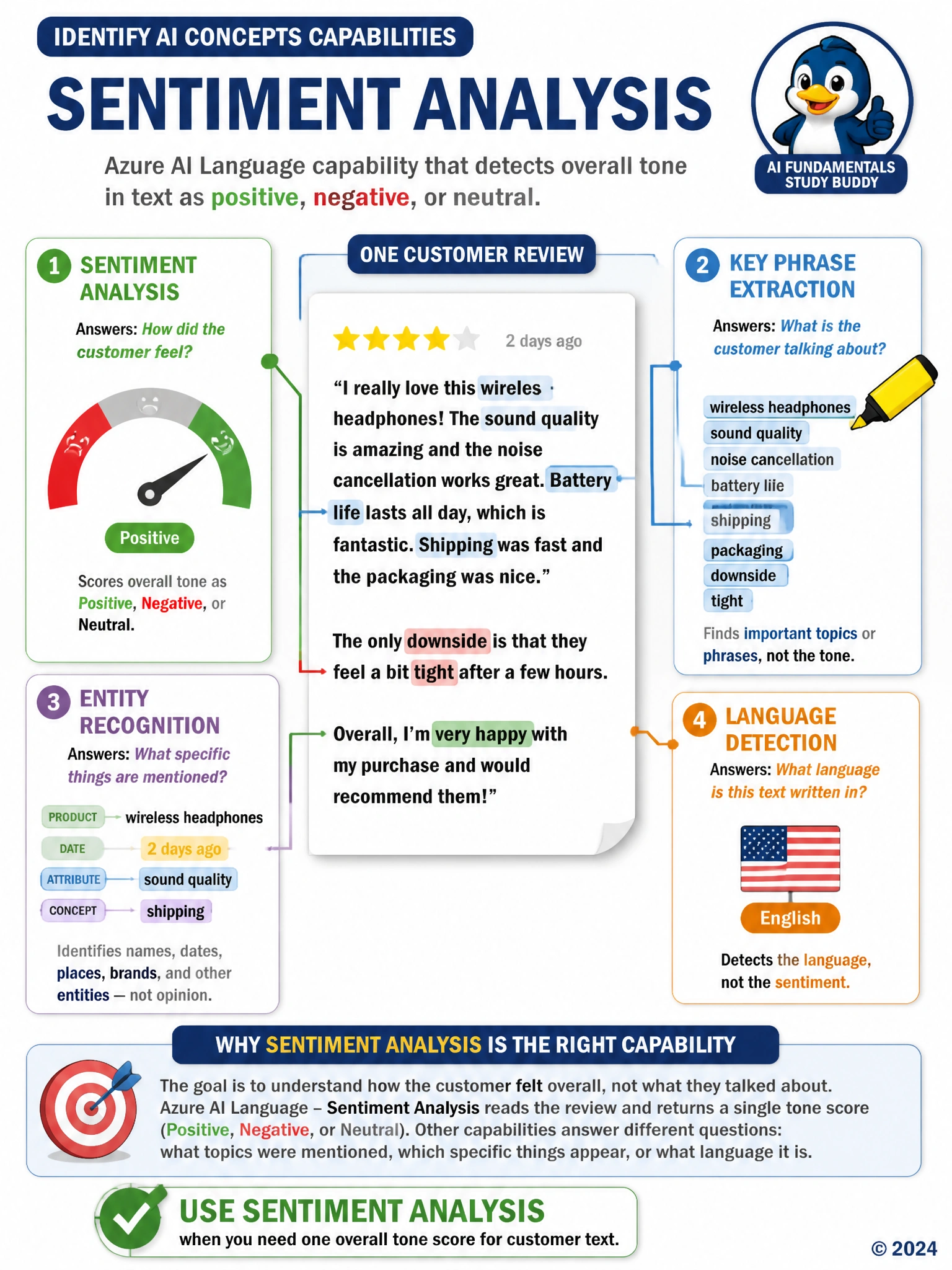
Short Explanation
Think of this as asking the model how did this customer feel rather than what did this customer talk about. The team does not want a list of nouns or product names pulled out of the review - they want one verdict per review: happy, unhappy, or neutral. That is a tone-scoring job, and Azure's language service has a purpose-built capability that reads a passage and returns exactly that kind of score. Pulling out the main topics or phrases in a review is a different job - it tells you what people are discussing, not how they feel about it, so a reviewer would still have to read every excerpt to judge tone. Spotting named things like brand names, dates, or places is useful for cataloging mentions but again says nothing about attitude. And figuring out which language a review is written in is just a housekeeping step you might run first if reviews came in from customers worldwide - it does not evaluate opinion at all. Since the ask here is strictly about overall tone, the tone-focused capability is the one that fits.
Full Explanation
The correct answer is A. Sentiment analysis is the Azure AI Language capability designed to evaluate free text and return a score or label indicating the overall positive, negative, mixed, or neutral tone of the passage, which is exactly what the retail team needs to summarize customer opinion at scale. Option B is incorrect because key phrase extraction identifies the main topics or noun phrases in a passage, such as product names or complaint themes, but it does not judge whether the tone toward those topics is favorable or unfavorable. Option C is incorrect because named entity recognition locates and categorizes specific items in text, such as people, organizations, locations, or dates, which would tell the team what is mentioned but not how the customer feels about it. Option D is incorrect because language detection only identifies which natural language a piece of text is written in, a preliminary step that would be useful if reviews arrived in multiple languages but does nothing to measure sentiment on its own. Because the team's stated goal is a single tone score per review with no interest in itemizing topics, sentiment analysis is the capability that directly produces that output without extra processing.