
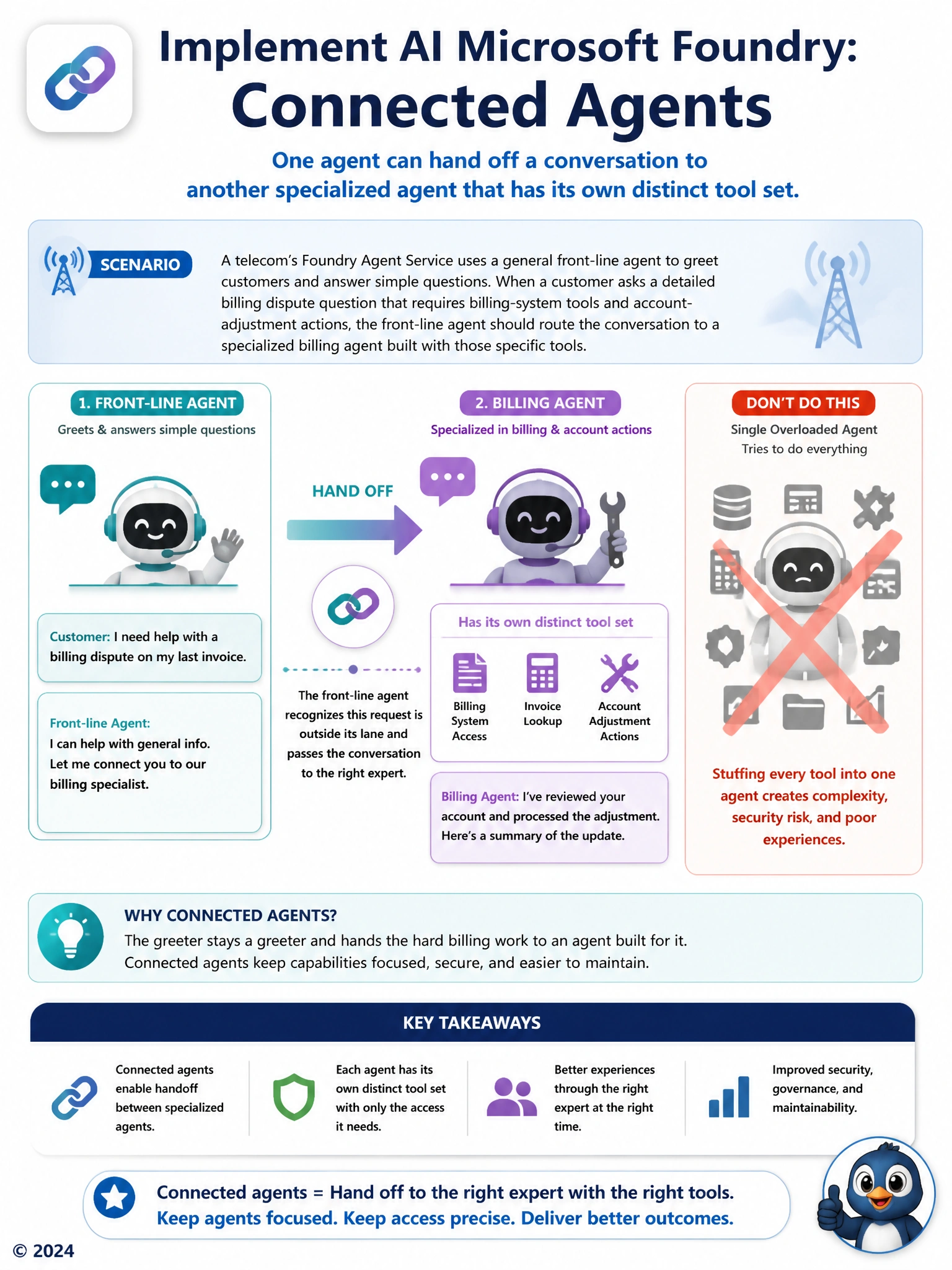
A telecom's Foundry Agent Service deployment uses a general front-line agent to greet customers and answer simple questions. When a customer asks a detailed billing dispute question requiring access to billing-system tools and account-adjustment actions, the team wants the front-line agent to route the conversation to a specialized billing agent built with those specific tools, rather than giving every tool to the one front-line agent. Which Foundry Agent Service capability supports this design?
Select an answer to reveal the explanation.
Short Explanation
The team wants the greeter to stay a greeter and hand the hard billing work to someone built for it, rather than stuffing every tool into one do-everything agent. That is exactly what connecting agents together is for: one agent recognizes a request is outside its lane and passes the conversation to a specialized counterpart that already has the right tools wired up, in this case billing-system access and account-adjustment actions. Just writing a longer, more detailed set of instructions for the front-line agent does not hand it any new capabilities, it can talk about billing procedures without being able to actually touch a billing system. Letting it generate longer responses has the same problem, more words does not mean more access. And a content filter aimed at blocking certain keywords does not connect anyone to a more capable agent, it just prevents the front-line agent from discussing the topic at all.
Full Explanation
The correct answer is B. Connected agents let one agent recognize that a request falls outside its scope and hand the conversation off to a separate, specialized agent equipped with its own tools, in this case one wired up to billing-system access and account-adjustment actions, which is exactly the separation of responsibility the team wants instead of loading every tool onto the front-line agent. Option A is incorrect because a longer system message only changes what the front-line agent says; it does not give that agent access to billing-system tools or adjustment actions it was never equipped with. Option C is incorrect because a larger output token limit affects response length, not the agent's ability to call billing tools it does not have. Option D is incorrect because a content safety filter blocks unsafe content categories; it has no role in routing a conversation to a more capable specialized agent and would only prevent the front-line agent from discussing billing at all.