
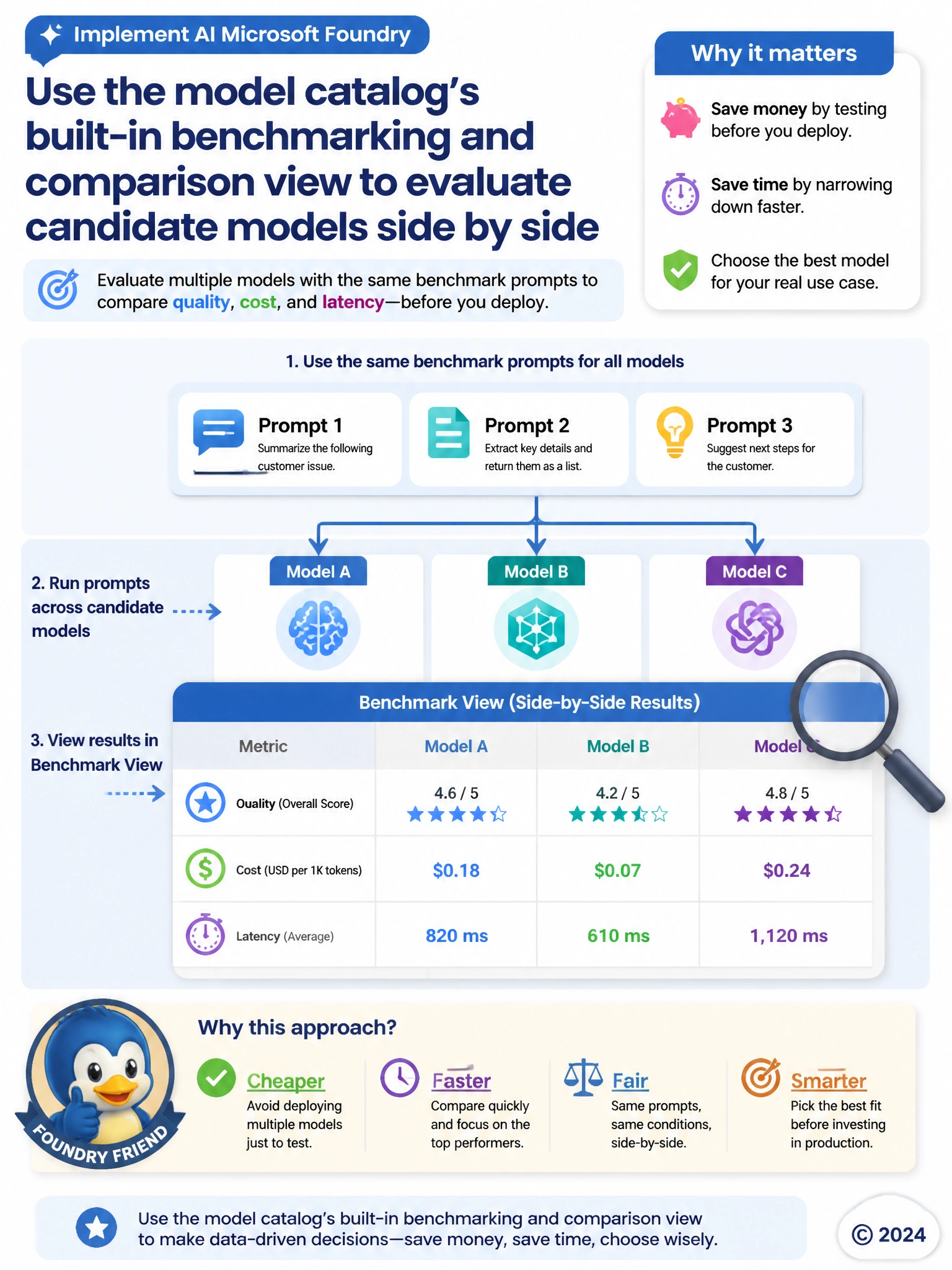
A machine learning team is choosing among several candidate language models in the Azure AI Foundry model catalog for a new customer-facing assistant. Before committing to one, they want to compare quality, cost, and latency metrics for multiple models side by side using the same benchmark prompts, without deploying every candidate to production first.
Select an answer to reveal the explanation.
Short Explanation
Before this team spends money deploying five different models to see which one performs best, there is a much cheaper way to find out: the model catalog has a comparison view built for exactly this, letting them run the same test prompts across candidates and see quality, cost, and speed side by side. Think of it like a taste test where every model gets the same three questions instead of every model getting its own separate restaurant opening. Skipping straight to full production deployment for every option burns time and money on models that might get eliminated in the first round. Trusting a vendor's marketing copy is even riskier, since that page is written to sell the model, not to measure it against this team's actual use case. And jumping to fine-tuning every candidate up front is solving the wrong problem first, since fine-tuning cost tells you nothing about how well a model reasons before it has been customized at all.
Full Explanation
The correct answer is B. Azure AI Foundry's model catalog includes a benchmarking and comparison view that lets a team run the same prompts against multiple candidate models and compare quality, cost, and latency metrics before committing to a deployment, which is exactly what this team needs while still evaluating options. Option A is incorrect because deploying every candidate to production is expensive, risky for real customers, and far slower than using the catalog's built-in comparison tools to narrow the field first. Option C is incorrect because marketing pages reflect vendor claims rather than measured performance on the team's own benchmark prompts, and are not a substitute for a controlled comparison. Option D is incorrect because fine-tuning cost is only one factor among several, and jumping straight to fine-tuning every candidate skips the earlier, cheaper step of comparing base model behavior first; it also conflates model selection with a separate customization decision that should come later, once a base model has already been chosen.