
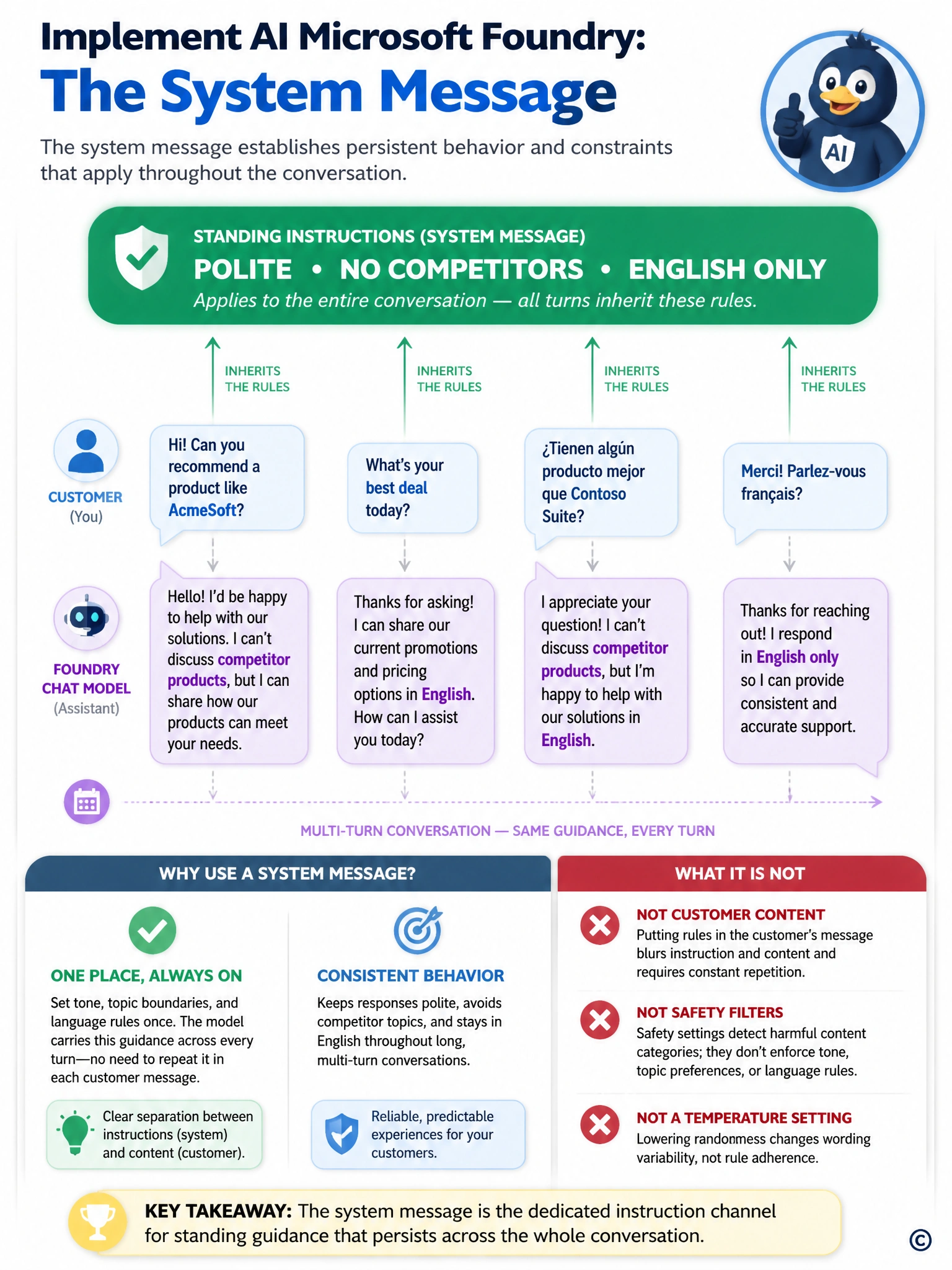
A customer-service team deploys a Foundry-hosted chat model and wants it to consistently stay polite, avoid discussing competitor products, and respond only in English, no matter what a customer types across a long, multi-turn conversation. Rather than repeating these instructions inside every customer message sent to the model, a developer sets them once in a distinct instruction channel that the model treats as standing guidance for the whole conversation. What is this instruction channel called?
Select an answer to reveal the explanation.
Short Explanation
There is a reason developers do not just retype the same rules into every single customer message, there is a dedicated place for exactly this kind of standing instruction, and it sits apart from what the customer types. Setting the tone, the off-limits competitor topic and the language requirement there once means the model carries that guidance through the whole back-and-forth without anyone needing to restate it turn after turn. Putting those same rules inside the customer's own message would blur instruction and content together and would need repeating constantly to keep working. It also is not something handled by the safety filtering settings, those exist to catch specific harmful content categories, not to steer tone or topic preference. And adjusting how randomly the model picks its words does not make it suddenly start following rules it was never given in the first place, that setting changes phrasing variability, not rule adherence.
Full Explanation
The correct answer is D. The system message is the channel intended for exactly this purpose, standing instructions that shape the model's behavior, tone and boundaries across an entire conversation, so the developer sets politeness, the competitor-topic restriction and the English-only requirement there once instead of repeating them in every customer turn, and the model treats that guidance as persistent context rather than something tied to a single message. Option A is incorrect because user messages represent what the customer actually types in each turn; repeating behavioral rules there would require restating them constantly and would mix instructions with the customer's own content rather than establishing them as a stable baseline. Option B is incorrect because content safety configuration governs filtering of harmful content categories like hate speech or self-harm, it is not the mechanism for shaping tone, topic scope or language preference, which are behavioral instructions rather than safety categories. Option C is incorrect because temperature controls how random or deterministic the model's word choices are, it does not cause the model to adhere to behavioral rules more closely, and a low-temperature response can still ignore instructions if those instructions were never actually provided.