
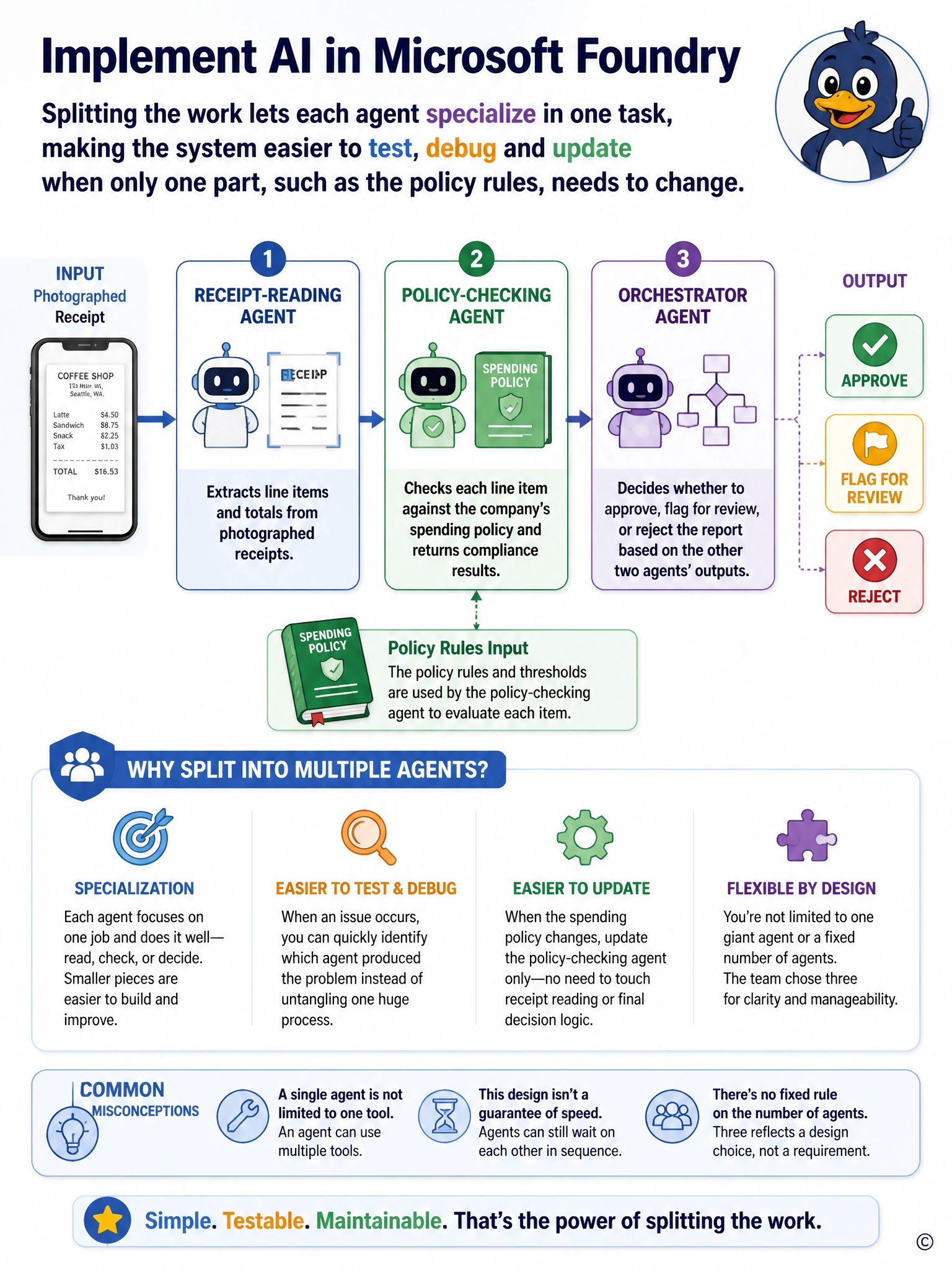
A finance team is automating expense report processing in Microsoft Foundry. One agent extracts line items and totals from photographed receipts, a second agent checks each line item against the company's spending policy, and a third orchestrator agent decides whether to approve, flag for review, or reject the report based on the other two agents' outputs. Why might the team choose this multi-agent structure over building a single agent that handles receipt reading, policy checking and final decisions all at once?
Select an answer to reveal the explanation.
Short Explanation
The reason to split this into three agents instead of one giant do-everything agent comes down to keeping each piece simple enough to actually manage. When the spending policy changes next quarter, the team only has to touch the piece that knows about policy, not the piece that reads receipts or the piece that makes the final call. That also means when something goes wrong, like the wrong report getting approved, it is much easier to figure out which piece produced the bad output instead of untangling one enormous process. It is not that a single agent is stuck with only one tool, an agent can absolutely be given several tools and use them as needed. It is also not a guarantee of speed, since these agents can still end up waiting on each other in sequence just like steps in any pipeline. And there is no fixed rule forcing a workflow with images and decisions into exactly three agents, that number reflects a design choice the team made for clarity, not a requirement imposed on them.
Full Explanation
The correct answer is B. Dividing the work into a receipt-reading agent, a policy-checking agent and an orchestrator that makes the final call means each one has a narrow, well-defined job, so when spending policy changes, only the policy-checking agent needs to be updated and retested, without touching the receipt extraction logic or the approval decision logic; this separation also makes it far easier to isolate a bug, since a wrong approval can be traced to whichever agent's output was faulty. Option A is incorrect because a single agent can be equipped with multiple tools and call several of them within one workflow; the limitation the team is working around is complexity and maintainability, not a hard technical cap on tool count. Option C is incorrect because splitting work across agents does not guarantee faster performance, since the agents may still run sequentially, each waiting on the previous one's output, and coordination between agents can add its own overhead. Option D is incorrect because there is no rule requiring a minimum number of agents based on whether a workflow involves images or structured output; the team chose three agents for organizational clarity, not because Foundry mandated that count.