
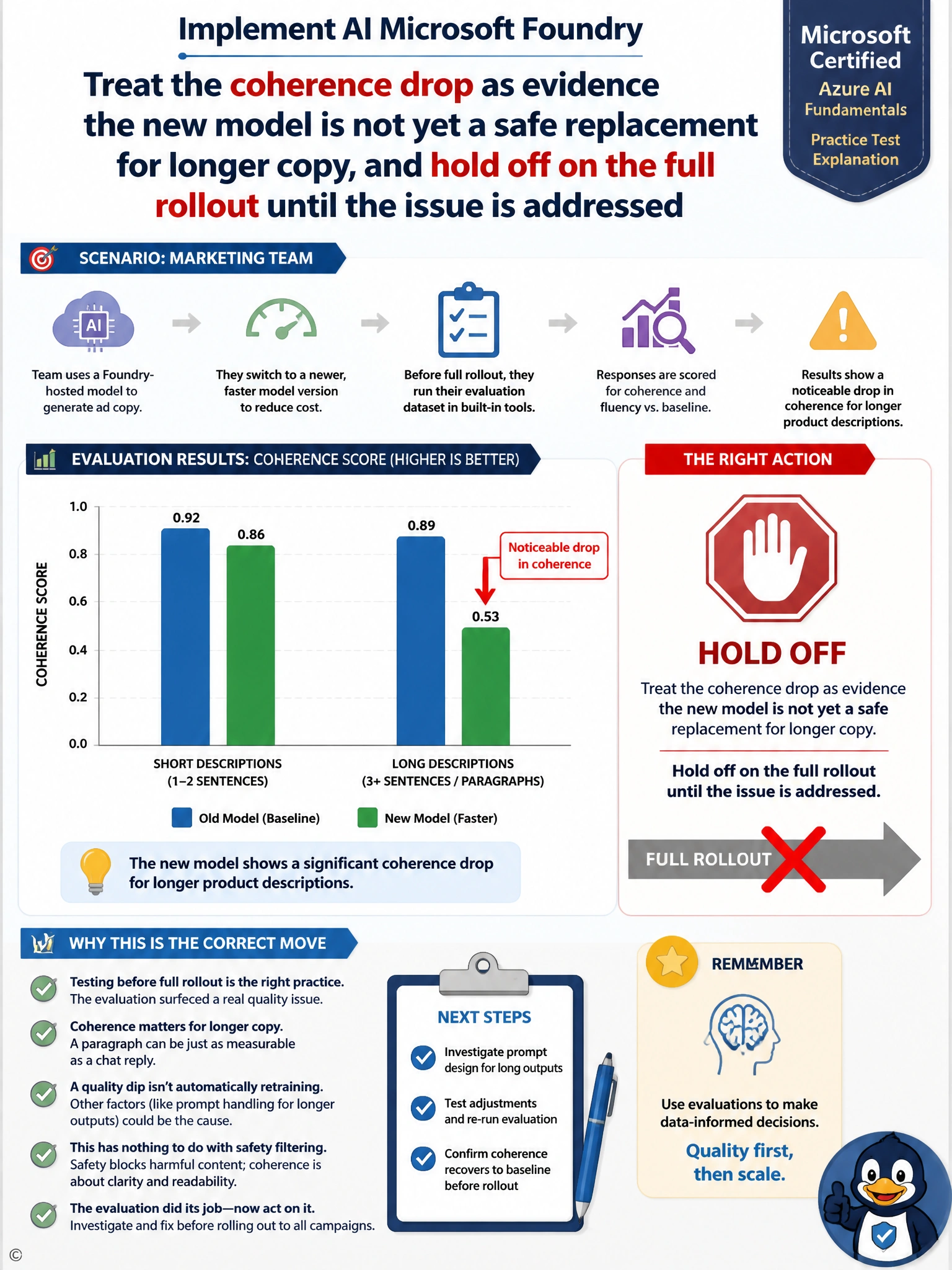
A marketing team generates ad copy using a Foundry-hosted model and recently switched to a newer, faster model version to reduce cost. Before rolling the change out to all campaigns, they run their existing evaluation dataset of sample prompts and human-approved outputs through the built-in evaluation tools, which score each new response for coherence and fluency against the prior baseline. The scores show a noticeable drop in coherence for longer product descriptions. What should the team do with this result?
Select an answer to reveal the explanation.
Short Explanation
The team did exactly the right thing by testing before flipping the switch for everyone, and the result they got is telling them something real: whatever made the new model faster and cheaper seems to be costing it clarity once the copy gets longer. The sensible reaction is to treat that as a warning sign worth chasing down before every campaign starts using it, not to explain it away. It is not that these quality checks only count for back-and-forth chat, a paragraph of ad copy can be just as measurably confusing or well-formed as a chat reply. And a dip in quality is not automatically a signal to jump straight to retraining the model, since plenty of other things could be at play first, like how the prompt handles longer outputs. It definitely has nothing to do with safety filtering either, since that system is about blocking unsafe content, not about whether a sentence reads smoothly. The evaluation did its job; now the team needs to act on what it found instead of pushing forward anyway.
Full Explanation
The correct answer is A. The whole purpose of running the evaluation dataset before rollout was to catch regressions like this, and a measurable coherence drop specifically on longer descriptions is a concrete signal that the faster model is not yet producing acceptable quality for that use case, so the responsible move is to pause the full rollout and investigate, perhaps adjusting prompts, trying a different model, or narrowing where the new model is used, before exposing it to every campaign. Option B is incorrect because coherence and fluency metrics evaluate how well-formed and logically consistent generated text is regardless of whether it is a conversation or generated marketing copy; there is nothing chat-specific about measuring whether a paragraph reads clearly. Option C is incorrect because a coherence drop does not automatically mean fine-tuning is the fix; the cause could be prompt design, length handling, or the model simply being unsuited to this task, and jumping straight to fine-tuning skips the diagnosis step the evaluation was meant to support. Option D is incorrect because content safety filtering and coherence are unrelated systems; filters block or flag unsafe content, they do not rewrite text for grammatical or logical quality, so disabling them would not address a coherence problem and would only remove a safety protection.