
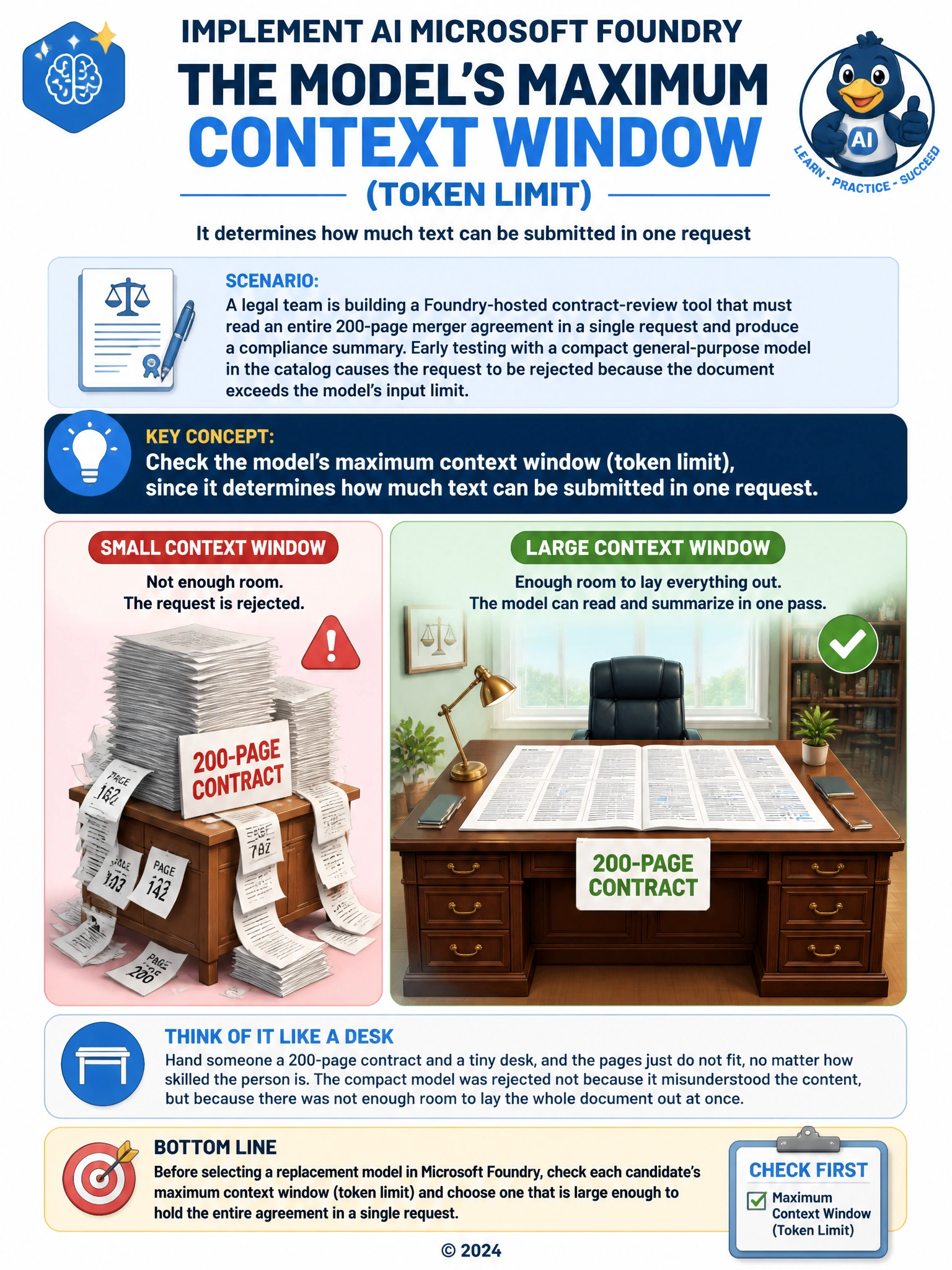
A legal team is building a Foundry-hosted contract-review tool that must read an entire 200-page merger agreement in a single request and produce a compliance summary. Early testing with a compact general-purpose model in the catalog causes the request to be rejected because the document exceeds the model's input limit. Which model catalog specification should the team check first when selecting a replacement model?
Select an answer to reveal the explanation.
Short Explanation
Think of a model's context window like the size of a desk someone is asked to work at. Hand them a 200-page contract and a tiny desk, and the pages just do not fit, no matter how skilled the person is. That is exactly what happened here: the compact model got rejected not because it misunderstood the content, but because there was not enough room to lay the whole document out at once. Swapping to a different output style would not add desk space, and neither would adjusting how strict the safety filters are, since the problem never got far enough to reach filtering or formatting. Region matters for where the desk is located, not how big it is. So before picking a replacement, check how much text each candidate model can actually hold in one sitting. Pick one with a context window roomy enough for the full agreement, and the rejection goes away because the whole document can finally be laid out for the model to read and summarize in a single pass.
Full Explanation
The correct answer is B. The rejection happened because the 200-page agreement exceeded the compact model's input limit, so the specification that directly addresses that failure is the maximum context window, which caps how many tokens (input plus expected output) a model can process in a single call; the team needs a model whose context window is large enough to hold the entire agreement text before it can even attempt a summary. Option A is incorrect because output format controls how the response is structured, not how much input the model can accept, and swapping formats would not fix a rejected oversized request. Option C is incorrect because content safety severity governs whether flagged content is filtered or blocked, which is unrelated to a request being too large to process at all. Option D is incorrect because regional availability determines where a model can be deployed for latency or compliance reasons, but it has no bearing on how much text a single request can contain; a model available in the right region could still reject the document if its context window is too small. Checking context window size first lets the team narrow the catalog to models capable of handling the full document.