
An online furniture retailer wants shoppers to upload a photo of a chair they like and have the site return visually similar chairs from the catalog, without relying on any text description. Which capability should the team deploy through Azure AI Foundry?
Select an answer to reveal the explanation.
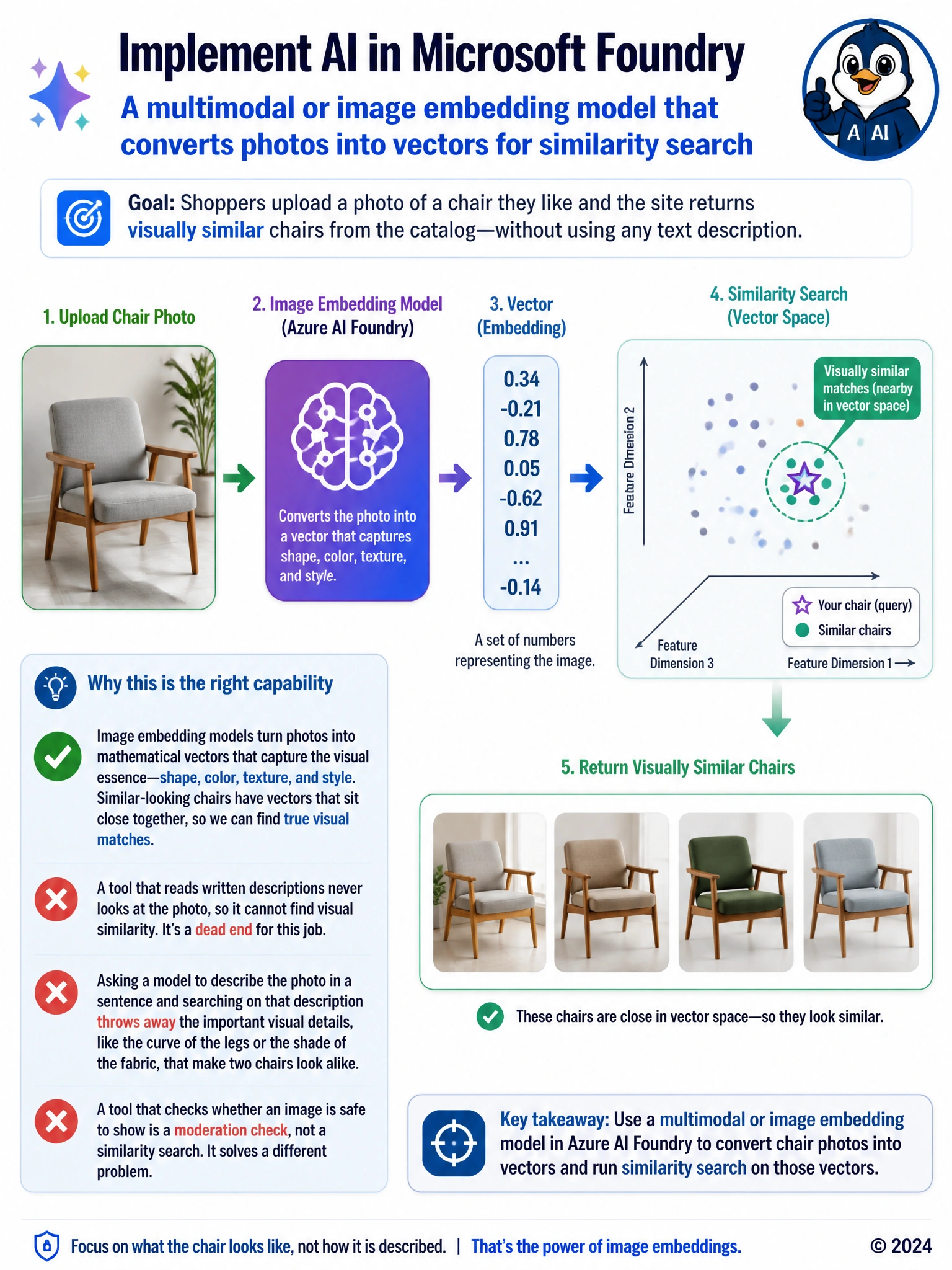
Short Explanation
Since the whole point is matching by what a chair actually looks like, not by how it is described in a product listing, the tool needed here is one that turns photos themselves into a set of numbers capturing shape, color, and style, so similar-looking chairs end up with numbers that sit close together and different-looking ones end up far apart. A tool built to read written descriptions never even looks at the photo, so it is a dead end for this job. Asking a model to describe the photo in a sentence first and searching on that description throws away exactly the visual detail, like the curve of the legs or the shade of the fabric, that makes two chairs look alike in the first place. And a tool that checks whether an image is safe to show is solving a completely different problem: it is a moderation check, not a similarity search.
Full Explanation
The correct answer is A. Finding visually similar products from an uploaded photo requires converting images into numeric vectors that capture visual features like shape, color, and pattern, which is what a multimodal or image embedding model does; the retailer can then compare the uploaded photo's vector against stored vectors for catalog items to find the closest visual matches. Option B is incorrect because a text embedding model only processes written descriptions and has no way to interpret the pixels of an uploaded photo, so it cannot power a photo-in search. Option C is incorrect because asking a language model to describe the photo in words introduces an unnecessary translation step that discards visual detail like exact shape and shading, making the match less accurate than comparing image vectors directly. Option D is incorrect because a content safety model classifies whether an image is appropriate to display, which is a moderation task entirely separate from measuring visual similarity between products.