
An edtech company is preparing to launch a Foundry-hosted tutoring chatbot for children under age 13. Before launch, the team wants to reduce two specific risks: the chatbot exposing kids to inappropriate content, and the chatbot confidently stating incorrect facts about the curriculum. (Select TWO.)
Select all correct answers, then click Submit.
Short Explanation
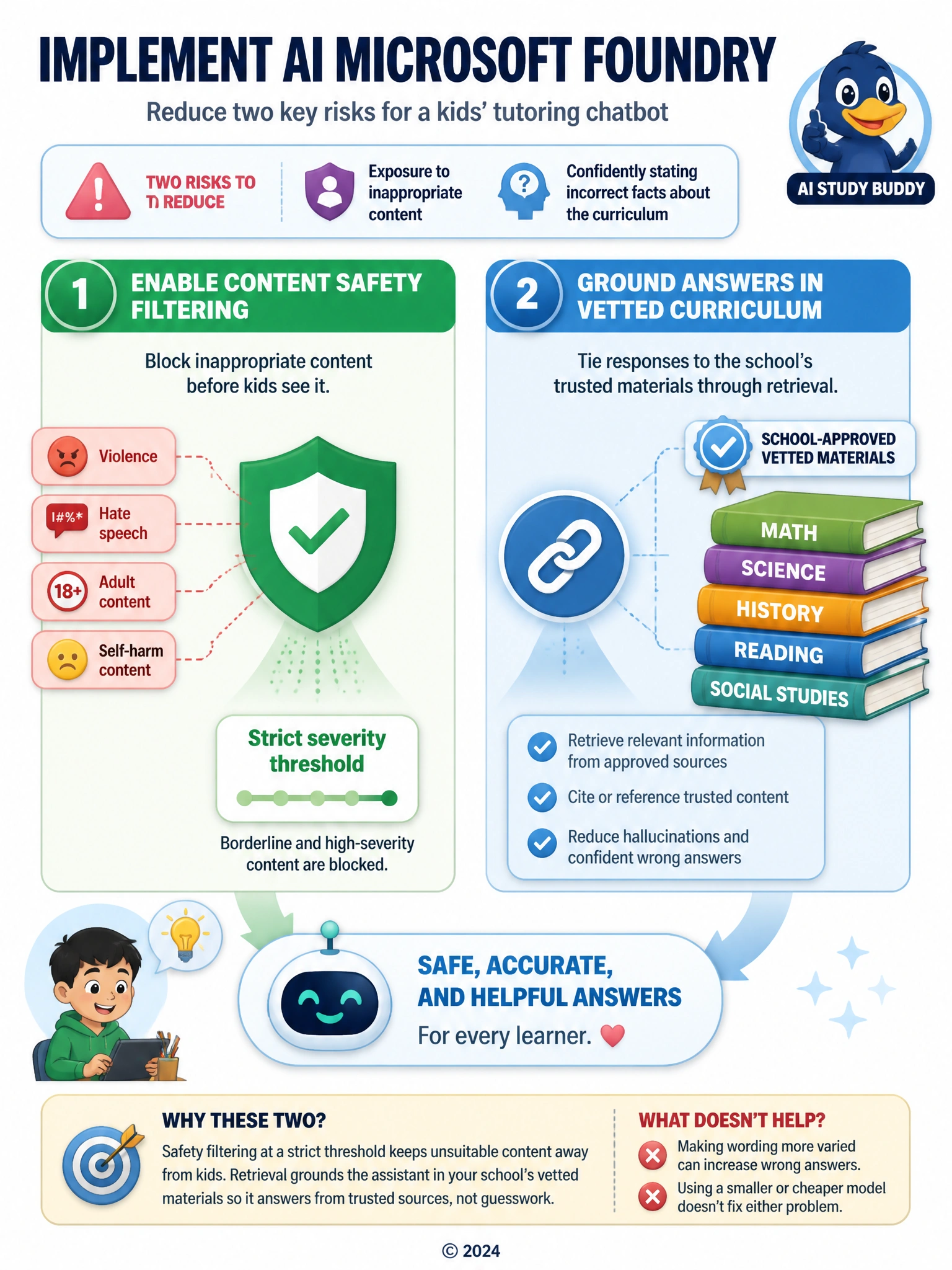
There are two separate problems to solve here, and each needs its own fix. Keeping unsuitable content away from kids is a job for the safety filtering settings, cranked up to a strict level so borderline material gets blocked before a child ever sees it. Keeping the facts straight on curriculum topics is a different problem, solved by tying the assistant's answers to the school's own vetted materials through retrieval, so it is pulling from a trusted source instead of guessing from whatever it picked up during training. Making the wording more varied and unpredictable sounds harmless but actually pushes in the wrong direction, since it tends to make confident-sounding wrong answers more likely rather than less. And swapping in a cheaper, smaller model is purely a budget move that does not touch either the filtering problem or the factual-accuracy problem, so it does not belong on this list at all.
Full Explanation
The correct answers are A and D. A children's tutoring chatbot needs safeguards against two distinct failure modes: exposure to inappropriate content, and confidently wrong facts about the curriculum. Enabling content safety filtering at a strict severity threshold addresses the first risk by blocking outputs that fall into harmful categories before they reach a child. Grounding the assistant's answers in the school's vetted curriculum materials through retrieval addresses the second risk by anchoring responses to a trusted, curated source rather than the model's general training knowledge, reducing the chance of confident fabrication. Option B is incorrect because raising the temperature increases the variety and unpredictability of wording, which tends to make hallucinated facts more likely, not less, working against the second goal. Option C is incorrect because switching to a smaller, cheaper model is a cost decision that says nothing about content filtering or factual grounding, and a smaller model may actually be more prone to both inappropriate outputs and inaccurate answers if it is chosen for price alone.