
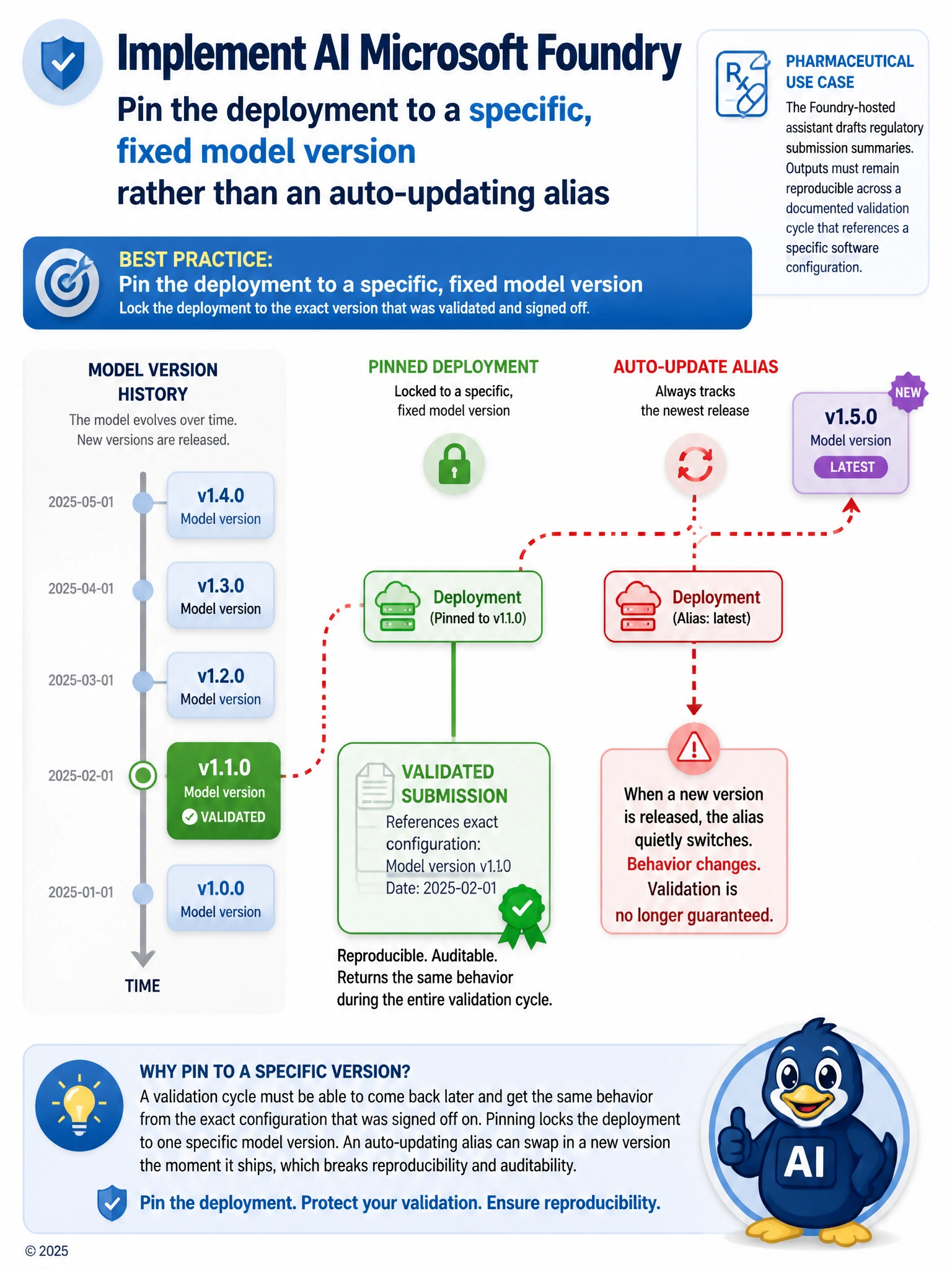
A pharmaceutical company's Foundry-hosted assistant is used to draft regulatory submission summaries, and outputs must remain reproducible across a documented validation cycle that references a specific software configuration. Which deployment practice best supports this requirement?
Select an answer to reveal the explanation.
Short Explanation
Because the whole point of a validation cycle is that someone can come back later and get the same behavior out of the exact configuration that was signed off on, the deployment needs to be locked to one specific model version rather than left pointed at whatever the vendor currently calls the latest release. An alias that always tracks the newest release can quietly swap the model out from under the team the moment a new version ships, which is the opposite of what a documented, auditable configuration needs. Turning on autoscaling only changes how much compute capacity responds to traffic, not which model answers the request. And dialing randomness down to zero makes one particular model version more consistent with itself, but it does nothing to stop the provider from retiring or replacing that version entirely, so it does not actually lock anything down.
Full Explanation
The correct answer is A. A validation cycle that must reference a documented software configuration requires that the exact model behavior stay fixed until the company deliberately revalidates it, so the deployment should point to a specific, immutable model version rather than an alias that can silently swap in a newer model. Option B is incorrect because a latest-pointing alias can change the underlying model at any time as the provider releases updates, breaking reproducibility for a submission that was validated against a prior version. Option C is incorrect because autoscaling adjusts compute resources to maintain response times under varying load; it has no effect on which model version answers B request. Option D is incorrect because setting temperature to zero reduces randomness in a single model's output but does not prevent the underlying model version itself from being changed or retired by the provider, so it does not satisfy a reproducibility requirement tied to a documented configuration.