
A regional bank's automated loan-approval system must ensure that applicants from different neighborhoods with similar financial profiles receive similar approval outcomes, and separately must ensure that applicants' income statements and identity documents are encrypted and accessible only to authorized staff. Which two Responsible AI principles are most directly addressed by these two requirements? (Select TWO.)
Select all correct answers, then click Submit.
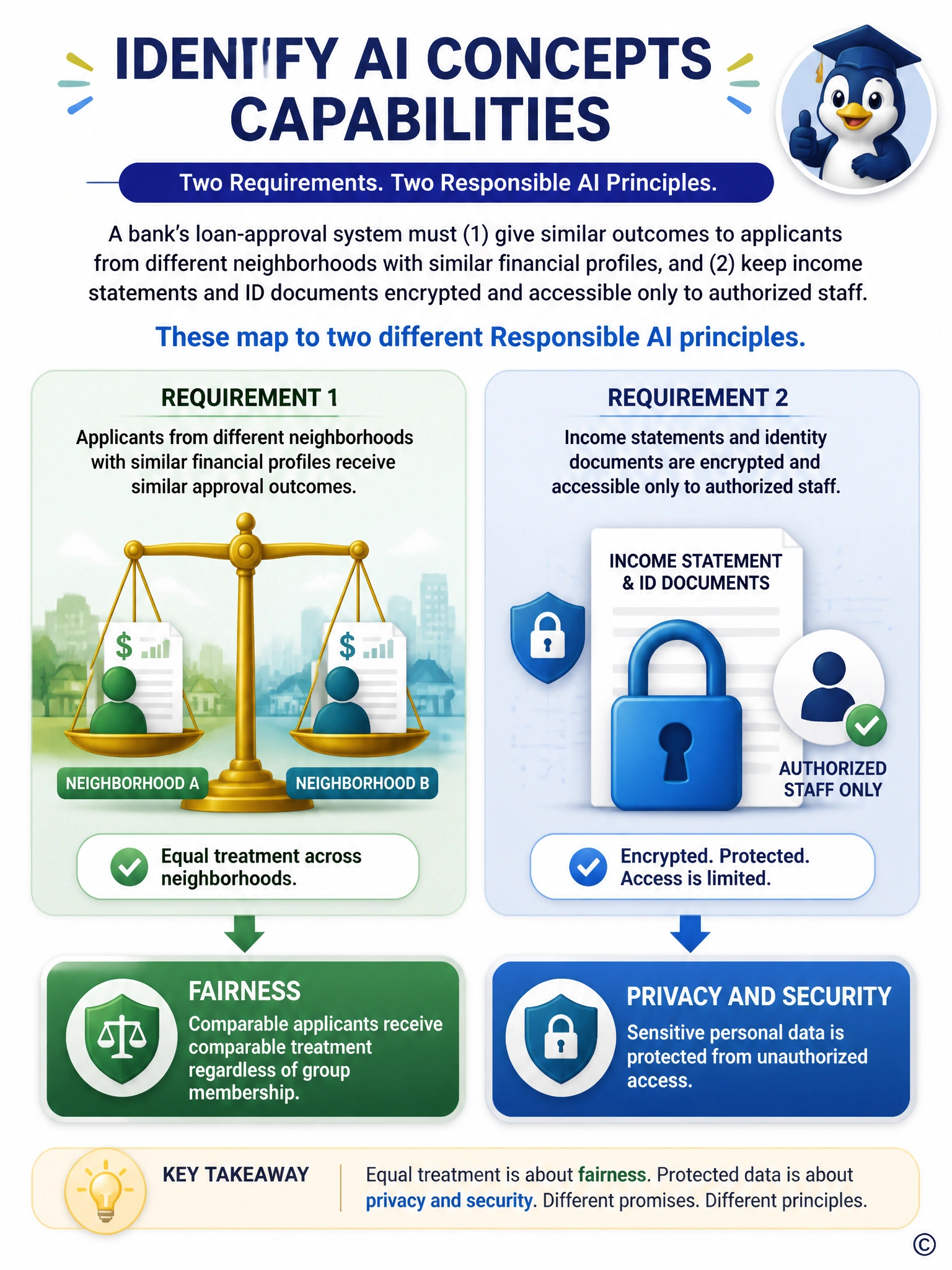
Short Explanation
Two separate promises are being made here, and they map to two separate ideas. The first promise, that where you live shouldn't tilt the outcome when your financial picture looks the same as someone else's, is about making sure comparable people are treated comparably - that's the fairness half. The second promise, locking down income statements and ID documents so only the right staff can see them, is about keeping sensitive personal information safe from prying eyes - that's the privacy and security half. Neither promise is really about whether the interface works for someone using a screen reader, which is a different concern entirely, and neither is about the system holding up reliably under odd or unexpected conditions, which is also a different concern. Once you separate 'equal treatment' from 'protected data,' the two matching principles fall right out.
Full Explanation
The correct answers are A and B. The first requirement, that applicants with similar financial profiles get similar outcomes regardless of their neighborhood, is a direct statement of the fairness principle, which calls for AI systems to treat comparable people comparably and avoid embedding unjustified disparities, such as ones that could correlate with neighborhood demographics. The second requirement, encrypting income and identity documents and restricting access to authorized staff, is a direct statement of the privacy and security principle, which calls for protecting personal data from misuse or unauthorized exposure. Option C is incorrect because inclusiveness concerns designing systems that people of varying abilities and backgrounds can actually use, such as accessible interfaces, which is not what either requirement describes. Option D is incorrect because reliability and safety concerns the system performing consistently and safely under expected operating conditions, such as handling unusual inputs gracefully, which is a different concern from equal treatment across applicants or data protection. The scenario maps cleanly to fairness and privacy and security, with no overlap into the other two principles.