
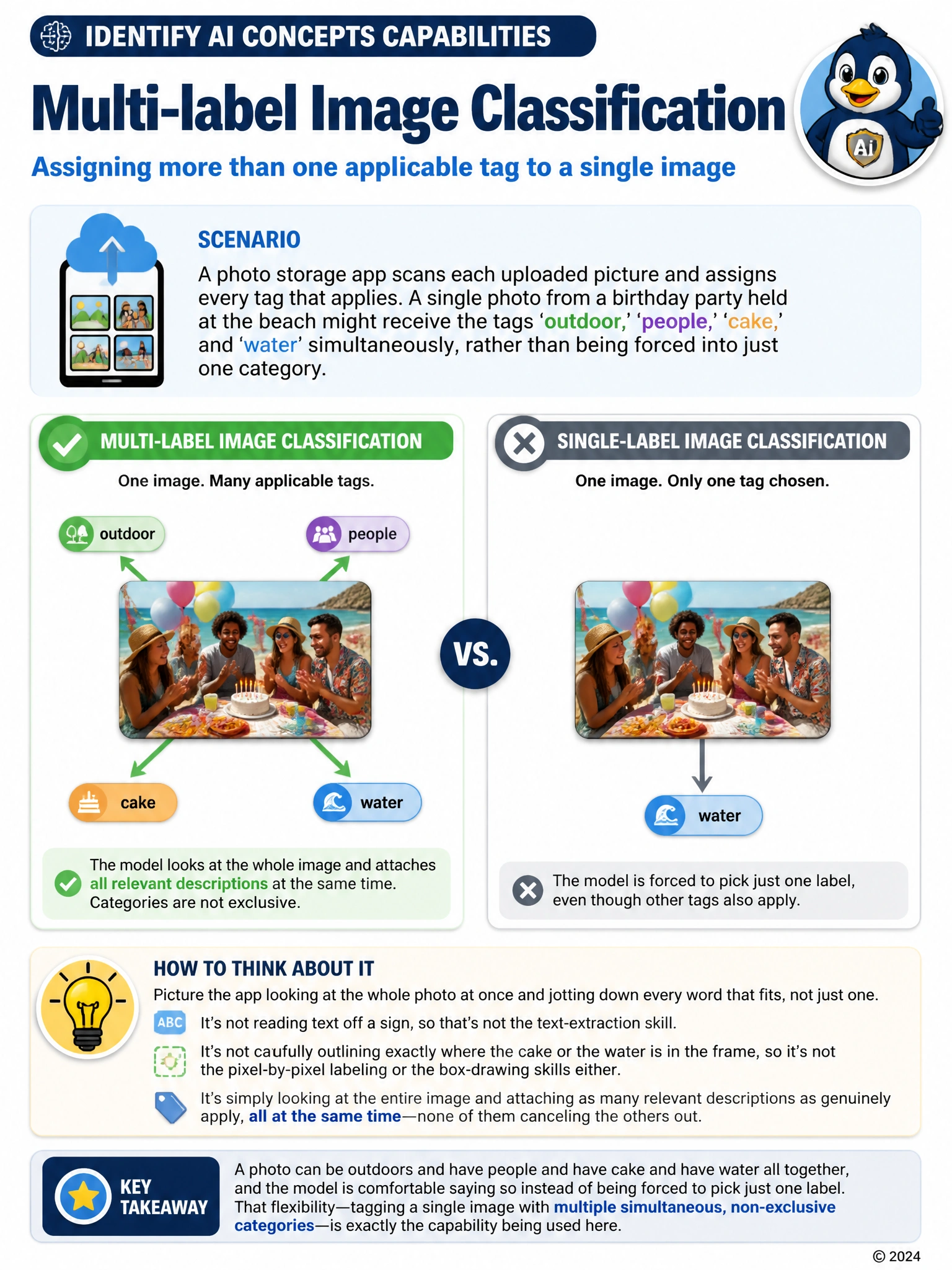
A photo storage app scans each uploaded picture and assigns every tag that applies. A single photo from a birthday party held at the beach might receive the tags 'outdoor,' 'people,' 'cake,' and 'water' simultaneously, rather than being forced into just one category. Which capability produces this kind of output?
Select an answer to reveal the explanation.
Short Explanation
Picture the app looking at the whole photo at once and jotting down every word that fits, not just one. It's not reading text off a sign, so that's not the text-extraction skill, and it's not carefully outlining exactly where the cake or the water is in the frame, so it's not the pixel-by-pixel labeling or the box-drawing skills either. It's simply looking at the entire image and attaching as many relevant descriptions as genuinely apply, all at the same time, none of them canceling the others out. A photo can be outdoors and have people and have cake and have water all together, and the model is comfortable saying so instead of being forced to pick just one label. That flexibility, tagging a single image with multiple simultaneous, non-exclusive categories, is exactly the capability being used here.
Full Explanation
The correct answer is D. The scenario describes a model that assigns several independent tags to the same photo at once, none of which exclude the others, which is the definition of multi-label image classification: the whole image gets multiple category labels simultaneously rather than being forced into a single mutually exclusive class. Option A is incorrect because optical character recognition extracts text characters that appear in an image, such as a sign or label, and would not produce conceptual tags like 'outdoor' or 'cake' unless those words were literally printed somewhere in the photo. Option B is incorrect because semantic segmentation assigns a category to every individual pixel, producing a detailed map of where each region is, rather than a short list of whole-image tags. Option C is incorrect because object detection locates specific items with bounding boxes and identifies where each one sits in the frame, which is a different output than a flat set of descriptive tags applied to the picture as a whole with no location information. Only multi-label classification matches assigning several non-exclusive tags to one entire image.