
A retail analytics team builds a regression model to predict a store's monthly revenue. The inputs include the store's square footage, the number of sales staff scheduled, and the local population within five miles. The team also includes each store's actual monthly revenue from the past three years so the model can learn the relationship between the inputs and that outcome. In this dataset, what role does 'actual monthly revenue' play?
Select an answer to reveal the explanation.
Short Explanation
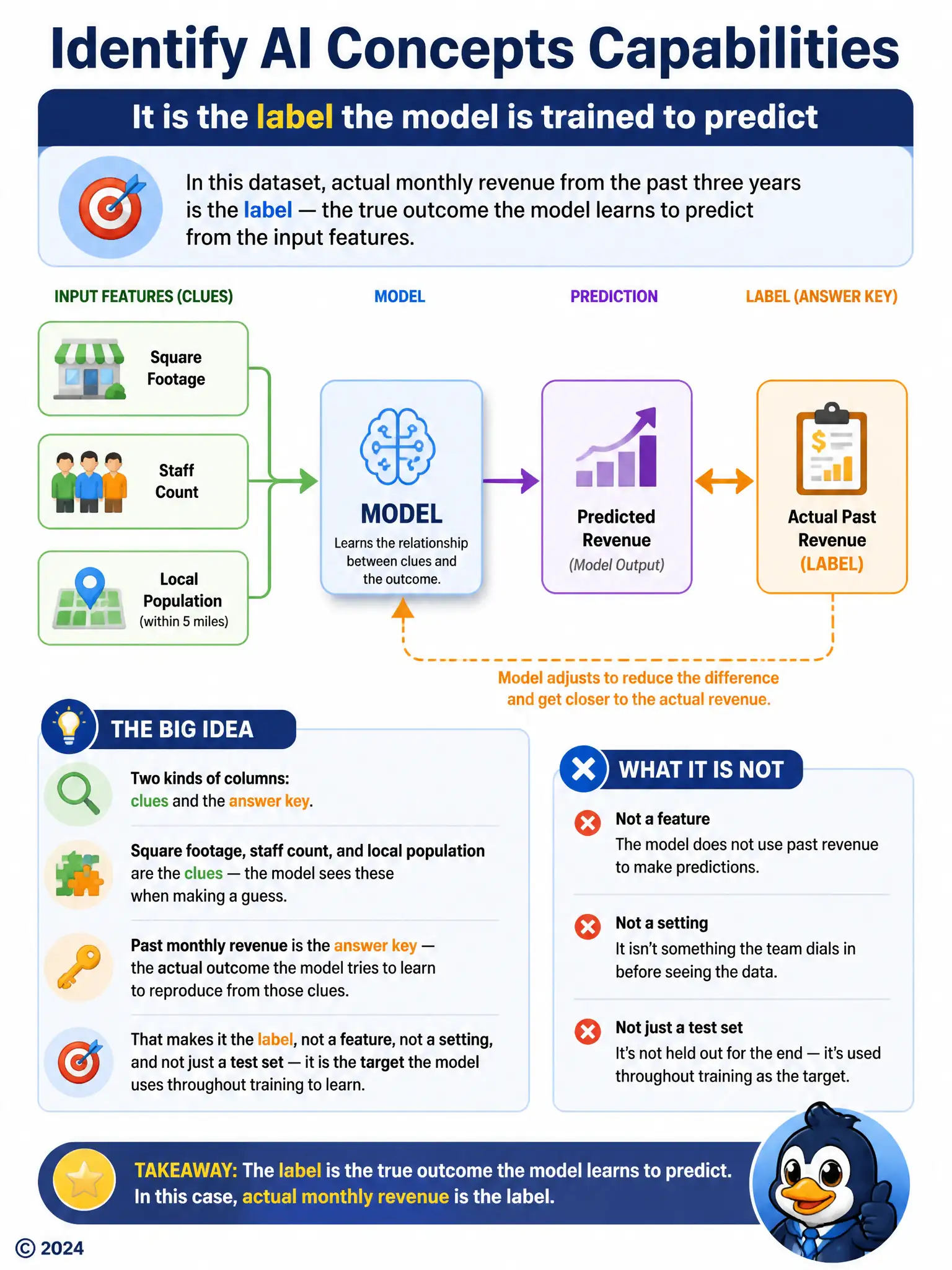
You’ve got clues and an answer key. Square footage, staff count, and local population are the clues; past monthly revenue is the answer key the model learns to predict. That makes it the label, not a feature, hyperparameter, or validation split.
Full Explanation
Actual monthly revenue is the known outcome the model is trying to learn to predict from the other inputs, which makes it the label; the model is trained by comparing its predictions against this recorded value and adjusting until it gets closer. The idea that it is a feature the model uses to make predictions is incorrect because features are the explanatory inputs fed into the model, such as square footage, staff count, and local population, and revenue is the target the model produces an estimate of, not an input used to generate that estimate. The idea that it is a hyperparameter tuned before training begins is incorrect because a hyperparameter is a setting chosen by the engineer before training, such as how many training passes to run, and it is not a value drawn from the historical data at all. The idea that it is a validation split used only to test the trained model is incorrect because a validation split is a portion of the dataset set aside purely for evaluating the trained model's performance, whereas the past revenue figures described here are used throughout training as the target value the model learns to match, not merely held back for a later check.