
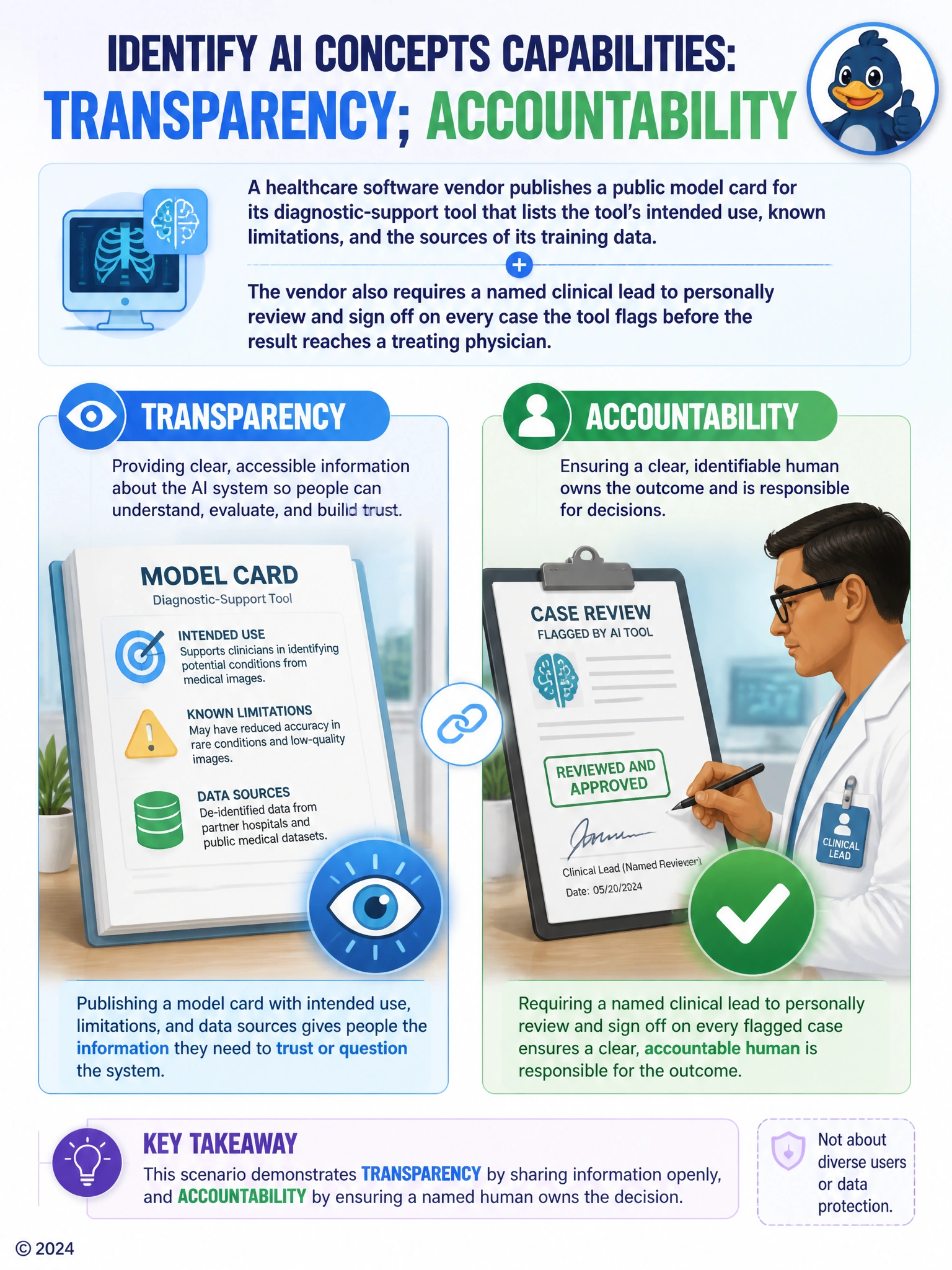
A healthcare software vendor publishes a public model card for its diagnostic-support tool that lists the tool's intended use, known limitations, and the sources of its training data. The vendor also requires a named clinical lead to personally review and sign off on every case the tool flags before the result reaches a treating physician. Which two responsible AI principles does this combination of practices demonstrate? (Select TWO.)
Select all correct answers, then click Submit.
Short Explanation
Notice this scenario is really doing two separate things at once. Publishing a model card that spells out what the tool is for, what it isn't good at, and where its training data came from is all about giving people the information they need to trust or question the system, that's the transparency piece. Naming an actual person who has to personally sign off on every flagged case before it reaches a doctor is a different move entirely, it's about making sure there's a clear, identifiable human in the loop who owns the outcome, that's the accountability piece. It's tempting to reach for a principle about designing for diverse users, but nothing here is about who can use the tool or how accessible it is. It's also tempting to think of data protection, but nothing here describes safeguarding data confidentiality, the scenario is entirely about documentation and human sign-off, not data handling.
Full Explanation
The correct answers are C and D. Publishing a model card that discloses the tool's intended use, limitations, and training data sources gives users and clinicians the information they need to understand what the system can and cannot do, which is the essence of transparency. Requiring a named clinical lead to personally review and sign off on every flagged case establishes a clear, identifiable point of human responsibility for the tool's outputs, which is the essence of accountability. Option A is incorrect because inclusiveness concerns designing a system so it works well for people with a broad range of abilities, backgrounds, and needs, and nothing in the scenario describes accommodating diverse users. Option B is incorrect because privacy and security concerns protecting the confidentiality and integrity of data used by or produced by the system, and the scenario describes documentation and sign-off practices rather than any data protection measure.