
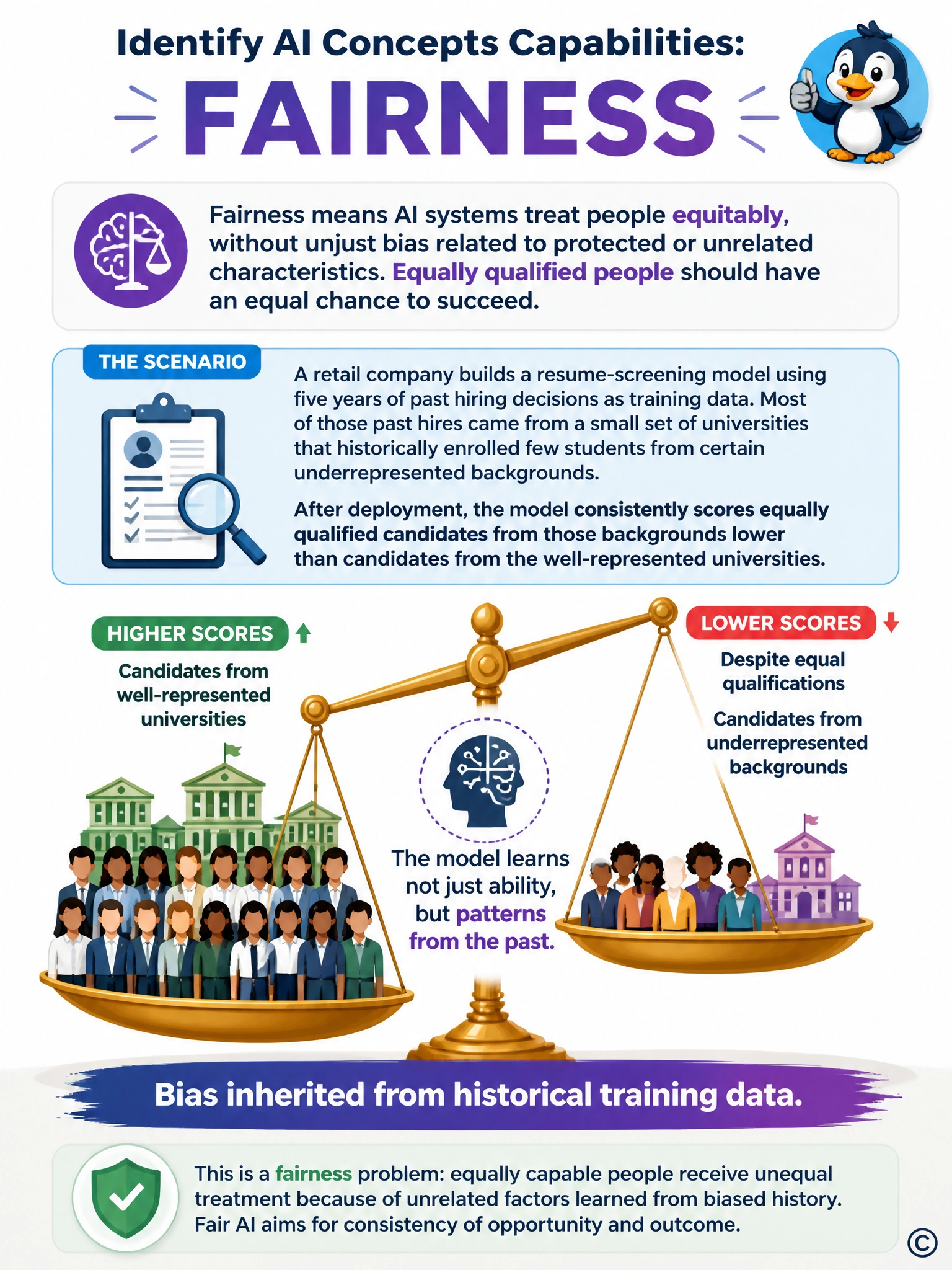
A retail company builds a resume-screening model using five years of past hiring decisions as training data. Most of those past hires came from a small set of universities that historically enrolled few students from certain underrepresented backgrounds. After deployment, the model consistently scores equally qualified candidates from those backgrounds lower than candidates from the well-represented universities. Which responsible AI principle is most directly at risk in this scenario?
Select an answer to reveal the explanation.
Short Explanation
When a hiring model learns from years of past decisions, it doesn't just learn what makes a good candidate, it also absorbs whatever patterns were baked into those past decisions, including who historically got hired from where. If the training data skews heavily toward a handful of schools, the model can end up treating candidates from those schools as the template for success and scoring everyone else lower, even when they are just as qualified. That is a textbook fairness problem: equally capable people getting unequal treatment because of a factor that has nothing to do with their actual ability. The other options describe real concerns but not this one. Keeping a system running safely and consistently is a different issue from whether its scores are skewed. Being upfront about how a system works and what it can't do doesn't fix unequal scoring by itself. And having someone officially responsible for the system's outcomes matters, but it addresses governance, not the root cause of why the scores are skewed in the first place.
Full Explanation
The correct answer is B. The model is producing systematically unequal outcomes for equally qualified candidates based on a characteristic tied to their background, which is precisely the kind of biased treatment the fairness principle is meant to catch and prevent. Option A is incorrect because reliability and safety concerns whether a system performs consistently and safely under the conditions it was designed for, such as avoiding crashes or unsafe recommendations, not whether its scores are skewed across groups. Option C is incorrect because transparency is about disclosing how a system works, what data it uses, and what its limitations are so users can make informed judgments; the scenario does not describe a disclosure problem, it describes an outcome problem. Option D is incorrect because accountability concerns having identifiable people or processes responsible for a system's outcomes and able to intervene when something goes wrong; while accountability structures might eventually help catch this issue, the scenario itself describes the biased scoring pattern, which is a fairness violation at its core.