
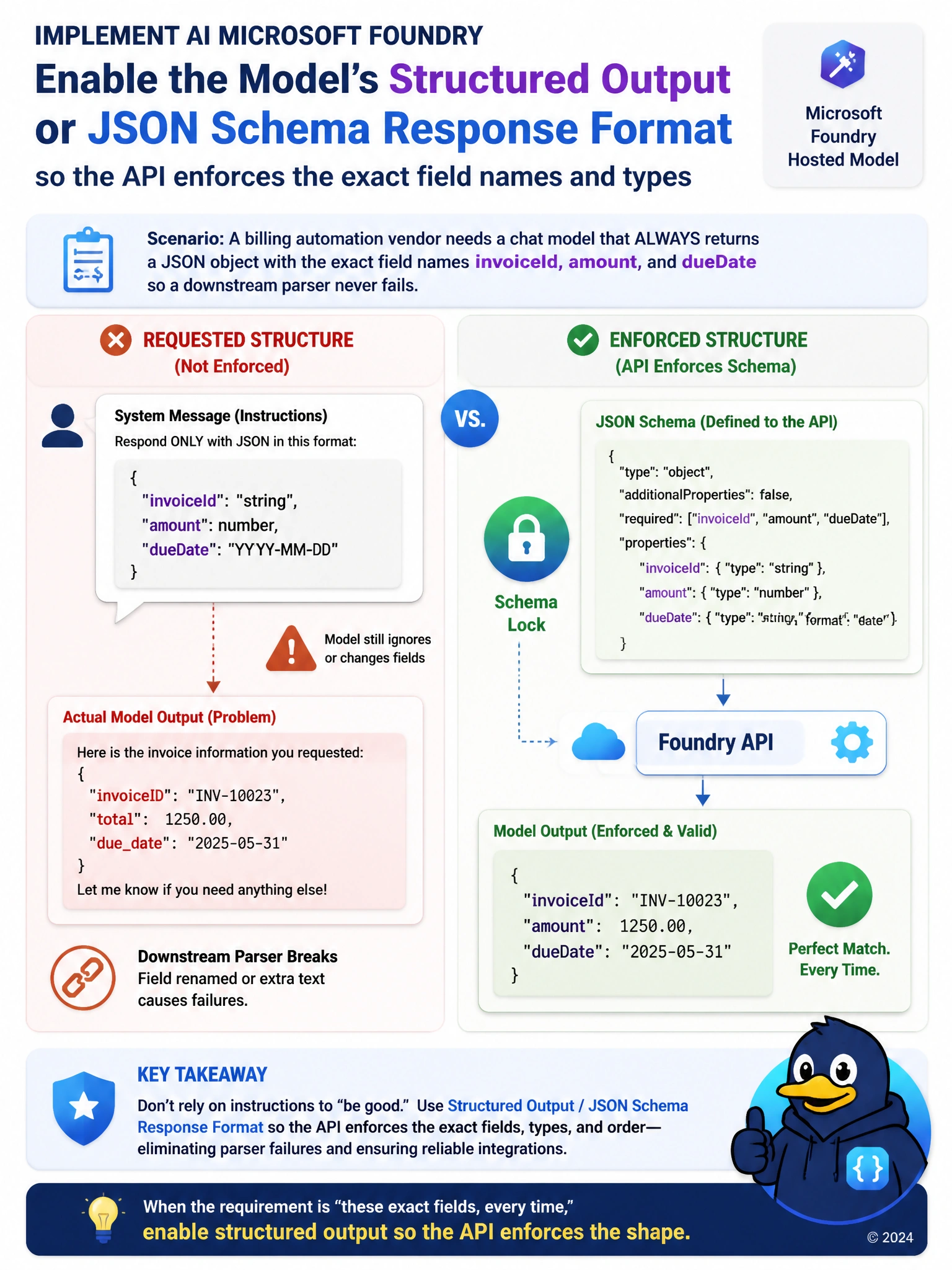
A billing automation vendor deploys a Foundry-hosted chat model that must always return output as a JSON object with the exact field names 'invoiceId', 'amount', and 'dueDate' so a downstream parser never fails. The team has already tried detailed system message instructions, but the model still occasionally adds extra commentary or renames a field. Which approach should the team try next, before starting a costly fine-tuning project?
Select an answer to reveal the explanation.
Short Explanation
Picture a parser downstream that breaks the moment a field gets renamed or an extra sentence sneaks in before the JSON. Telling the model nicely to behave, again and again in the system message, is like asking someone to always sign a form the same way by hand: most of the time it works, and then one day it does not. What actually locks the format in place is telling the API itself what shape the answer has to take, so it is enforced at the response level rather than hoped for at the instruction level. Turning down randomness helps with tone, not structure. Giving the response more room to finish helps if it was getting cut off, but that is not the problem here. Switching how the deployment is provisioned changes speed and capacity, not the shape of the text coming back. When the requirement is 'these exact fields, every time,' reach for the feature that enforces schema directly instead of layering on more prose instructions.
Full Explanation
The correct answer is B. Structured output support lets a developer define a JSON schema that the API enforces on the response, guaranteeing the exact field names and types requested instead of relying on the model to interpret plain-language instructions correctly every time. This directly solves the reported problem: renamed fields and stray commentary. Option A is incorrect because lowering temperature reduces wording variation but does not enforce a schema; the model can still omit a field or add extra text confidently and consistently. Option C is incorrect because the failure described is not truncation, it is structural non-compliance, so giving the response more room to finish does not stop the model from renaming a field or adding commentary. Option D is incorrect because switching to provisioned throughput changes latency and throughput consistency for high-volume traffic, not whether the returned text conforms to a required JSON structure. Structured output is the tool built specifically for enforcing response format, making it the right next step before considering fine-tuning, which would be a heavier investment for a problem schema enforcement already solves.