
A team building a loan-inquiry assistant in Microsoft Foundry needs the workflow to check the model's confidence in its answer and, when confidence is low, route the conversation to a human loan officer instead of returning an uncertain answer to the applicant. Which capability should they use to implement this branching behavior between the retrieval step and the final response?
Select an answer to reveal the explanation.
Short Explanation
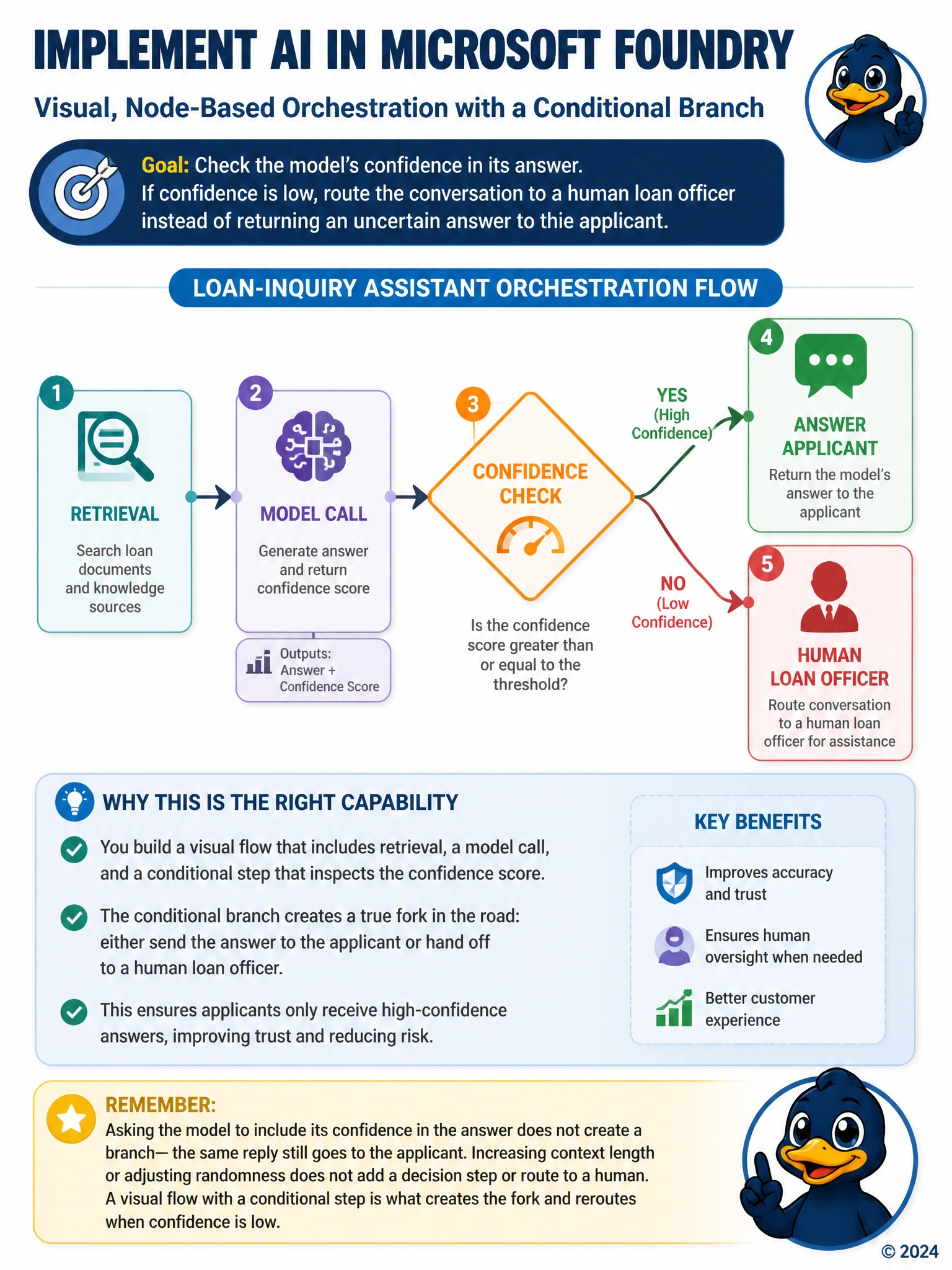
What is needed here is a fork in the road, somewhere in the pipeline that checks how confident the answer is and sends the conversation one of two different ways depending on the result: straight to the applicant, or over to a human loan officer. That kind of explicit branching is exactly what a visual flow with a conditional step is for, you build the retrieval, the model call, and then a decision point that inspects the confidence score and picks a path. Just asking the model to mention its confidence inside its answer does not create that fork at all, the same reply still goes straight to the applicant either way, uncertain or not. Giving the model more room to read text does not add any decision-making step either, it just changes how much input it can take in. And turning up the randomness dial only changes how varied the wording sounds when the model is unsure, it does not catch that uncertainty and reroute the conversation to a person.
Full Explanation
The correct answer is A. A node-based orchestration flow lets the team wire together discrete steps, retrieval, model call, and a conditional branch, so the confidence output from one step can be evaluated and used to route the conversation down one of two paths: returning the model's answer or handing off to a human loan officer. That explicit branching logic is what the scenario requires. Option B is incorrect because asking the model to mention its confidence inside the same free-text reply still sends that reply straight to the applicant either way, it does not actually intercept low-confidence cases and redirect them to a human before the applicant sees an uncertain answer. Option C is incorrect because a larger context window affects how much input text the model can process, not whether the workflow branches based on a confidence check. Option D is incorrect because raising temperature increases the variety of wording the model generates, which does not create a decision point that can detect low confidence and escalate to a person; it would make uncertain answers more varied, not routed away from the applicant.