
A gaming forum's moderation team deploys a Foundry-hosted model to draft replies to player posts. They want the content safety filter to block violent content at a low severity threshold, since even mild violent language upsets younger players, while allowing moderate sexual-innuendo humor common in the community to pass more often. What should they configure?
Select an answer to reveal the explanation.
Short Explanation
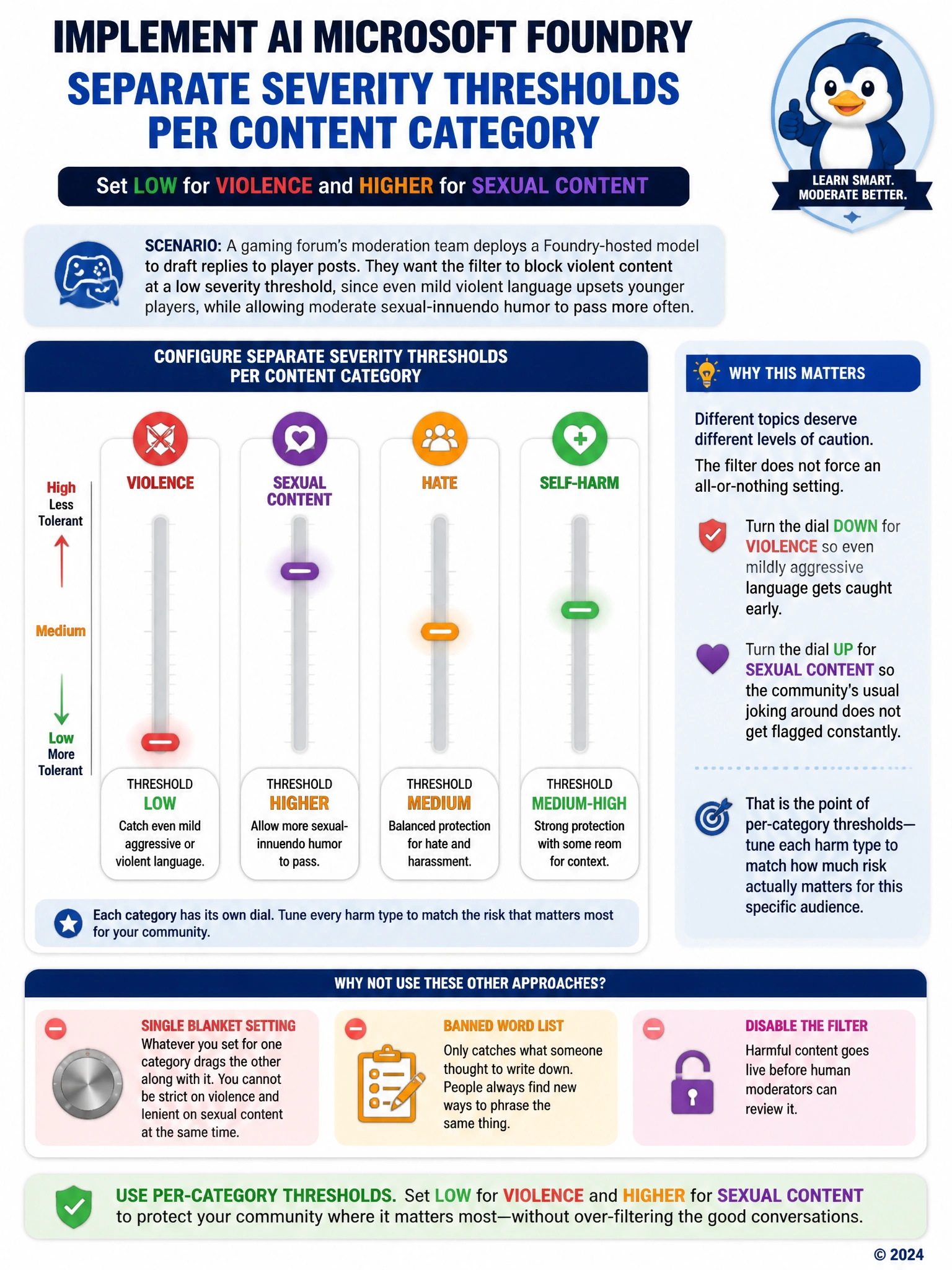
Different topics deserve different levels of caution, and the good news is the filter does not force an all-or-nothing setting. The forum can turn the dial way down on tolerance for violent content, so even mildly aggressive language gets caught early, while turning the dial up a bit for sexual content so the community's usual joking around does not get flagged constantly. That is the point of per-category thresholds, tune each harm type to match how much risk actually matters for that specific audience. A single blanket setting cannot do that split job, whatever you set for one category drags the other along with it. Typing in a list of banned words sounds precise but it only catches what someone thought to write down, and people always find new ways to phrase the same thing. And just switching the filter off and hoping human moderators catch everything after the fact means the harmful post is already live before anyone steps in.
Full Explanation
The correct answer is A. Azure AI Foundry's content safety filtering lets a team set independent severity thresholds for different harm categories, so the forum can configure a strict, low threshold that blocks violent content early while allowing a comparatively higher threshold for sexual content so mild innuendo humor typical of the community is not over-blocked. This matches the two different tolerance levels the team wants. Option B is incorrect because one uniform threshold across categories cannot express the team's actual requirement, tightening violence sensitivity would also tighten sexual-content sensitivity, and loosening one to fit community humor would loosen the other, which is not what they want for violent content. Option C is incorrect because a manually typed keyword list only catches exact wording the team thought to include and misses paraphrases or new phrasing, unlike the built-in categorized filter, which uses trained classifiers. Option D is incorrect because disabling the filter removes automated protection entirely and shifts the full moderation burden to humans reviewing content only after it has already been published, which does not prevent the harmful content from appearing in the first place.