
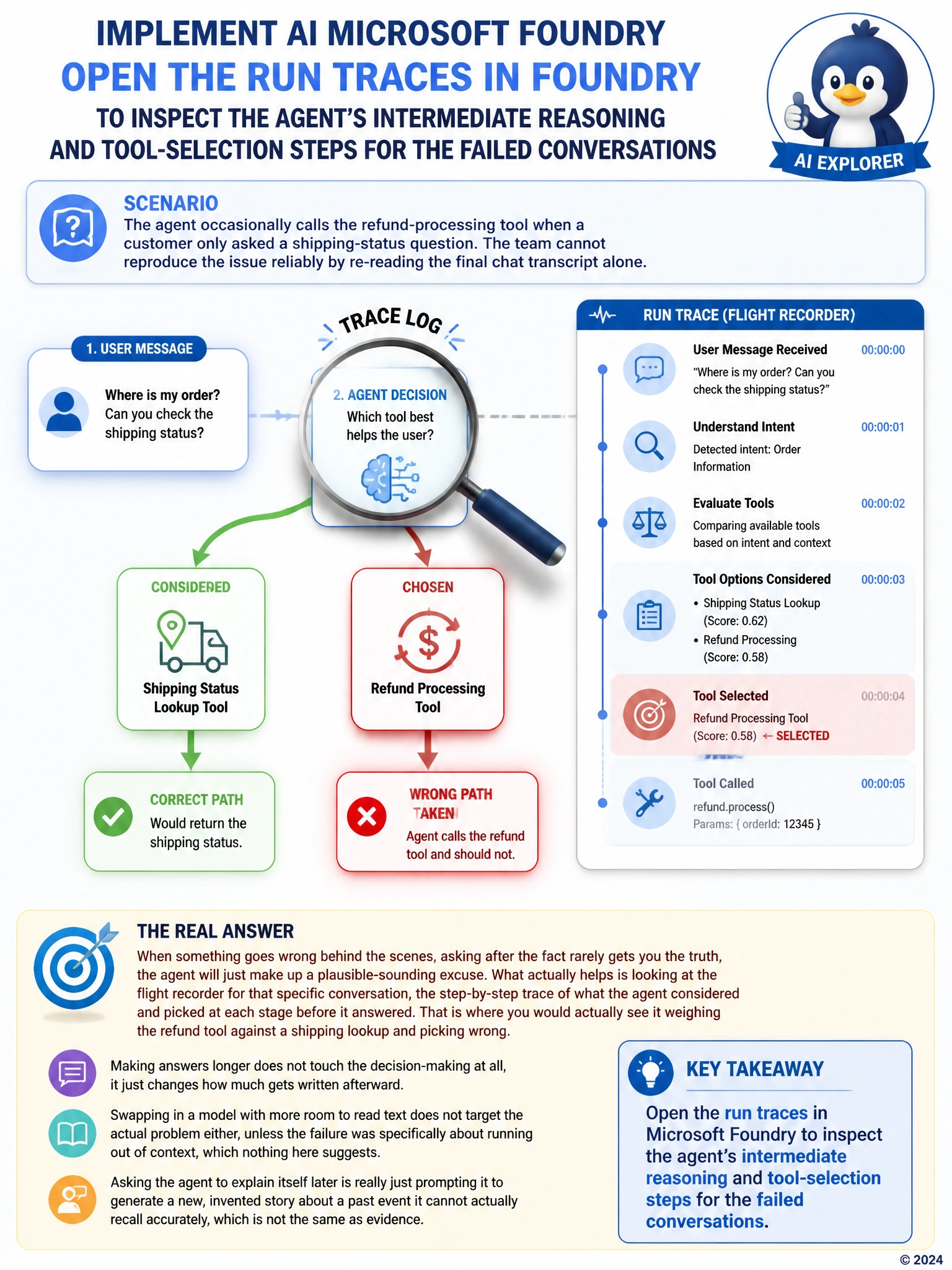
An agent built in Microsoft Foundry occasionally calls the refund-processing tool when a customer only asked a shipping-status question. The team cannot reproduce the issue reliably by re-reading the final chat transcript alone. What should they use to find out why the agent chose the wrong tool on those specific runs?
Select an answer to reveal the explanation.
Short Explanation
When something goes wrong behind the scenes, asking after the fact rarely gets you the truth, the agent will just make up a plausible-sounding excuse. What actually helps is looking at the flight recorder for that specific conversation, the step-by-step trace of what the agent considered and picked at each stage before it answered. That is where you would actually see it weighing the refund tool against a shipping lookup and picking wrong. Making answers longer does not touch the decision-making at all, it just changes how much gets written afterward. Swapping in a model with more room to read text does not target the actual problem either, unless the failure was specifically about running out of context, which nothing here suggests. And asking the agent to explain itself later is really just prompting it to generate a new, invented story about a past event it cannot actually recall accurately, which is not the same as evidence.
Full Explanation
The correct answer is D. Foundry's tracing captures the intermediate steps an agent takes between receiving a message and producing a final answer, including which tools it considered and selected and the reasoning that led there; reviewing traces for the specific failed runs is the direct way to see why the refund tool was chosen instead of a shipping-status lookup. Option A is incorrect because a longer response limit changes how much text the agent can output, not what internal decision led it to pick a tool, so it would not reveal the cause of the misrouting. Option B is incorrect because a larger context window lets the model consider more input tokens at once, which does not diagnose a tool-selection error and may not be related to the failure at all. Option C is incorrect because asking the agent after the fact to explain a past decision produces a generated, after-the-fact justification rather than an accurate account of what actually happened during that run; the agent has no reliable memory of its own internal reasoning process to report back.