
A helpdesk platform processes 50,000 incoming support tickets per day and only needs to sort each one into one of six predefined categories, such as billing or password reset. The team compares options in the Azure AI Foundry model catalog and finds a small, low-cost model already meets the accuracy target for this sorting task in benchmark tests. What should the team do?
Select an answer to reveal the explanation.
Short Explanation
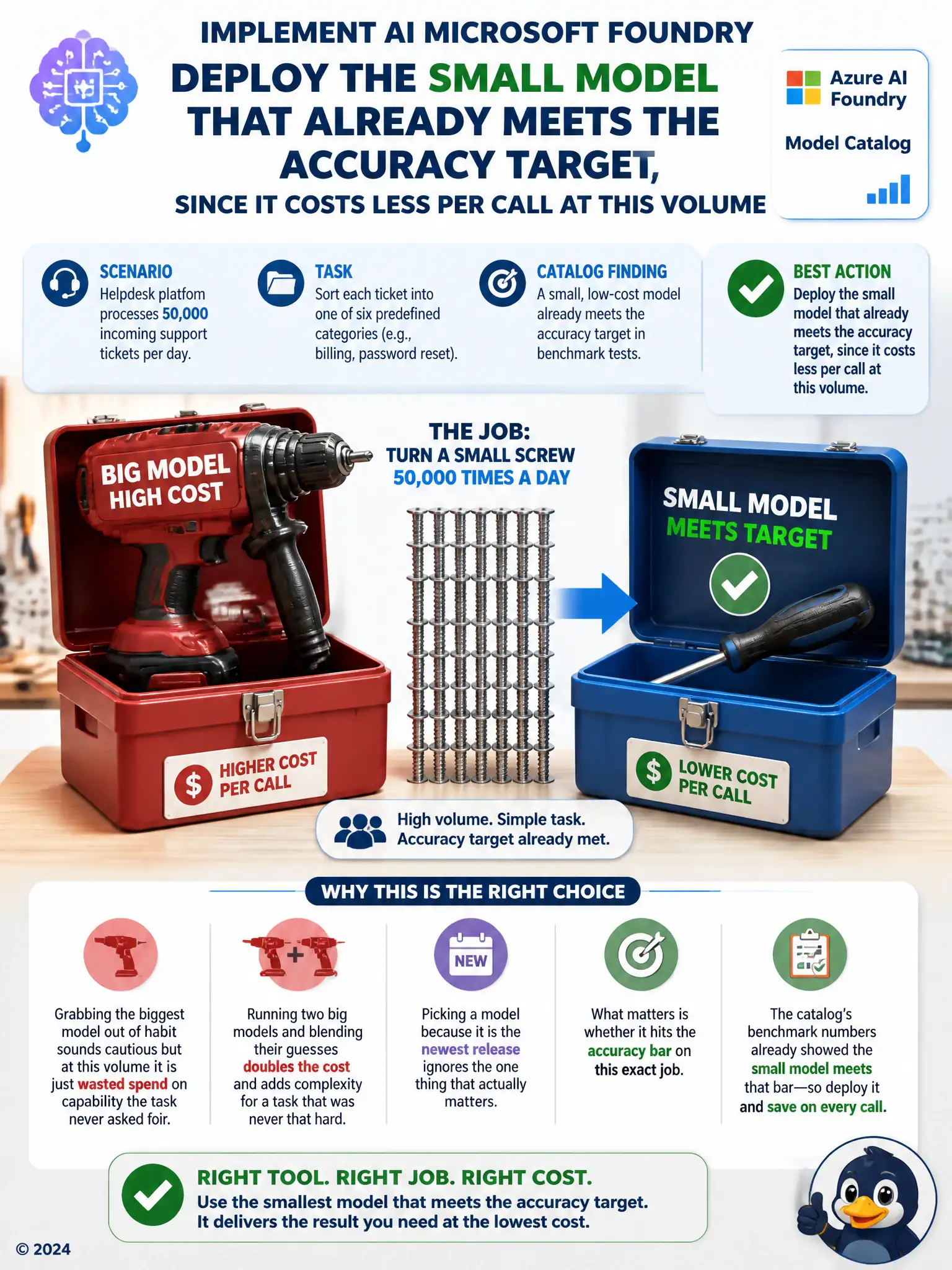
You can deploy the small model that already meets your accuracy target, since it's cheaper per call at 50,000 tickets daily. The benchmark already proves the small model can do the six-way sorting job, so bigger models just burn budget. Release-date choices or blended large models ignore the evidence.
Full Explanation
The correct choice is to deploy the small model that already meets the accuracy target, since it costs less per call at this volume. When benchmark results show that a small, inexpensive model already meets the accuracy bar for a simple, well-defined task like sorting tickets into six categories, deploying that model minimizes cost per call across 50,000 daily requests without sacrificing the quality the team actually needs; the model catalog's benchmark data exists precisely to support this kind of size-to-task matching. The largest flagship model in the catalog regardless of benchmark results is wrong because model size does not automatically translate into safety or reliability for a narrow classification task, and paying for a larger model's extra capacity when it is not needed just inflates cost at high volume for no measurable benefit. Running two different large models and averaging their category predictions for every ticket is wrong because running two large models and averaging their outputs roughly doubles inference cost and adds latency and complexity, which is a poor trade for a task the benchmarks already show a single small model handles adequately. Skipping the model catalog benchmarks entirely and choosing a model based on its release date is wrong because release date says nothing about a model's fitness for a specific task; ignoring the catalog's benchmark comparisons in favor of recency abandons the evidence the team already gathered.