
A subscription software company's Foundry-deployed support chatbot must always reflect the current pricing page, which marketing updates every week with new tiers and discounts. The team wants the chatbot's answers to stay accurate without retraining the underlying model each time pricing changes. Which approach best meets this need?
Select an answer to reveal the explanation.
Short Explanation
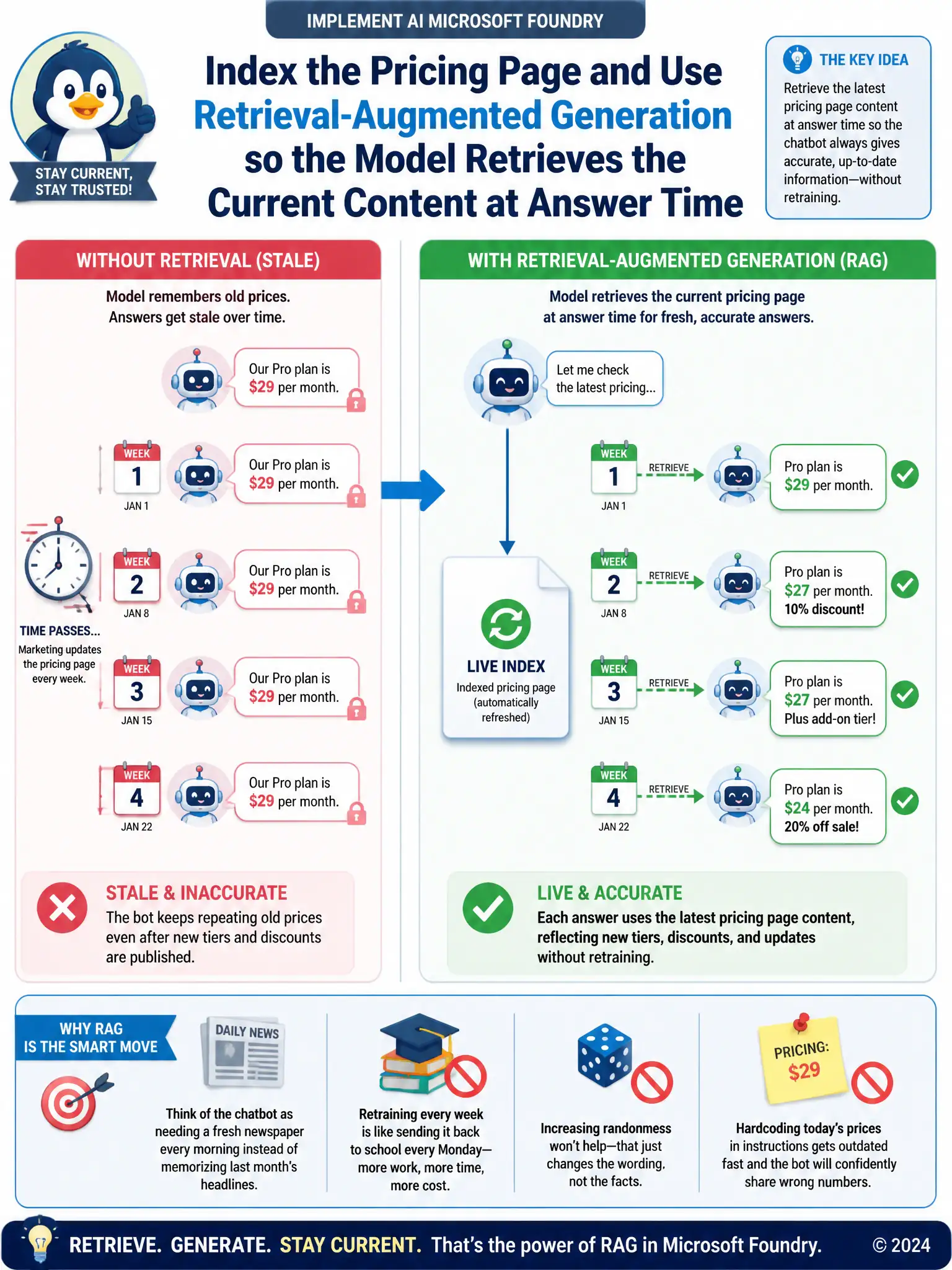
When pricing changes weekly, you want the chatbot to check a live, searchable copy of the pricing page at answer time, not memorize stale numbers. That's retrieval-augmented generation: the model stays the same, but it gets fresh facts when someone asks. Fine-tuning every week is overkill, randomness doesn't add facts, and a one-time system message goes stale fast.
Full Explanation
The best approach is to index the pricing page and use retrieval-augmented generation so the model retrieves the current content at answer time. This lets the chatbot pull the latest indexed version of the pricing page at the moment a question is asked, so as soon as the source document is re-indexed after a weekly update, answers reflect the new tiers and discounts without touching the model itself. This keeps the knowledge current while avoiding retraining. The fine-tuning approach is incorrect because fine-tuning bakes information into the model's weights through a training run; doing that every week to chase a fast-changing pricing page is slow, costly, and unnecessary when the same freshness can be achieved by updating a retrieval index instead. The temperature-raising approach is incorrect because temperature controls the randomness of the model's word choices, not its access to facts; raising it would make pricing answers less reliable, not more current. The one-time system-message approach is incorrect because a static system message is fixed at deployment time; once pricing changes, that hardcoded block becomes outdated and the chatbot will keep quoting stale figures until someone manually edits the message, which is exactly the maintenance burden retrieval-augmented generation avoids.