
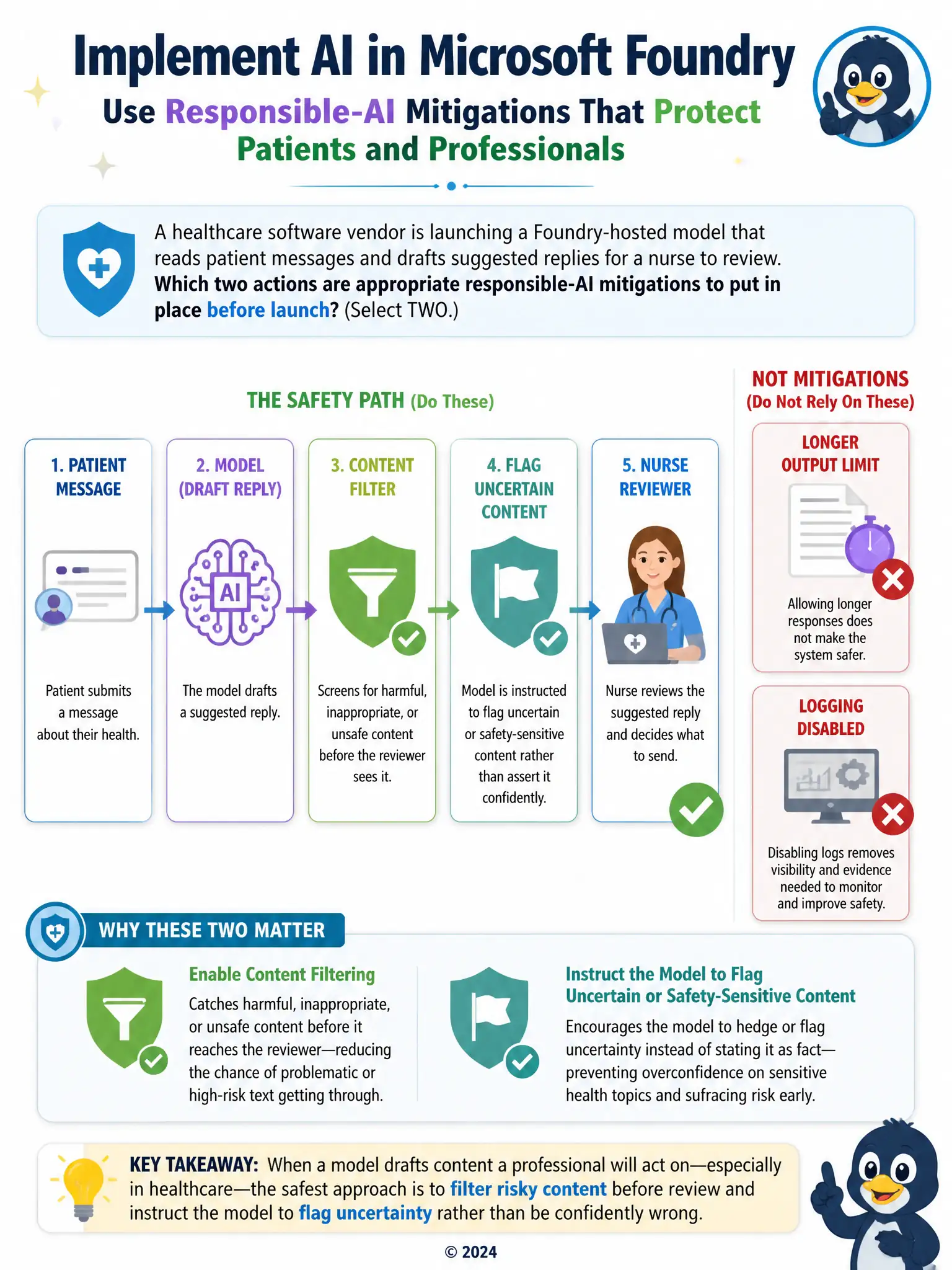
A healthcare software vendor is preparing to launch a Foundry-hosted model that will read patient-submitted messages and draft suggested replies for a nurse to review before sending. Which two actions are appropriate responsible-AI mitigations to put in place before launch? (Select TWO.)
Select all correct answers, then click Submit.
Short Explanation
When a model drafts patient replies, you need safeguards that catch bad output and stop overconfidence. Enable content filtering to block harmful or inappropriate text before a nurse sees it, and use a system message that tells the model to flag uncertain or safety-sensitive content instead of stating it as fact.
Full Explanation
The appropriate responsible-AI mitigations to put in place before launch are enabling content filtering and writing a system message that instructs the model to flag uncertain or safety-sensitive content rather than asserting it confidently. Enabling content filtering reduces the chance that harmful, offensive, or otherwise inappropriate generated text ever reaches the nurse reviewing drafts. The system message that pushes the model to flag rather than assert uncertain or safety-sensitive content directly reduces the risk of a confidently wrong suggestion slipping past review in a healthcare setting. Both are genuine responsible-AI mitigations for this scenario. Increasing the maximum output token limit is incorrect because a larger output token limit only changes how much text the model is allowed to generate; it does nothing to reduce risk and, if anything, gives more room for unreviewed detail to appear in a draft. Turning off request and response logging is incorrect because disabling logging removes the audit trail needed to review what the model produced and why, which undermines oversight and accountability rather than supporting it, and any latency saved is not worth losing that traceability in a patient-facing healthcare workflow.