
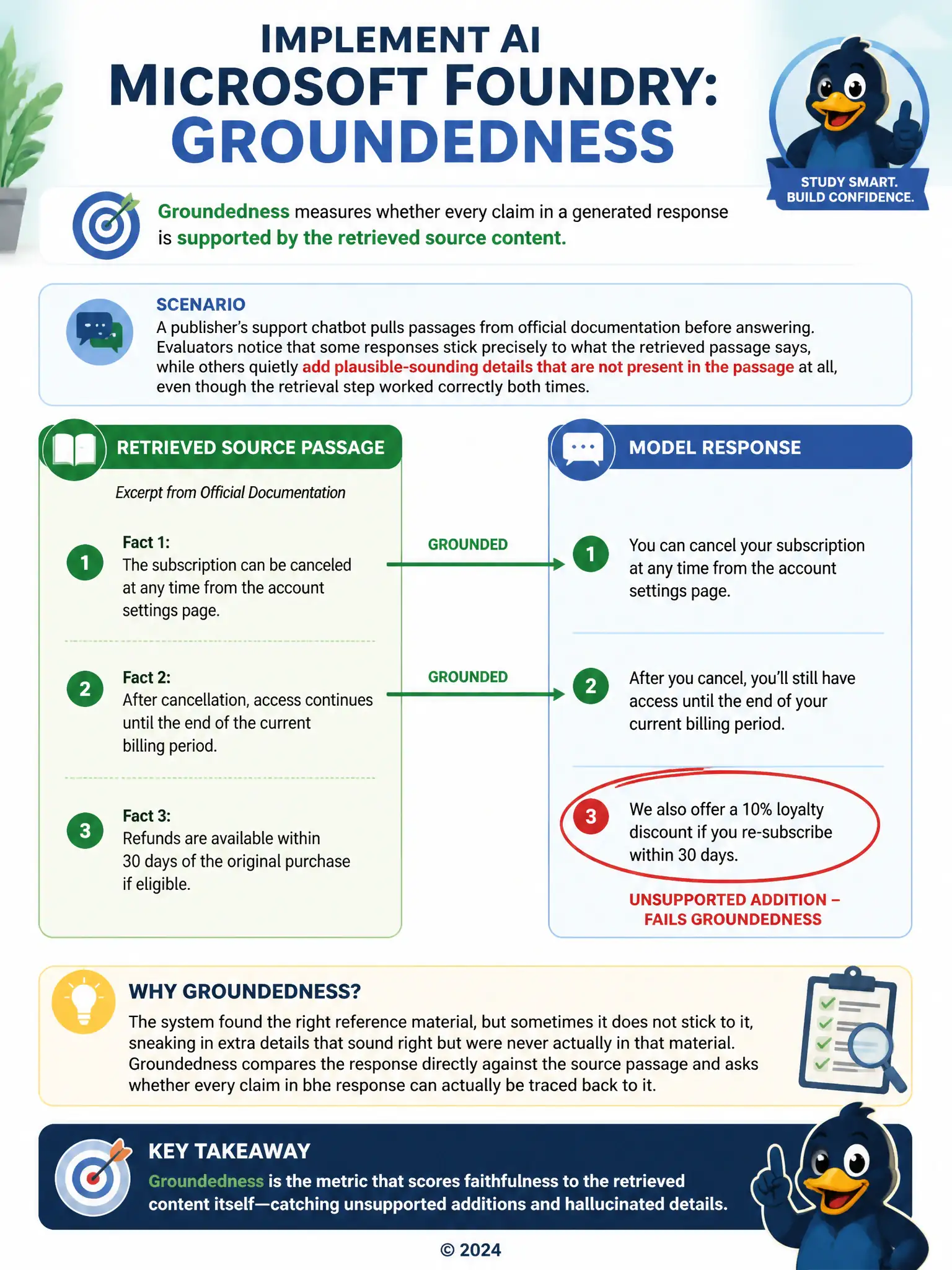
A publisher's support chatbot pulls passages from official documentation before answering. Evaluators notice that some responses stick precisely to what the retrieved passage says, while others quietly add plausible-sounding details that are not present in the passage at all, even though the retrieval step worked correctly both times. Which evaluation metric is specifically designed to score whether a generated response is supported by its retrieved source content?
Select an answer to reveal the explanation.
Short Explanation
When the bot pulls the right docs but still invents details, you need groundedness. It checks whether every claim in the answer can be traced back to the retrieved passage. Fluency, coherence, and similarity don't answer that source-support question.
Full Explanation
Groundedness is the evaluation metric built specifically to measure whether a generated response's claims are actually supported by the retrieved or provided source content, which directly captures the failure being described: passages retrieved correctly, but the model sometimes adds claims not present in them. The fluency metric measures how natural and grammatically well-formed the language is, and responses can read perfectly smoothly while still fabricating unsupported details, so it would not catch this problem. The coherence metric measures whether responses are logically organized and internally consistent, which says nothing about whether their content matches the source passage they were supposed to be grounded in. The similarity metric typically compares generated responses against reference answers for overlap in wording or meaning, not against retrieved source passages for factual support, so it targets a different comparison than the one needed here.