
A logistics company operates across the European Union and must keep all AI processing within EU data centers for regulatory reasons. When browsing the Foundry model catalog, the team finds that the specific frontier model their prototype was built on is not offered as a deployment option in any EU region. What should the team do?
Select an answer to reveal the explanation.
Short Explanation
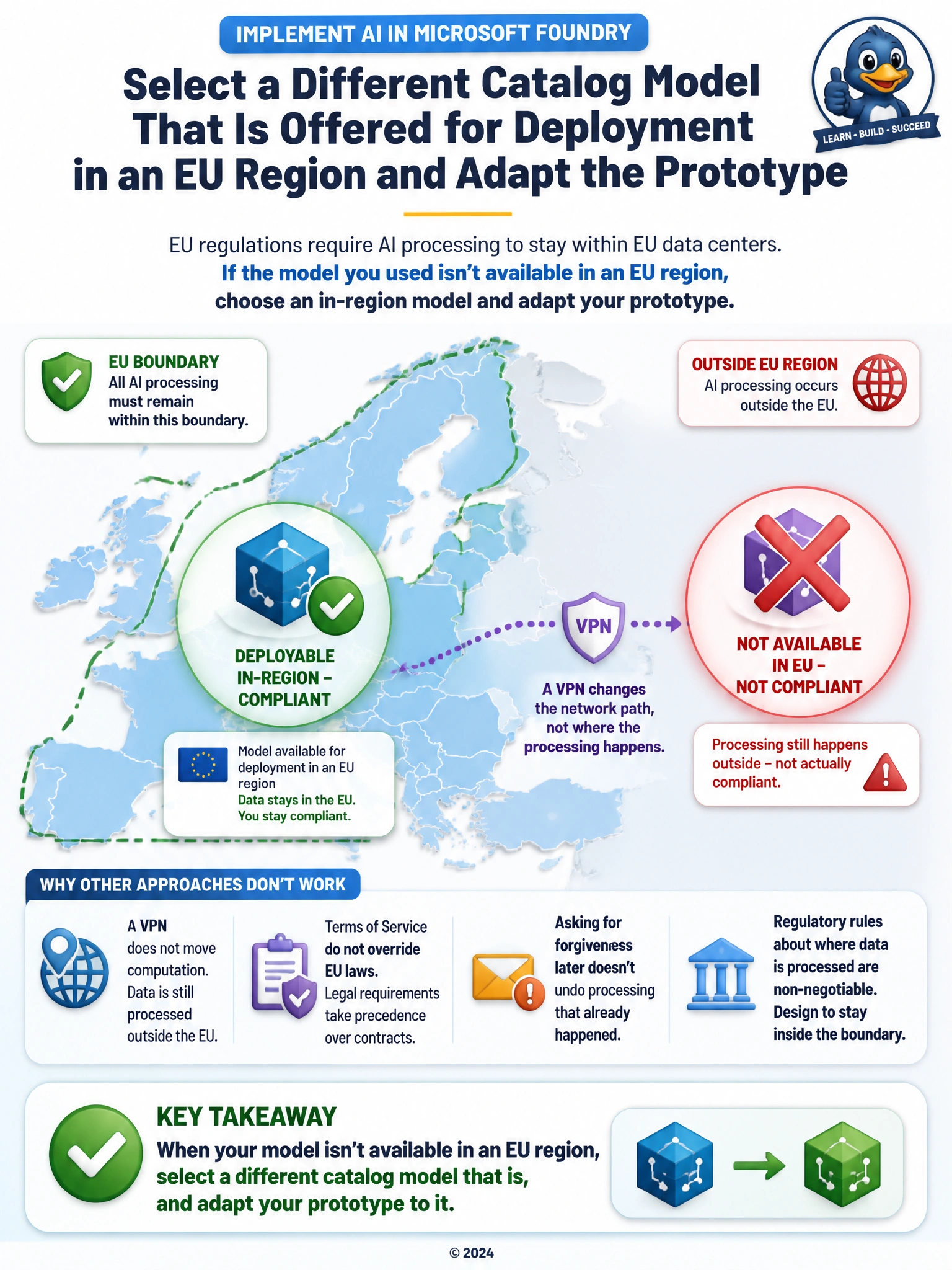
When a rule about where data can physically be processed is non-negotiable, the only real fix is to change what fits inside that boundary, not to disguise where the boundary was crossed. If the model that inspired the prototype simply is not available in an EU deployment region, the practical move is to look at what is available in-region and adapt the design to that instead. Trying to mask where traffic is coming from with something like a VPN does not change where the actual computation happens, the data still gets processed outside the region even if the network path looks different, so the core violation is still there. Treating a vendor's terms of service as overriding a country or region's legal requirements gets the hierarchy backwards, and asking for forgiveness after the fact does not undo processing that already happened somewhere it should not have.
Full Explanation
The correct answer is B. Since regional data residency is a hard regulatory constraint, the only compliant path is to choose a catalog model that is actually deployable within an EU region and adjust the prototype to work with it, rather than trying to work around where the data is processed. Option A is incorrect because routing traffic through a VPN changes where the traffic appears to originate on the network, not where the model actually executes and processes the data, so the underlying compliance problem is not solved, it is only obscured. Option C is incorrect because a cloud provider's terms of service do not override the regulatory data residency requirements a company operating in the EU is subject to, so this reasoning inverts the actual legal relationship. Option D is incorrect because launching first and seeking a compliance exception afterward exposes the company to the very violation it is trying to avoid; residency requirements need to be satisfied before processing happens, not retroactively excused.