
A content-moderation platform hosts a Foundry-deployed model for a public forum. The team wants to strictly block violent language in what users type into the box, since that could indicate a real threat, but they do not want the model prevented from generating its own responses that reference violence when discussing safety resources, news summaries, or crisis-support information. What configuration addresses this?
Select an answer to reveal the explanation.
Short Explanation
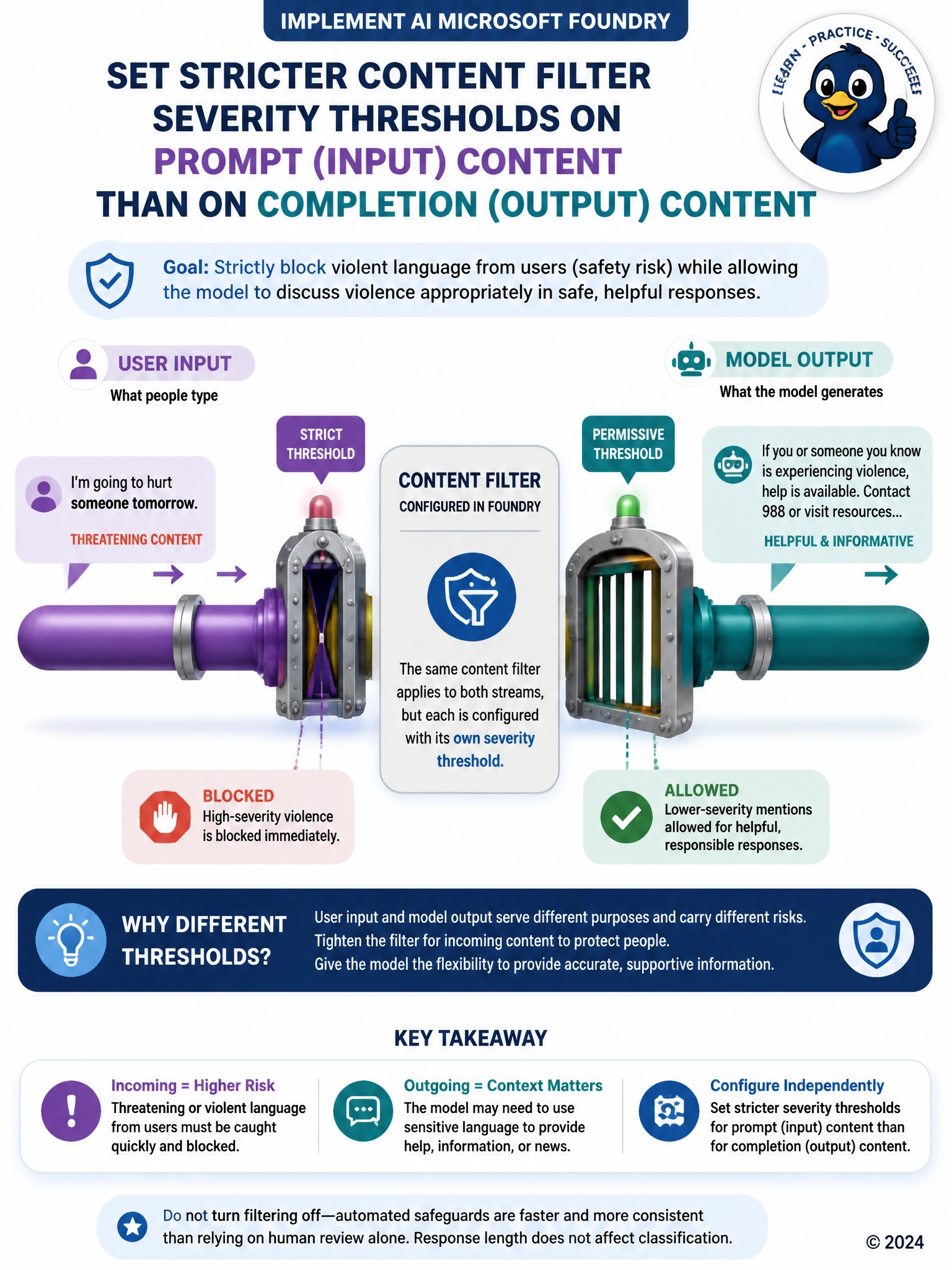
The forum has two very different concerns wearing the same word 'violence.' A user typing something threatening is a safety risk that should be caught immediately, but a model calmly explaining where to find crisis resources or summarizing a news event will naturally use some of that same vocabulary and should not get flagged the same way. Treating both directions identically forces an impossible choice: either the filter is loose enough to miss real threats, or strict enough to also silence legitimate safety information. The fix is recognizing that what comes in from users and what goes out from the model are separate streams that can be judged by separate standards, tightening the screen on the incoming side while giving the outgoing side room to discuss a sensitive topic responsibly. Turning filtering off entirely just trades an automated safeguard for a slower, less reliable human one, and padding response length has nothing to do with how content gets classified in the first place.
Full Explanation
The correct answer is A. Foundry content filters can be configured with independent severity thresholds for prompt content and completion content, so the team can set a strict, low-tolerance threshold on what users submit while allowing a more permissive threshold on the model's own generated responses that legitimately reference violence in a safety or informational context. Option B is incorrect because applying one uniform threshold to both directions would either block the legitimate safety-resource responses along with user threats, or loosen screening on user input to the point it misses real threats, failing one side of the stated requirement. Option C is incorrect because disabling filtering removes the automated safeguard against threatening user content entirely and shifts all risk onto manual review, which does not scale to a public forum's volume and leaves harmful posts live until a human catches them. Option D is incorrect because token limits control response length, not content classification, and padding a response with more text does nothing to change whether violent content is detected or how it is judged.