
A research group has 2 million archived scientific PDFs that need a one-paragraph summary generated for each. The job will run overnight with no user waiting on results, and the team is choosing a deployment approach that minimizes cost since immediate response time does not matter. Which deployment choice fits this workload?
Select an answer to reveal the explanation.
Short Explanation
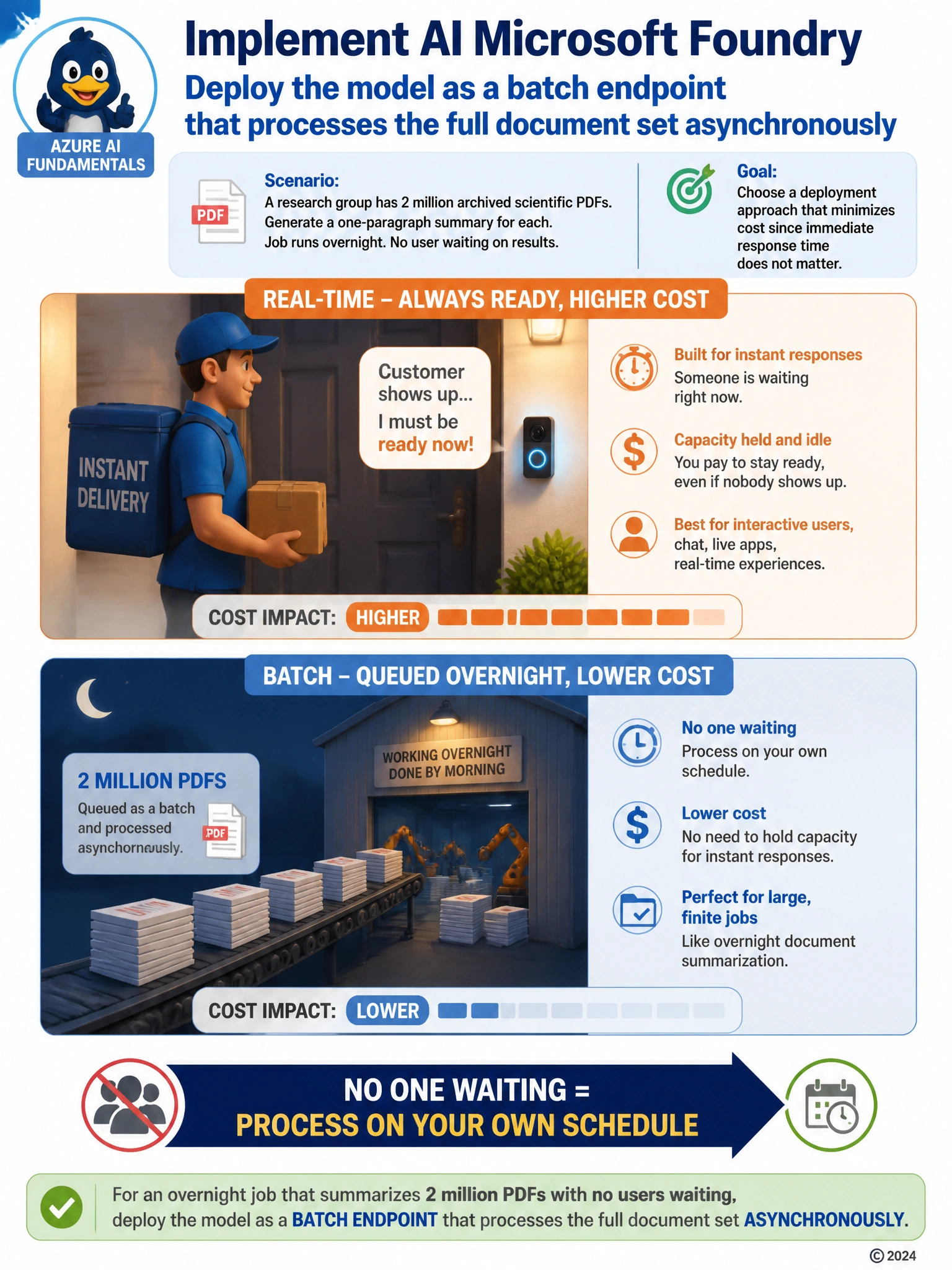
Picture the difference between a cashier who has to be ready the instant a customer walks up versus a warehouse crew processing a pallet of orders overnight with nobody watching the clock. Real-time and dedicated-capacity deployments are built for the cashier situation, someone is waiting right now, so the system has to stay ready and responsive, and that readiness costs money whether or not anyone shows up. This job is the warehouse situation: a known, finite pile of documents, nobody waiting, done by morning is fine. The deployment style built for exactly that is one that queues the whole batch and works through it at its own pace, which also happens to be the cheaper option since it does not need to hold capacity in reserve for instant answers. Autoscaling for sudden spikes is solving yet another problem, unpredictable live traffic, which is not what an overnight archive job looks like at all.
Full Explanation
The correct answer is C. A batch endpoint is built exactly for this pattern: a large, known volume of work with no live user waiting on each response, so requests can be queued and processed at a pace that favors lower cost over speed, which matches an overnight job with 2 million documents and no latency requirement. Option A is incorrect because a real-time endpoint is optimized for immediate response to each request and is billed and provisioned for that responsiveness, which is unnecessary expense when nothing is waiting on the answer. Option B is incorrect because a dedicated throughput unit is meant to guarantee consistent low-latency capacity for steady interactive traffic; committing to that capacity model for an overnight, non-interactive job pays for responsiveness the task does not need. Option D is incorrect because autoscaling for second-by-second spikes solves a bursty, unpredictable interactive-traffic problem, not a single large known batch of offline work, so it adds complexity without addressing the actual requirement of processing a fixed dataset cheaply.