
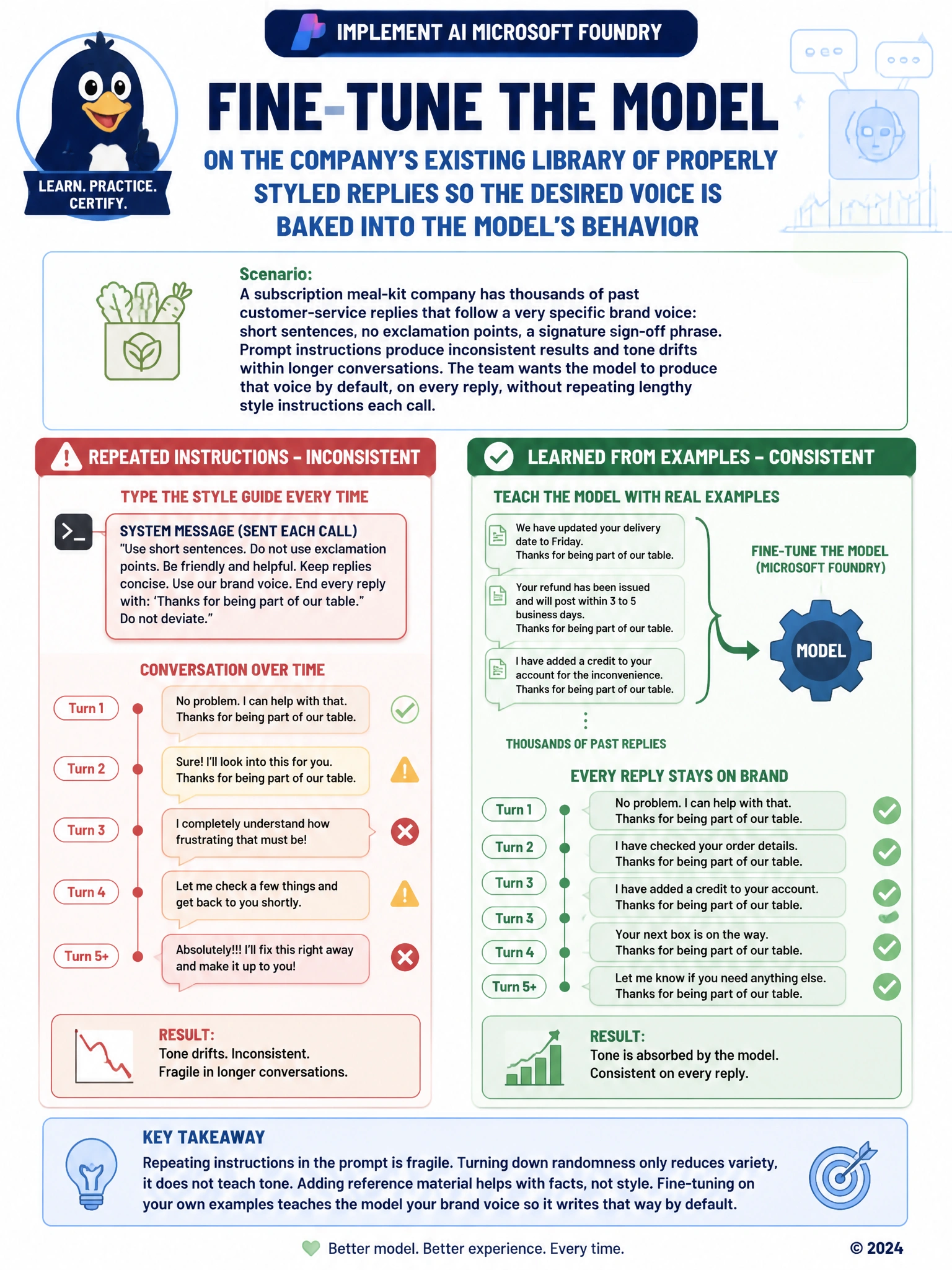
A subscription meal-kit company has thousands of past customer-service replies that all follow a very specific brand voice: short sentences, no exclamation points, a signature sign-off phrase. Prompt instructions describing this style in the system message produce inconsistent results, and the tone drifts within longer conversations. The team wants the model to produce that voice by default, on every reply, without repeating lengthy style instructions each call. Which approach best fits this need?
Select an answer to reveal the explanation.
Short Explanation
Think about the difference between handing someone a style guide every single time versus someone who has simply absorbed the house style after years of writing that way. Repeating instructions in the prompt is the first approach, and it is fragile, the model can forget or drift, especially in a longer back-and-forth. What this team actually wants is the second kind of consistency, where the voice is just how the model writes, full stop. That is what training on their own real examples accomplishes: the patterns get absorbed into the model itself instead of being bolted on through a reminder. Turning down randomness only changes how varied word choices are, it does not teach a tone. Pulling in reference material during the conversation is great for injecting facts the model does not already know, but a writing style is not a fact to look up, it is a behavior to learn. And a filter that watches for mismatched tone is a moderation tool, not a way to produce the right tone in the first place.
Full Explanation
The correct answer is B. Fine-tuning trains the model directly on the company's own example replies, so the brand voice becomes part of the model's learned behavior rather than something that has to be re-explained through prompt instructions every time, which is exactly the consistency problem described. Option A is incorrect because temperature controls the randomness of word choice at generation time; it does not teach the model a specific tone and would not fix instructions being followed inconsistently. Option C is incorrect because retrieval-augmented generation is for supplying factual reference content the model does not know, not for instilling a writing style, and it would still rely on the model correctly interpreting style text in context each time, which is the failure mode described. Option D is incorrect because a content filter screens for harmful categories like hate speech or violence; it has no mechanism for detecting or correcting tone and would not make replies match a brand voice.