
A consumer electronics company is preparing to launch a public-facing Foundry-hosted chatbot on its retail website. Before launch, the team wants the chatbot protected against both the standard categories of unsafe content, such as hate speech and violence, and against company-specific terms that generic safety categories would never catch, such as the names of banned competitor products the company does not want mentioned. (Select TWO.) Which two configurations should they enable?
Select all correct answers, then click Submit.
Short Explanation
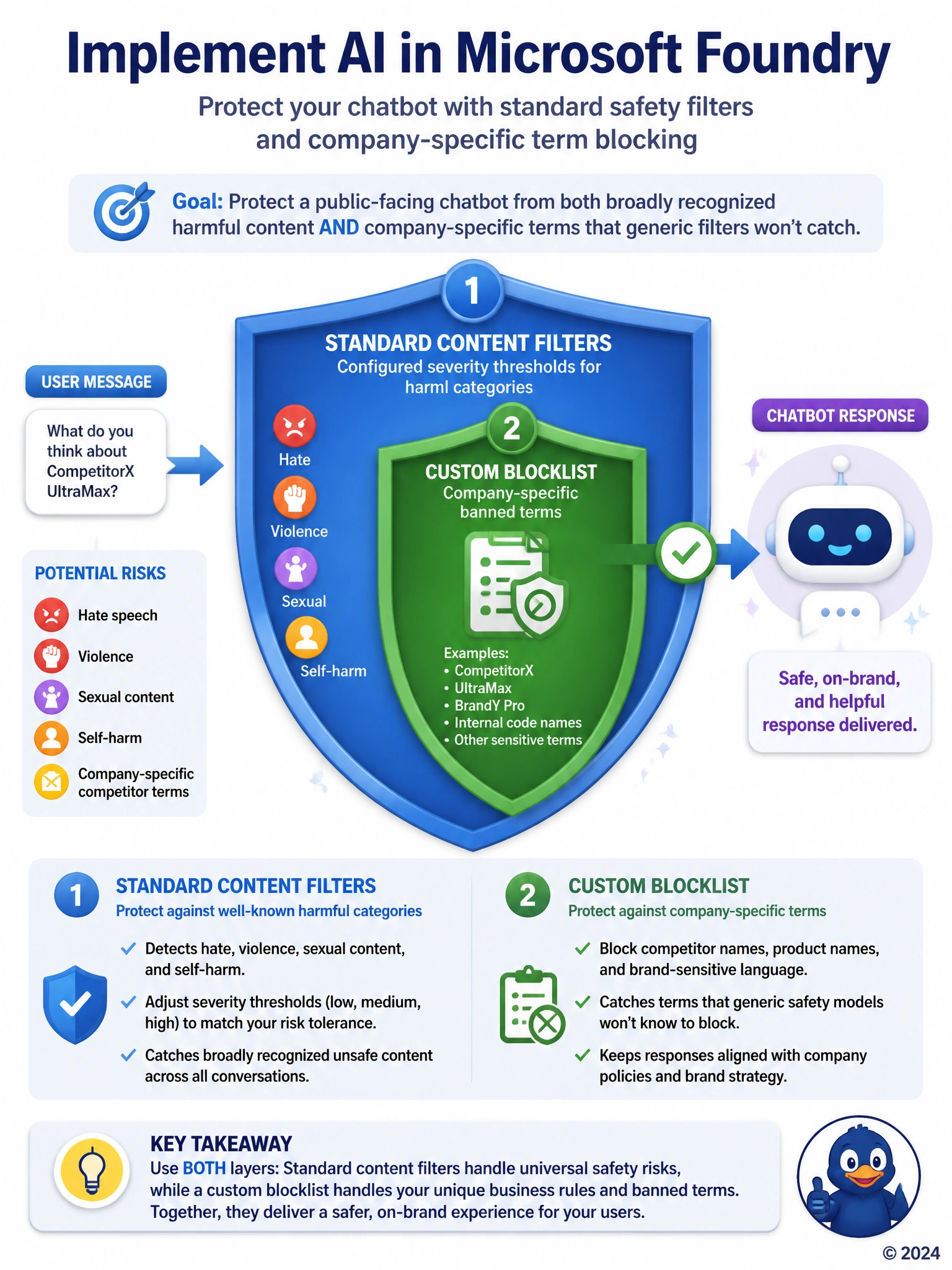
There are really two different problems being solved at once here, and it takes two different tools to cover both. The first problem is the well-known stuff, hate speech, violence, and other broadly recognized harmful categories, and there's a built-in safety system with adjustable sensitivity that's designed exactly for catching that. But the second problem is specific to this one company: nobody but them cares whether their chatbot mentions a particular competitor's product by name, so no generic safety system would ever know to block that on its own. That's where a custom list of banned terms comes in, letting the team add their own company-specific words on top of the standard protections. Letting the model write longer answers doesn't touch either of these concerns, it's just about length. And stripping away the instructions that guide the chatbot's behavior would actually make both problems worse, not better, since those instructions are part of what keeps the bot on-script in the first place.
Full Explanation
The correct answers are B and C. Content filters with configured severity thresholds address the standard, well-known categories of unsafe content like hate speech, violence, sexual content, and self-harm, which covers the general safety requirement. A custom blocklist separately covers terms that are specific to this company, such as competitor product names or other brand-sensitive language, which generic harm categories were never designed to catch, so both configurations are needed together to satisfy the full requirement described. Option D is incorrect because increasing the maximum output token limit only controls how long a response can be; it has no bearing on filtering unsafe or brand-sensitive content and does not address either stated need. Option A is incorrect because removing the system message would strip away the instructions that help keep the chatbot's behavior on-topic and constrained, which weakens safety and control rather than strengthening it, especially wrong for a public-facing launch.