
A developer's application calling a Foundry-hosted deployment begins receiving HTTP 429 errors during a sudden marketing campaign traffic spike, even though nothing in the application's code, authentication, or model configuration has changed. What is the most likely explanation, and what should the developer do first?
Select an answer to reveal the explanation.
Short Explanation
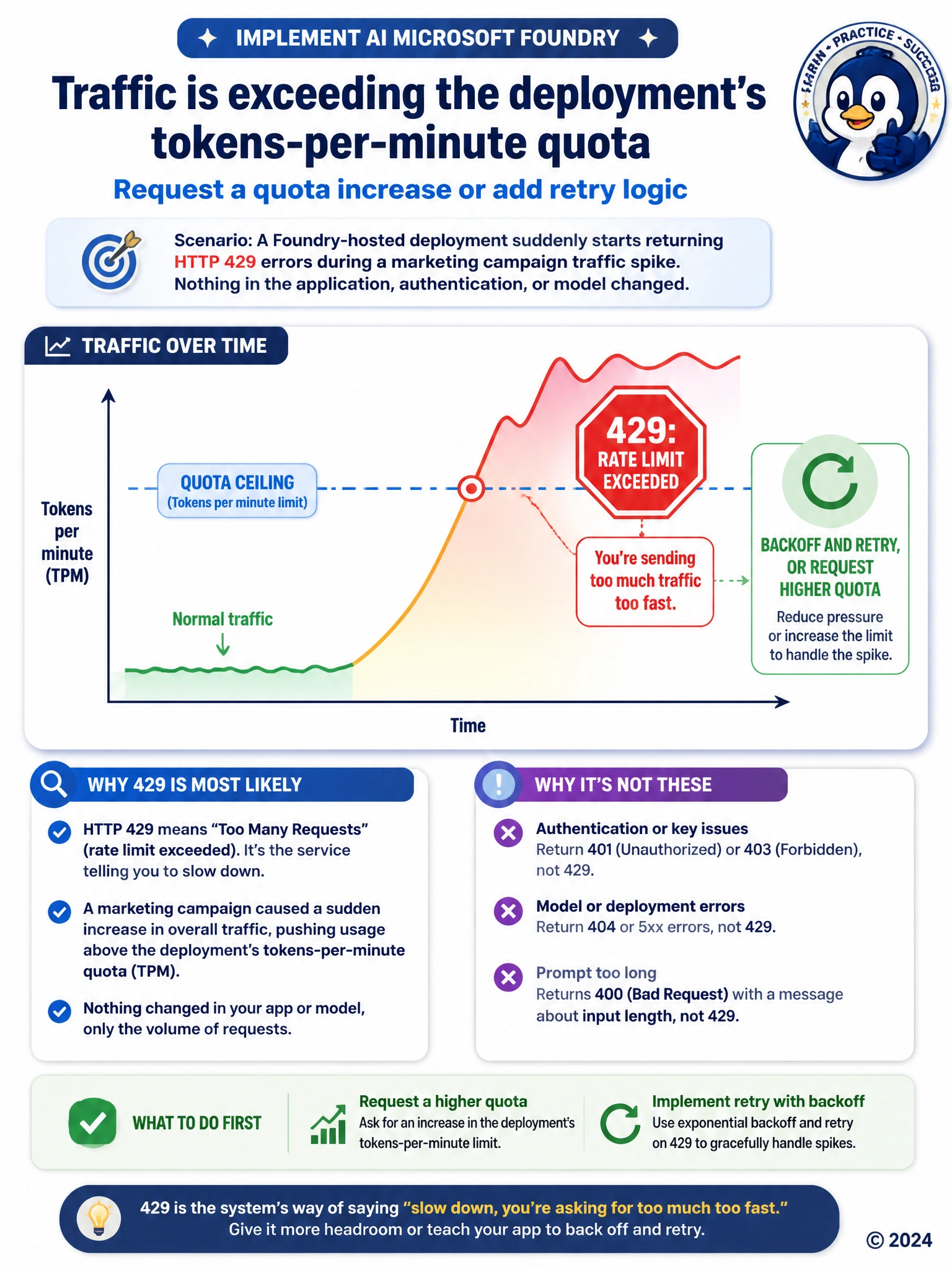
The number 429 is basically the system's way of saying 'slow down, you're asking for too much too fast,' which lines up perfectly with a marketing campaign suddenly sending a wave of new traffic through the same deployment. It's tempting to suspect something broke, like a key going bad or a model disappearing, but those failures look completely different and come back with their own distinct error codes, not this one. Same with sending too much text in a single request, that's a separate complaint about one oversized message, not about the overall pace of requests. Since nothing about the app itself changed, and the only thing that did change is how much traffic is hitting it, the real fix is either asking for more headroom on the rate limit or teaching the app to back off and retry gracefully when it gets throttled, rather than hammering the deployment harder during the spike.
Full Explanation
The correct answer is B. A 429 status code specifically signals that the caller is being throttled for sending more requests than the deployment's configured rate limit allows, so during a sudden spike in traffic the tokens-per-minute quota is the most likely cause, and the appropriate response is to request a higher quota or add retry-with-backoff logic to smooth out bursts. Option A is incorrect because an expired or invalid API key produces a 401 authentication error, not a 429, and the scenario states the code and credentials are unchanged. Option C is incorrect because calling a retired or unavailable model version returns a 404-style not-found error rather than a rate-limit response, and nothing in the scenario suggests the model version changed. Option D is incorrect because exceeding the context window produces a 400-level request error describing the input as too large, which is a different failure than being throttled for request volume.