
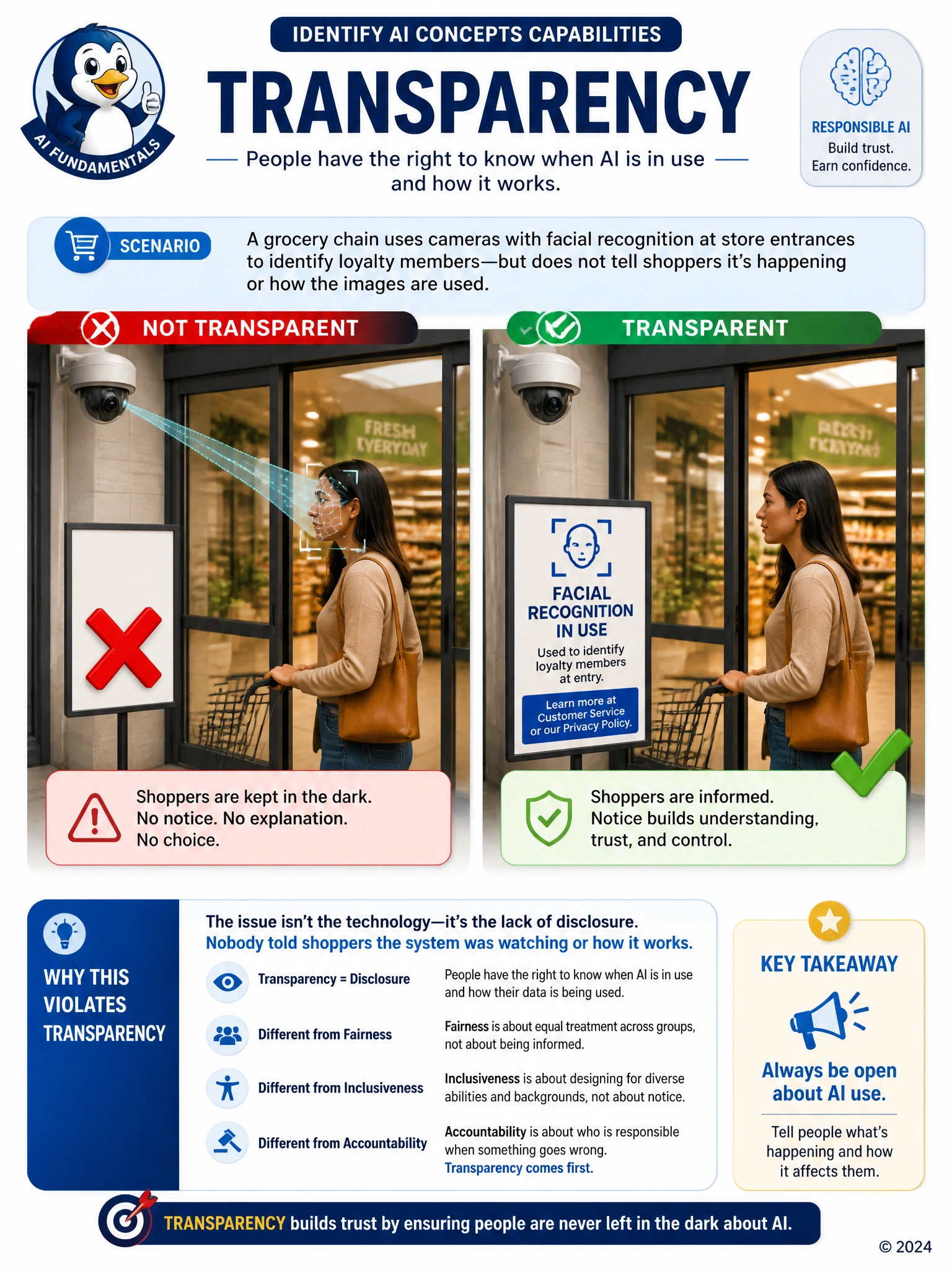
A grocery chain installs cameras with facial recognition at store entrances to automatically identify loyalty-program members as they walk in, but it does not post any signage, update its privacy policy, or otherwise tell shoppers that facial recognition is running or how the images are used. Which responsible AI principle is most directly violated?
Select an answer to reveal the explanation.
Short Explanation
Strip away the facial recognition detail for a second and just ask what actually went wrong: shoppers walked into a store and had no idea a camera system was identifying their faces, because nobody told them. That's fundamentally a disclosure problem, people being kept in the dark about a system that's watching them, and the principle built around making sure people know an AI system is in use and how it works is the one that speaks directly to that. Whether the system is accurate across different groups of people is a real concern too, but it's a different concern about equal treatment, not about notice. Designing the system to work well for people of different abilities and backgrounds is also a distinct question from whether anyone was told it exists. And having clear ownership of who's responsible if something goes wrong is a governance question that comes after the disclosure problem, not a substitute for it. The missing piece here is simply telling people what's happening.
Full Explanation
The correct answer is A. Transparency requires that people affected by an AI system understand that it is being used and how it works, and the grocery chain's failure to disclose the facial recognition system through signage or an updated policy directly violates that expectation. Option B is incorrect because fairness concerns whether an AI system treats different groups of people equitably, such as recognition accuracy varying across demographics, which is a separate issue from whether shoppers were told the system exists. Option C is incorrect because inclusiveness concerns designing systems that work well for and empower people of varying abilities and backgrounds, not the act of disclosing a system's presence. Option D is incorrect because accountability concerns having identifiable people and processes responsible for how an AI system behaves and for remediating problems, which is a governance concern distinct from the lack of customer notice described here. Since the core problem in the scenario is that shoppers were kept in the dark about a system observing them, transparency is the principle at stake.