
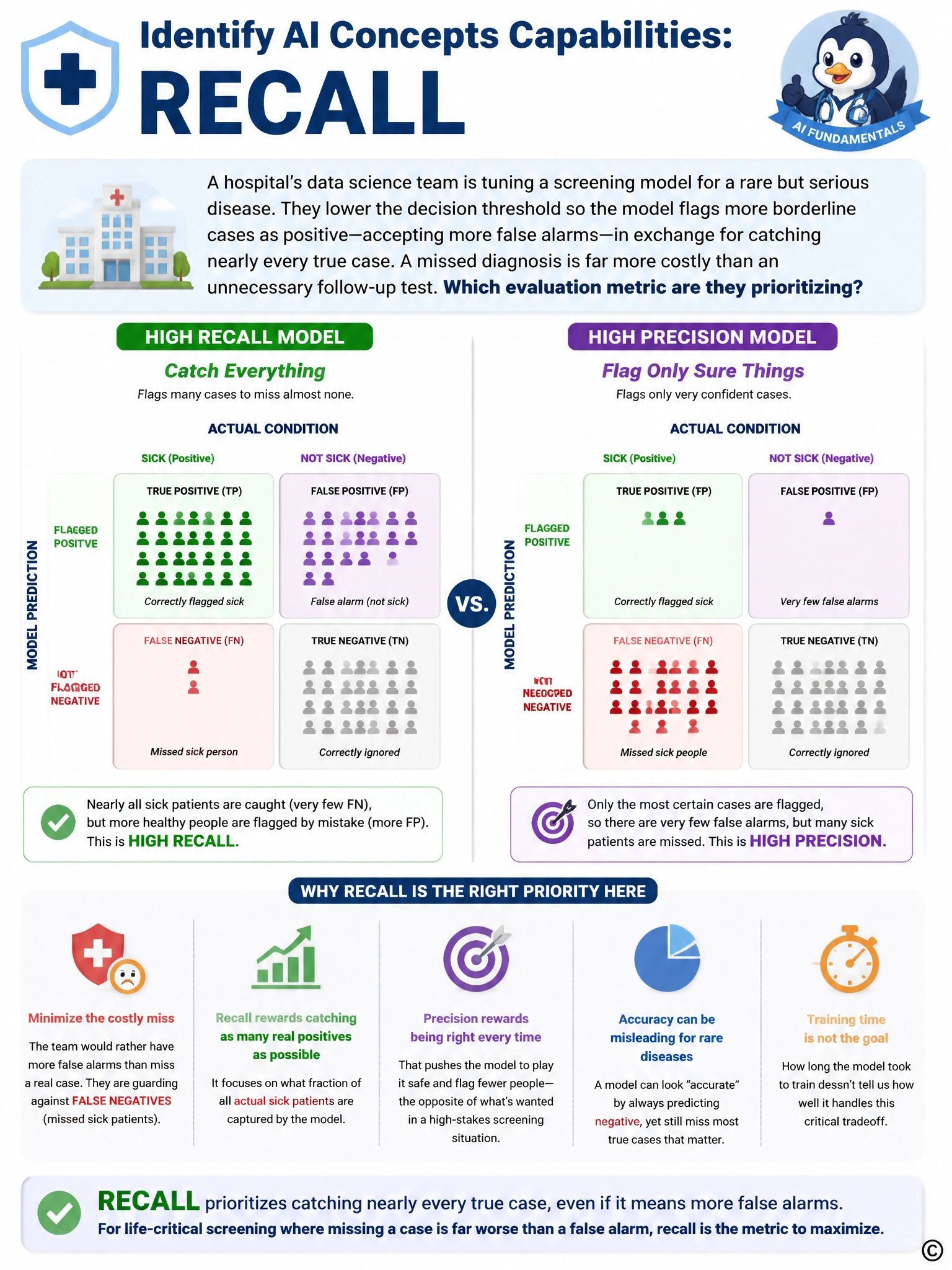
A hospital's data science team is tuning a screening model for a rare but serious disease. They deliberately adjust the decision threshold so the model flags more borderline cases as positive, accepting more false alarms in exchange for catching nearly every true case, because a missed diagnosis is far more costly than an unnecessary follow-up test. Which evaluation metric are they prioritizing?
Select an answer to reveal the explanation.
Short Explanation
Picture the two ways a screening test can fail: it can miss someone who's actually sick, or it can raise a false alarm on someone who's actually fine. The team here has explicitly said they'd rather have more false alarms than miss a real case, which tells you exactly which failure mode they're guarding against. The metric that rewards catching as many real positives as possible, even if it means more false alarms, is the one they're chasing. A metric that instead rewards being confident and correct every time it flags someone would push the model toward playing it safer and flagging fewer people, which is the opposite of what's wanted here. A single overall correctness score can look great just because the disease is rare, without telling you anything about the cases that matter most. And how long the model took to train has nothing to do with how it handles this tradeoff.
Full Explanation
The correct answer is D. Recall measures the proportion of actual positive cases the model correctly identifies, so maximizing recall means minimizing missed true cases, which is exactly the tradeoff the team is making by accepting more false alarms. Option A is incorrect because precision measures how many of the model's positive predictions are actually correct; optimizing for precision would push the model toward fewer, more confident positive flags, which is the opposite of what the team wants when a missed case is costly. Option B is incorrect because overall accuracy treats all correct predictions equally and can look misleadingly high on an imbalanced dataset where the disease is rare, without reflecting how well rare positive cases are being caught. Option C is incorrect because training time is an engineering and cost consideration unrelated to how well the model balances catching true cases against generating false alarms. Since the scenario centers on not missing real cases even at the cost of more false alarms, recall is the metric being prioritized.