
A conference organizer wants spoken presentations, delivered live on stage, to appear as scrolling captions on a screen for attendees in real time, updating within a second or two of each word being spoken. Which Azure AI capability should the organizer use?
Select an answer to reveal the explanation.
Short Explanation
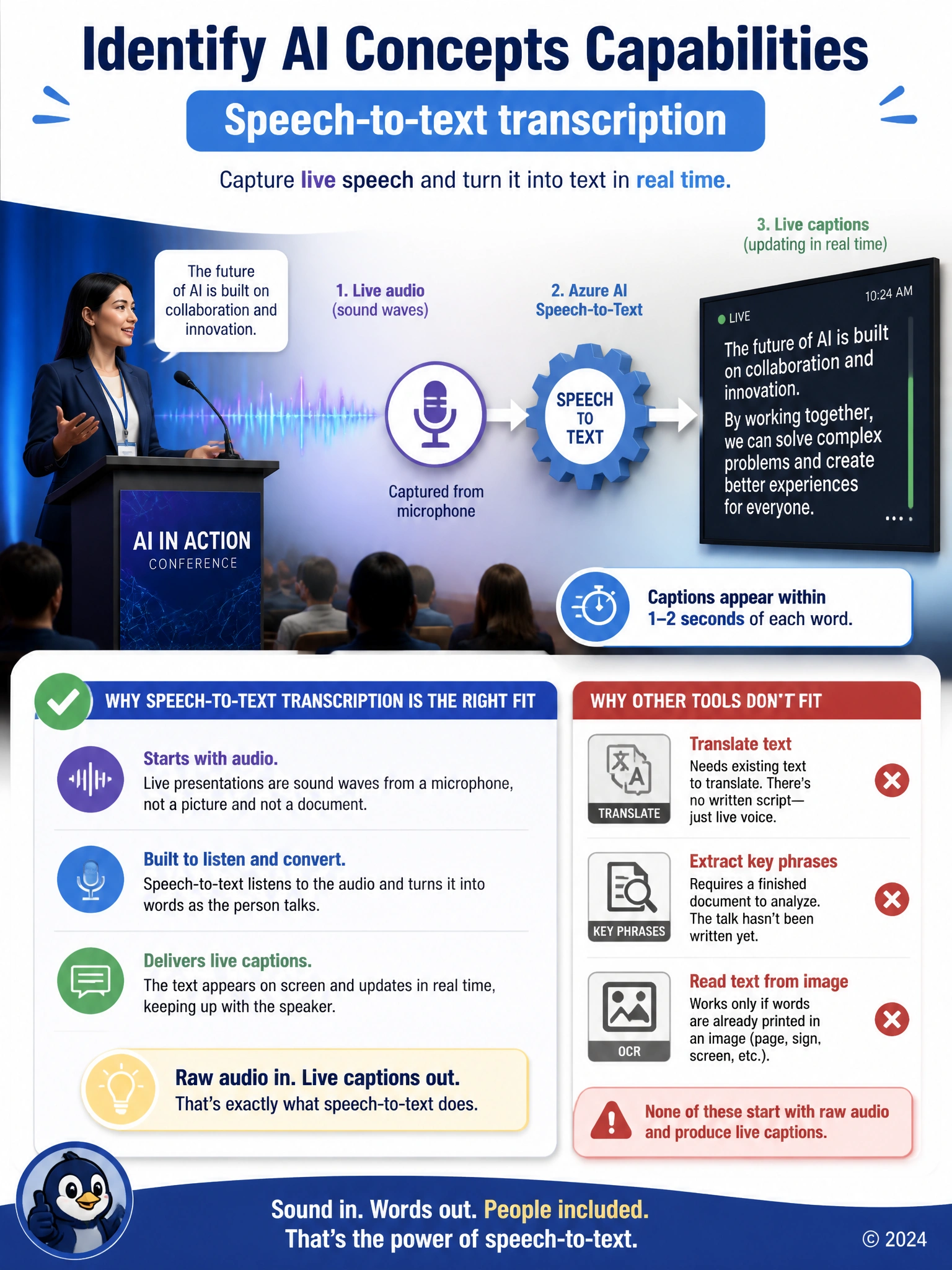
Think about what's actually coming into the system: sound waves from a microphone, not a picture and not a document. The tool that's built for that job listens to audio and turns it into words on screen as the person talks. Translating text only works if you already have text to translate, and there's no written script here, just a live voice. Pulling out key phrases assumes you already have a finished document to analyze, which doesn't exist yet during a live talk. And reading text out of an image only works if the words are already printed somewhere, like on a page or a sign, which isn't the case with someone speaking into a mic. The one option that starts from raw audio and produces live captions is the right fit.
Full Explanation
The correct answer is A. Speech-to-text transcription converts spoken audio into written text in near real time, which is exactly what live captioning of a stage presentation requires. Option B is incorrect because text translation converts written text from one language to another; it does not take spoken audio as input, so it cannot caption a live talk on its own. Option C is incorrect because key phrase extraction pulls out important terms from existing text documents after the fact, which does not produce a live scrolling transcript of speech. Option D is incorrect because optical character recognition reads text that already appears in an image, such as a scanned page or photo, and has no way to process an audio signal from a microphone. Only the speech-to-text capability listens to audio and produces text output fast enough to caption a live event.