
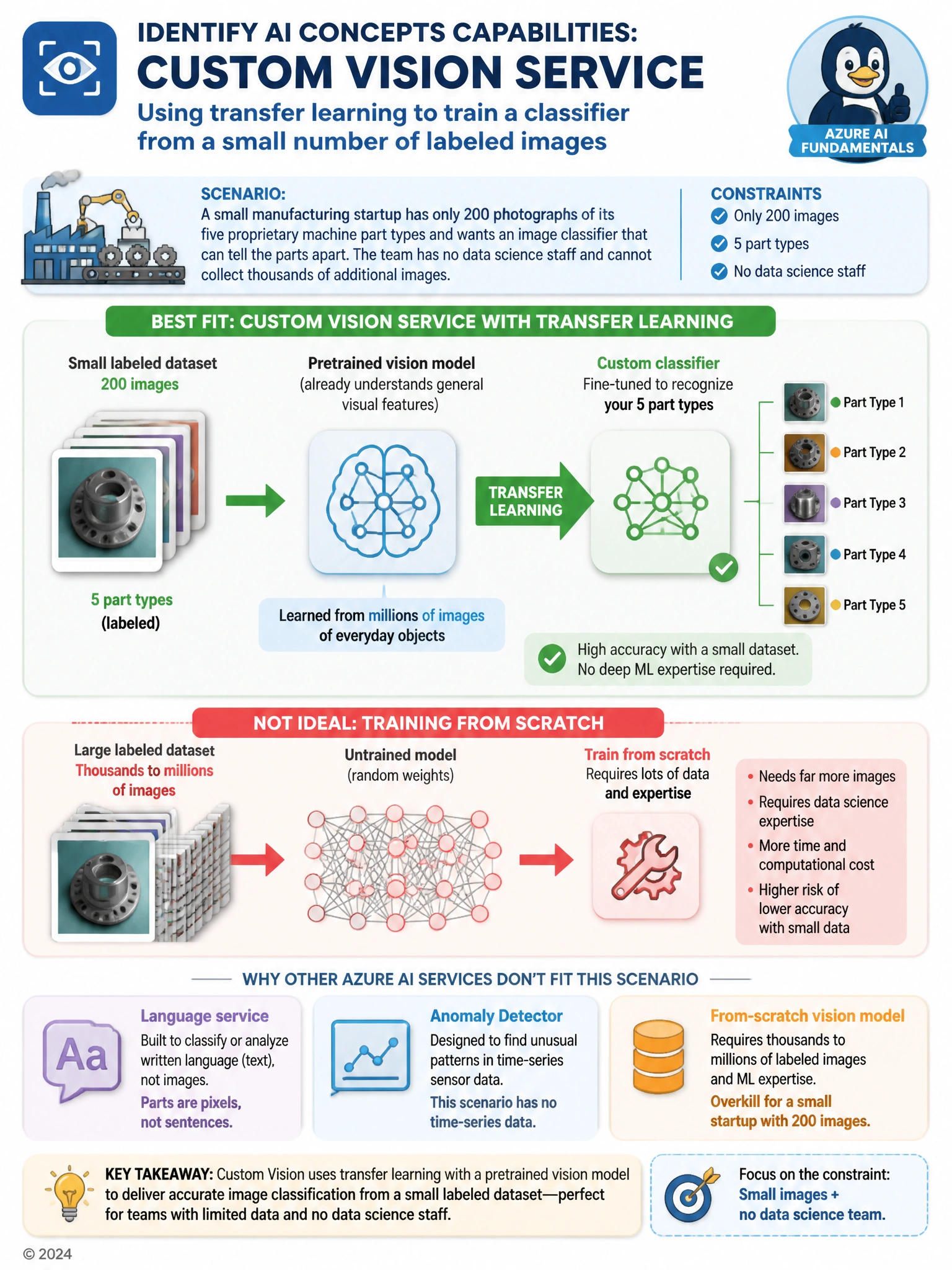
A small manufacturing startup has only 200 photographs of its five proprietary machine part types and wants an image classifier that can tell the parts apart. The team has no data science staff and cannot collect thousands of additional images. Which Azure AI approach best fits this constraint?
Select an answer to reveal the explanation.
Short Explanation
The real constraint here isn't the number of part types, it's the tiny pile of photos and the lack of a data science team to babysit a from-scratch model. What you want is a service built specifically to squeeze good accuracy out of a small labeled image set by starting from a model that already understands general visual features and only needs to learn the last bit that's specific to these parts. That's a very different path from training a neural network completely from zero, which typically wants far more images and far more expertise than this startup has. It's also not a fit for a service built to classify written language rather than photographs, since machine parts show up as pixels, not sentences. And it's not a match for a service tuned to catch odd blips in streams of sensor numbers over time, since there's no time-series data involved at all, just still images of parts.
Full Explanation
The correct answer is C. The startup has only a small set of labeled images and lacks in-house data science expertise, and the Custom Vision service is designed for exactly this situation, using transfer learning on a pretrained model so that a small number of labeled images per category is enough to produce an accurate classifier without deep machine learning knowledge. Option A is incorrect because building a convolutional neural network from scratch typically demands a large labeled dataset and considerable machine learning expertise to design, train, and tune the network, which conflicts directly with the startup's stated constraints. Option B is incorrect because custom text classification operates on written language, not photographs, so it cannot classify machine parts from images regardless of dataset size. Option D is incorrect because the Anomaly Detector service is built to find unusual patterns in time-series data such as sensor readings, not to categorize static photographs into part types.