
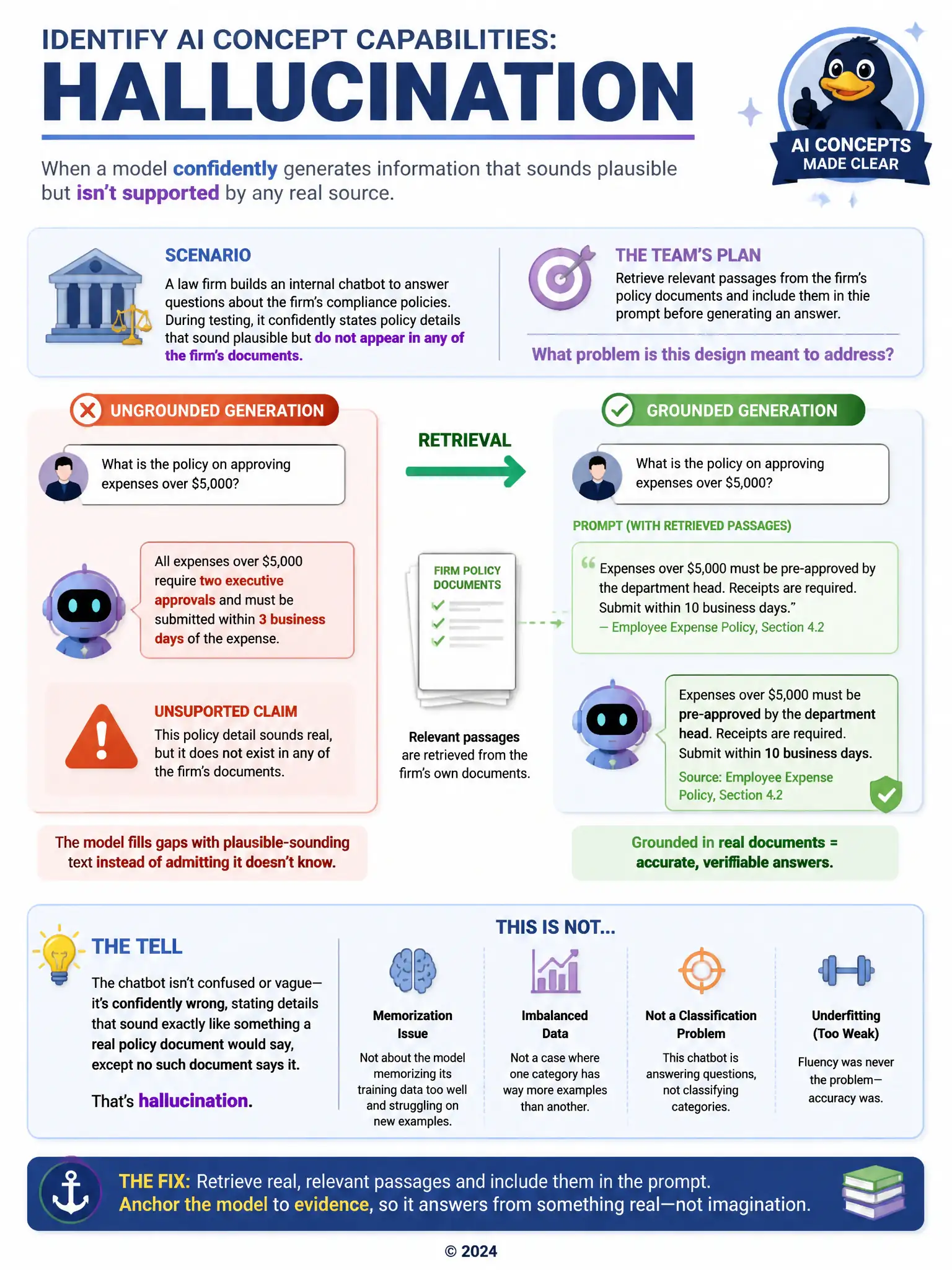
A law firm builds an internal chatbot on a large language model to answer questions about the firm's specific internal compliance policies. During testing, the chatbot confidently states policy details that sound plausible but do not actually appear in any of the firm's documents. To reduce this problem, the team plans to have the chatbot retrieve relevant passages from the firm's own policy documents and include them in the prompt before generating an answer. What problem is this design meant to address?
Select an answer to reveal the explanation.
Short Explanation
Here's the tell: the chatbot is confidently wrong, inventing policy details that aren't in any document. That's hallucination. Retrieving real passages and putting them in the prompt anchors the answer to actual firm policy instead of letting the model make stuff up.
Full Explanation
The problem being addressed is hallucination. The chatbot is producing confident, plausible-sounding statements about firm policy that are not actually supported by any real document, which is the defining behavior of hallucination in a large language model; retrieving and inserting real policy passages into the prompt grounds the model's answer in verified source material and reduces this risk. Overfitting is incorrect because it describes a training-time problem where a model performs well on training data but poorly on new data, which is unrelated to a deployed model inventing unsupported facts at answer time. Class imbalance is incorrect because it refers to unequal representation of categories in a labeled training dataset used for classification, which has no bearing on a chatbot generating free-form policy statements. Underfitting is incorrect because it describes a model too simple to capture patterns in its training data, whereas here the model is fluent and confident, just factually ungrounded, which is a different failure mode entirely.